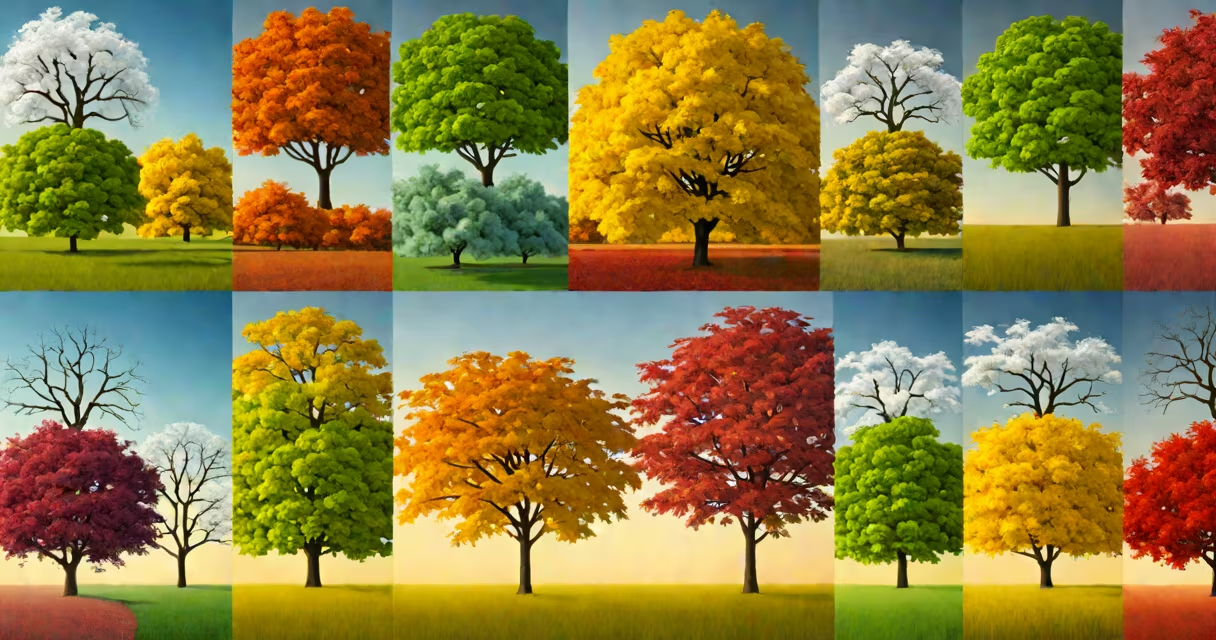
There are four distinct seasons in a year: spring, summer, autumn, and winter. These divisions result from Earth's axial tilt and its orbit around the Sun, creating predictable changes in temperature, daylight, and weather patterns across most temperate regions.
The four-season model is standard in temperate zones, including much of North America, Europe, and parts of Asia. Each season lasts roughly three months, aligning with the Gregorian calendar: spring (March-May), summer (June-August), autumn (September-November), and winter (December-February).
Seasonal shifts influence agriculture, wildlife behavior, human activity, and cultural traditions. For example, in the United States, planting begins in spring, harvests peak in late summer and early autumn, and winter brings reduced outdoor work and increased indoor energy use.
Earth's 23.5-degree axial tilt causes different parts of the planet to receive varying sunlight intensity throughout the year. When the Northern Hemisphere tilts toward the Sun, it experiences summer; when it tilts away, winter occurs. The equinoxes mark the transition between seasons, with equal day and night lengths.
At the solstices-around June 21 and December 21-the Sun reaches its highest or lowest point in the sky. On June 21, the Northern Hemisphere gets maximum sunlight, marking the start of summer. On December 21, it receives the least, beginning winter.
These astronomical events define the seasonal cycle. The equinoxes occur around March 20 and September 22, dividing the year into roughly equal halves. The timing is precise: the vernal equinox in 2024 occurred at 11:10 UTC on March 20.
Not all cultures divide the year into four seasons. Some tropical and desert regions experience only two main periods: wet and dry. In parts of sub-Saharan Africa, the year is split into rainy and dry seasons, each lasting several months.
Indigenous groups in Australia recognize six seasons based on ecological indicators such as animal behavior and plant flowering. The Noongar people of Western Australia label these as Bunuru (summer), Djeran (autumn), Makuru (winter), Djilba (spring), Kambarang (early summer), and Birak (late summer).
A comparison of global seasonal models:
| Region | Number of Seasons | Primary Basis | Example Names |
|---|---|---|---|
| North America (temperate) | 4 | Astronomical dates | Spring, Summer, Autumn, Winter |
| Sub-Saharan Africa | 2 | Rainfall patterns | Dry, Wet |
| Western Australia (Noongar) | 6 | Ecological cues | Bunuru, Djeran, Makuru, Djilba, Kambarang, Birak |
Even within temperate zones, definitions vary slightly. In the UK, meteorologists define seasons by calendar months: spring (March-May), summer (June-August), autumn (September-November), and winter (December-February). This system simplifies weather reporting and long-term climate analysis.
Many assume seasons are caused by Earth's distance from the Sun. That's incorrect. Earth is actually closest to the Sun in early January, during Northern Hemisphere winter. The real driver is axial tilt, not orbital distance.
Another myth is that all places have four seasons. In equatorial regions near the equator, temperatures remain stable year-round. The Amazon Basin sees little variation in temperature, though rainfall patterns create wet and dry seasons. In Alaska, the difference between summer and winter is extreme, but the concept of "spring" and "autumn" still applies, even if they're brief.
A lesser-known fact: the length of seasons varies slightly due to Earth's elliptical orbit. Summer in the Southern Hemisphere is shorter than in the Northern Hemisphere because Earth moves faster when closer to the Sun. In 2024, Southern Hemisphere summer lasted 89.8 days, while Northern Hemisphere summer was 93.6 days.
Consider a farmer in central Illinois planning crop rotation. They rely on the four-season model to time planting and harvesting. Corn is typically planted in late April, after the last frost, which usually occurs around April 20. The growing season ends in early October, when frost threatens the crop.
Using historical climate data from NOAA, the average frost-free period in Champaign County is 172 days. This number guides seed selection and planting schedules. If planting too early, the crop risks freezing; too late, and yields drop due to shortened growing time.
Without the four-season structure, this precision wouldn't exist. Farmers depend on consistent seasonal markers to manage risk and maximize yield. The same logic applies to public health planning-flu season peaks in winter, prompting vaccine campaigns in fall.
Seasons affect everything from school calendars to holiday traditions. Thanksgiving in the U.S. falls on the fourth Thursday of November, a date chosen to align with autumn harvests. Christmas is celebrated in winter, often tied to ancient solstice festivals.
Climate change is altering seasonal patterns. A 2023 study published in *Nature Climate Change* found that spring is arriving earlier in the Northern Hemisphere, with an average advance of 2.3 days per decade since 1950. This shift impacts pollination cycles and species migration.
For accurate weather forecasting, seasonal models are essential. The National Oceanic and Atmospheric Administration (NOAA) uses seasonal outlooks to predict droughts, storms, and temperature anomalies. These forecasts inform emergency preparedness, water management, and energy demand planning.
When planning travel, understanding local seasonal norms prevents disappointment. Visiting Kyoto in cherry blossom season (late March to early April) offers stunning views-but missing the window means waiting a year. Similarly, hiking in the Swiss Alps is safest in summer, when snowpacks melt and trails clear.
Seasons are not just a backdrop to life-they are measurable, predictable, and deeply embedded in human systems. Knowing how many seasons exist-and how they function-enables better decisions across science, culture, and daily living.