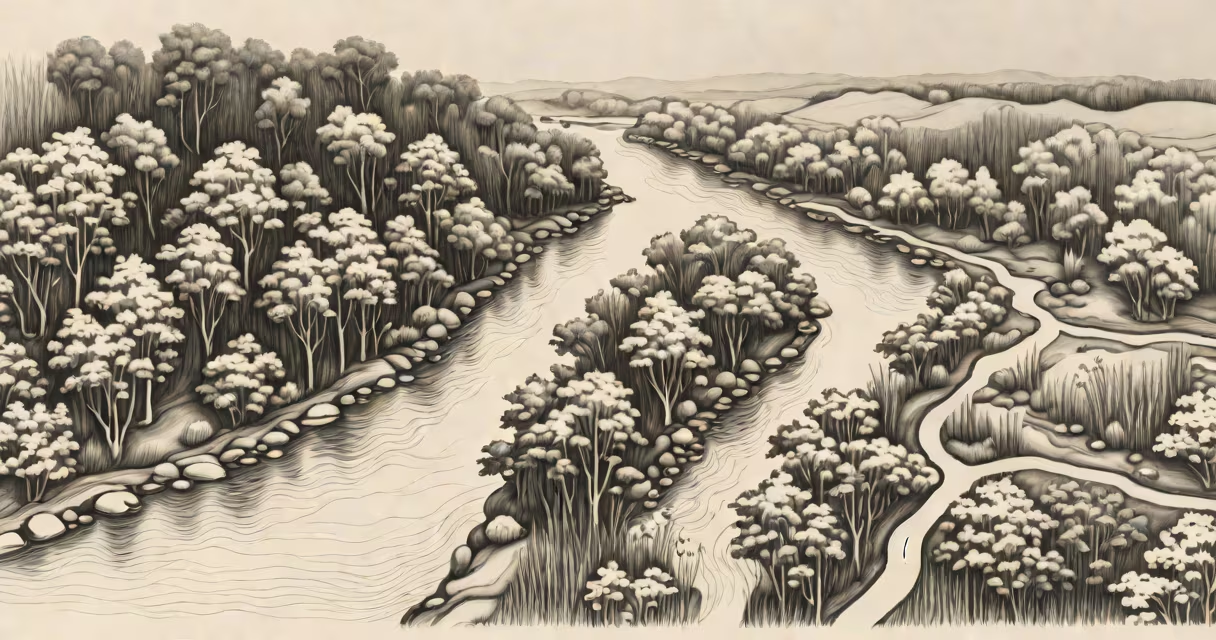
Water shapes Earth's surface, regulates climate, supports biodiversity, and sustains human activities. Its presence, movement, and quality determine the health of ecosystems, weather patterns, and long-term environmental stability. This influence spans from microscopic organisms to global atmospheric systems.
Water moves through the hydrological cycle-evaporation, condensation, precipitation, infiltration, and runoff-driving geological processes and sustaining life. When water is clean and properly distributed, it enables plant growth, maintains soil fertility, and supports animal habitats. But when altered by pollution, overuse, or climate shifts, it disrupts ecological balance and accelerates environmental degradation.
For example, the Amazon rainforest relies on consistent rainfall from moisture recycled through transpiration. A 20% reduction in regional precipitation due to deforestation and changing climate patterns has already led to increased dry-season fires and reduced tree regeneration, according to NASA's Global Precipitation Measurement mission (2022).
Water cycles continuously between oceans, atmosphere, land, and living organisms. Solar energy drives evaporation from oceans and lakes. Moisture rises, cools, and forms clouds. Rain falls, infiltrates soil, replenishes groundwater, or flows into rivers and eventually returns to the sea.
This cycle governs soil moisture levels, which affect plant root development and microbial activity. In arid regions, limited infiltration leads to desertification. In tropical zones, excessive rainfall causes erosion and nutrient leaching. The U.S. Geological Survey reports that 60% of U.S. rivers and streams have degraded water quality due to sedimentation from poor land management.
A 2019 study in *Nature Geoscience* found that changes in snowmelt timing in the western United States-caused by warming temperatures-have reduced summer streamflow by 15% since 1950, impacting fish spawning grounds and agricultural irrigation.
Water quality determines whether an environment supports life. Clean water contains balanced pH, dissolved oxygen, and low levels of toxins. Polluted water harms aquatic species, alters food webs, and degrades habitat integrity.
Nutrient overload from agricultural runoff-especially nitrogen and phosphorus-triggers algal blooms. When algae die and decompose, oxygen levels drop, creating dead zones. The Gulf of Mexico dead zone, caused by Mississippi River discharge, spans over 6,000 square miles annually, according to NOAA.
Heavy metals like mercury from industrial waste accumulate in fish tissue. The World Health Organization notes that mercury exposure through contaminated fish can cause neurological damage in children and pregnant women. In Minamata Bay, Japan, mercury poisoning from factory discharges led to over 2,000 cases of severe illness between 1953 and 1960.
| Type of Water Impact | Primary Cause | Environmental Consequence | Example Location |
|---|---|---|---|
| Sedimentation | Deforestation, construction | Smothers fish eggs, reduces light penetration | Chesapeake Bay, USA |
| Nutrient Pollution | Fertilizer runoff, sewage | Algal blooms, hypoxia | Gulf of Mexico |
| Chemical Contamination | Industrial discharge, pesticides | Endocrine disruption in wildlife | Great Lakes, North America |
| Thermal Pollution | Power plant cooling water | Reduces dissolved oxygen, kills cold-water species | Mississippi River near St. Louis |
Water moderates Earth's temperature. Oceans absorb 90% of excess heat from greenhouse gas emissions, slowing atmospheric warming. But this absorption causes ocean acidification and thermal expansion, contributing to sea level rise.
Glaciers and ice sheets store freshwater and reflect sunlight. As they melt, less solar radiation is reflected-increasing warming in a feedback loop known as albedo loss. Greenland's ice sheet lost 5,300 gigatons of mass between 1992 and 2020, accelerating sea level rise by 14 mm, per NASA's GRACE satellite data.
When permafrost thaws in Arctic regions, it releases methane-a greenhouse gas 25 times more potent than CO₂ over 100 years. The thawing process is driven by warmer water from rivers and melting snow, which seep into frozen ground. Research from the University of Alaska Fairbanks shows that permafrost thaw has increased by 30% since 2000 in Siberia.
Many assume that "water is renewable" means it's always available in sufficient quantity. But water scarcity stems from uneven distribution and overuse. Only 2.5% of Earth's water is fresh, and less than 1% is accessible for human use, according to the United Nations.
Another misconception is that wetlands are wastelands. In reality, they filter pollutants, buffer floods, and support high biodiversity. The Ramsar Convention estimates that 64% of global wetlands have been lost since 1900, despite their role in carbon sequestration and flood control.
I once observed a restored wetland in the Everglades where water flow was redirected to mimic natural seasonal patterns. Within five years, wading bird populations rebounded by 40%, and native plants returned after decades of decline. This demonstrated that water management decisions directly reverse environmental damage.
Water is not passive-it actively shapes landscapes, regulates climate, and sustains life. Its impact depends on quantity, quality, and timing. Changes in water systems trigger cascading effects across ecosystems, often irreversible without intervention.