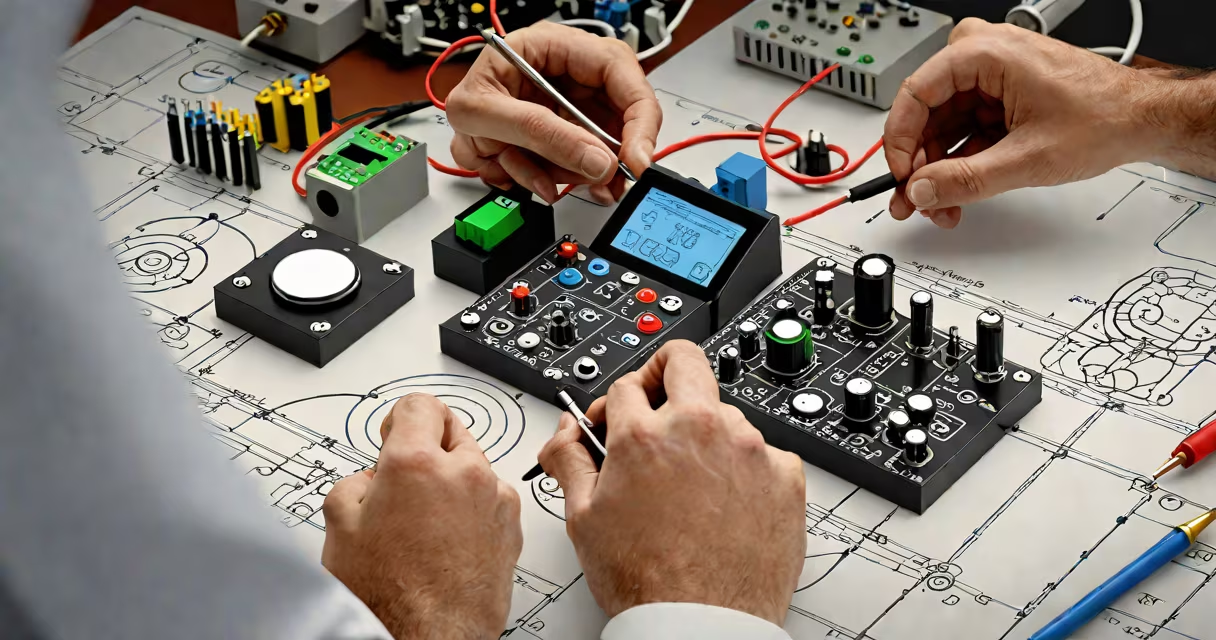
An instrumentation engineering degree prepares graduates to design, install, and manage systems that monitor and regulate industrial processes using sensors, controllers, and automated feedback mechanisms. These systems ensure safety, efficiency, and precision in manufacturing, energy production, and chemical processing.
Instrumentation engineers work with physical parameters such as temperature, pressure, flow rate, and level. They select appropriate sensors, configure signal conditioning hardware, and integrate control logic into programmable logic controllers (PLCs) or distributed control systems (DCS). The goal is to maintain process stability and respond quickly to deviations.
For example, in a petroleum refinery, an instrumentation engineer helps pressure levels in a distillation column remain within safe operating limits. If pressure exceeds a threshold, the system triggers automatic valves to release excess gas, preventing overpressure events. This requires accurate sensing, rapid data processing, and reliable actuation-all core competencies of the field.
Instrumentation systems operate through a closed-loop feedback mechanism. A sensor detects a physical variable, converts it into an electrical signal (typically 4-20 mA or 0-10 V), and sends it to a controller. The controller compares the measured value to a setpoint and calculates corrective action. That command is sent to an actuator-such as a valve or motor-to adjust the process.
Modern systems rely heavily on digital communication protocols like Modbus, Profibus, and HART. These allow multiple devices to share data over a single network, reducing wiring complexity and enabling remote monitoring. For instance, a single Ethernet cable can carry both power and data to a smart pressure transmitter located 500 meters from the control room.
The U.S. Bureau of Labor Statistics notes that demand for control systems technicians and engineers is growing due to increased automation in industries like food processing, pharmaceuticals, and renewable energy. By 2032, employment in industrial automation is projected to grow 11%-faster than average-for roles requiring technical proficiency in instrumentation.
Curricula in instrumentation engineering blend electrical engineering, mechanical systems, computer science, and process control theory. Students take courses in analog and digital electronics, microcontroller programming, fluid dynamics, thermodynamics, and signal processing.
Hands-on labs are central to the program. Students build PID (proportional-integral-derivative) controllers using Arduino or Raspberry Pi platforms. They learn to calibrate transmitters, troubleshoot loop errors, and simulate fault conditions in SCADA (Supervisory Control and Data Acquisition) software.
A common misconception is that instrumentation engineering focuses only on hardware. In reality, software integration is equally critical. Engineers must understand how to write scripts that parse sensor data, generate alarms, and interface with enterprise resource planning (ERP) systems. For example, a temperature spike in a bioreactor must trigger both a local alarm and a log entry in a cloud-based analytics dashboard.
| Type | Focus Area | Typical Applications |
|---|---|---|
| Process Instrumentation | Continuous monitoring in chemical plants and refineries | Flow meters, pressure transmitters, pH sensors |
| Discrete Automation | Batch operations in packaging and assembly lines | Photoelectric sensors, limit switches, servo motors |
| Smart Instrumentation | Networked devices with self-diagnostics and predictive maintenance | Wireless sensors, IIoT gateways, edge computing nodes |
One non-obvious distinction: not all sensors are created equal. A thermocouple measures temperature via voltage difference between two dissimilar metals. A resistance temperature detector (RTD) uses a metal wire whose resistance changes predictably with heat. Choosing between them depends on accuracy needs, response time, and environmental factors like vibration or corrosive gases.
Industries that depend on consistent output and safety standards rely heavily on instrumentation systems. In power generation, turbine speed and steam pressure are monitored continuously to prevent equipment failure. In water treatment facilities, dissolved oxygen and turbidity sensors ensure compliance with EPA regulations.
In the pharmaceutical industry, instrumentation ensures batch consistency. A fermentation tank must maintain precise temperature and pH levels during drug production. Even a 0.5°C deviation can alter protein folding and render a batch unusable. Instrumentation engineers help minimize variability through tight control loops and redundant sensing.
During a plant shutdown at a semiconductor fabrication facility, a malfunctioning pressure sensor caused a cascade failure in the gas delivery system. The root cause was traced to improper grounding, which introduced noise into the signal. An instrumentation engineer diagnosed the issue by analyzing the signal waveform and recommended shielded cables and isolated power supplies-solutions that prevented future incidents.
Many assume instrumentation engineering is synonymous with electrical engineering. While there is overlap, instrumentation focuses specifically on measurement and control-not power distribution or circuit design. An electrical engineer might design a transformer; an instrumentation engineer ensures the transformer's cooling system maintains optimal oil temperature.
Another confusion arises between instrumentation and automation. Automation involves making decisions based on data-like turning a machine on or off. Instrumentation provides the data. Without accurate measurements, automation systems cannot function reliably. Think of instrumentation as the eyes and ears of an automated factory.
There's also a persistent myth that instrumentation jobs are limited to oil and gas. While those sectors employ many graduates, opportunities exist in food and beverage (e.g., ensuring correct syrup ratios in soda bottling), aerospace (monitoring engine health), and even agriculture (automated irrigation based on soil moisture).
Consider a wastewater treatment plant needing to maintain a constant liquid level in a holding tank. The system must prevent overflow during heavy rain and avoid running dry during low inflow.
Step 1: Select a sensor. A radar level transmitter is chosen because it works well in wet environments and doesn't require contact with the liquid.
Step 2: Configure the signal. The transmitter outputs a 4-20 mA signal corresponding to 0-10 meters of depth. A PLC reads this signal and converts it to a percentage of full scale.
Step 3: Set control logic. The PLC compares the current level to a setpoint of 60%. If the level drops below 55%, it opens a valve to admit more inflow. If it rises above 65%, it closes the inlet and opens a discharge valve.
Step 4: Implement safety. A high-high alarm triggers at 90% to shut down incoming pumps. A low-low alarm at 10% stops the discharge pump to prevent damage.
This system runs continuously, adjusting in real time. The instrumentation engineering degree equips students to design such systems with reliability and safety as priorities.
Instrumentation engineering is not just about installing gauges-it's about building intelligent, responsive systems that protect people, preserve resources, and improve performance across industries.