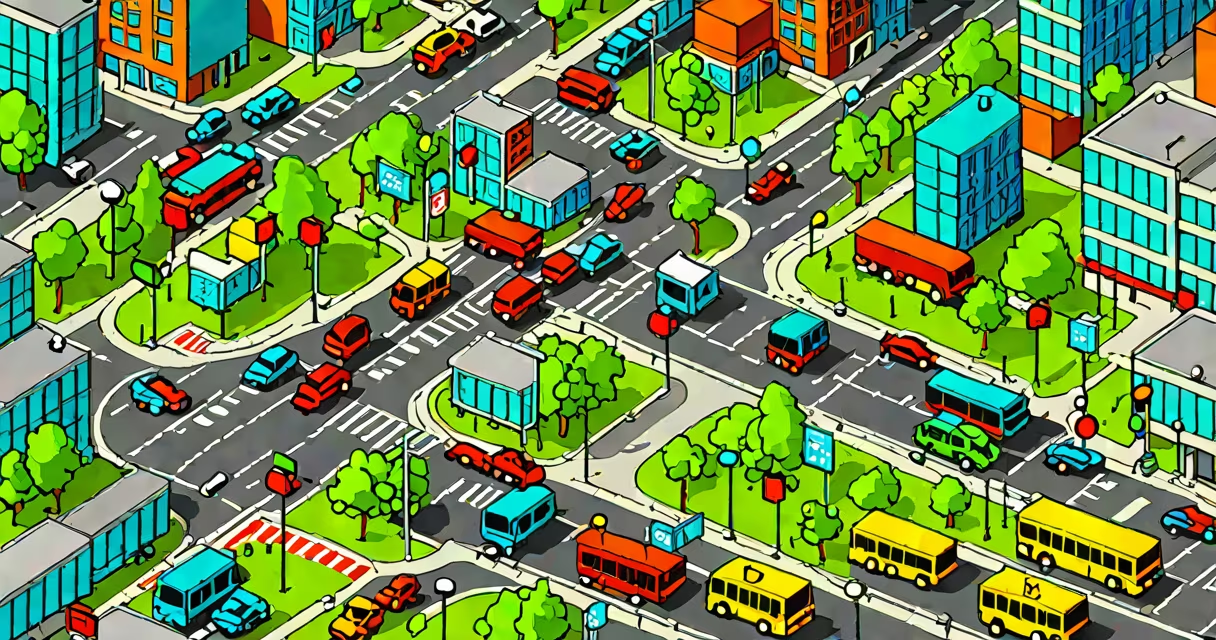
IoT for transportation uses interconnected sensors, devices, and cloud platforms to collect and analyze real-time data from vehicles, roads, and infrastructure, enabling smarter decision-making in logistics, public transit, and traffic management.
At its core, IoT for transportation turns physical assets into data sources. A delivery truck equipped with GPS, temperature sensors, and engine monitors sends live updates to a central system. That system tracks location, alerts dispatchers to delays, and logs cargo conditions-all automatically. This network of devices, data, and software reduces downtime, cuts fuel costs, and improves service reliability.
The foundation of this system lies in sensor networks embedded in vehicles and roadways. These sensors measure speed, vibration, tire pressure, weather conditions, and traffic density. Data flows through cellular or satellite connections to cloud-based analytics platforms. There, algorithms detect patterns-like a sudden drop in brake fluid pressure or recurring congestion at a specific intersection-and trigger alerts or automated responses.
Each vehicle or infrastructure node acts as a data point in a larger network. For example, a bus fleet uses onboard accelerometers and GPS units to report route deviations. When a bus slows unexpectedly near a school zone, the system flags it for review. If the slowdown exceeds 10 seconds, an alert goes to the operations center. This happens within 2 seconds of the event.
Data travels via secure wireless protocols such as LTE-M or NB-IoT, optimized for low power and long-range communication. Devices send small packets of data every 30 seconds, conserving battery life. The data reaches a central server where machine learning models assess performance trends. Over time, these models learn typical driving behavior and flag anomalies-such as erratic braking or extended idling-that may indicate driver fatigue or mechanical issues.
A real-world example is the Los Angeles Metro's deployment of IoT-enabled buses. Each bus transmits 12 data streams: location, door status, air conditioning levels, passenger count (via infrared counters), and engine diagnostics. This data feeds into a dashboard used by dispatchers and maintenance teams. Since implementation, average bus turnaround time dropped from 42 minutes to 36 minutes-a 14% improvement in fleet utilization.
IoT for transportation relies on four core elements: sensors, connectivity, gateways, and data platforms.
| Component | Purpose | Example |
|---|---|---|
| Sensors | Collect physical data from vehicles or infrastructure | Accelerometer measuring jolts during cornering |
| Connectivity | Transmit data over cellular, Wi-Fi, or satellite | NB-IoT module sending engine data every 15 minutes |
| Gateway | Aggregates and secures data before sending to the cloud | Onboard device converting CAN bus signals to IP packets |
| Analytics platform | Processes data and generates insights or actions | Cloud dashboard showing real-time traffic flow across 500 routes |
Without a gateway, raw data from a vehicle's internal bus (CAN bus) cannot be interpreted by external systems. Gateways act as protocol translators and data filters. They ensure only relevant information-like a critical fault code-is sent to the cloud, reducing bandwidth usage and improving response times.
Transportation providers use IoT to improve safety, reduce costs, and improve customer satisfaction. Public transit agencies deploy it to manage schedules and respond to disruptions. Freight companies use it to track shipments and prevent theft.
One major benefit is predictive maintenance. A bus operator in Chicago uses vibration sensors on wheel hubs. When vibrations exceed baseline levels, the system predicts bearing failure within 72 hours. Maintenance crews schedule repairs before breakdowns occur. This approach cut unscheduled downtime by 58% compared to traditional inspection cycles.
Another application is changing traffic routing. Cities like Singapore use IoT-connected traffic lights and road sensors to adjust signal timing based on real-time congestion. During peak hours, green light duration increases on high-traffic routes. This reduced average commute times by 18% between 2021 and 2023, according to the Land Transport Authority of Singapore.
Passenger-facing features include real-time arrival notifications and seat availability tracking. In Tokyo, train operators use IoT to monitor car occupancy. When a train reaches 85% capacity, the system displays "Full" on digital signs at stations. This prevents overcrowding and improves boarding efficiency.
IoT for transportation is frequently confused with basic telematics. Telematics systems track location and speed, but they don't integrate with broader data ecosystems. An IoT-enabled fleet goes beyond tracking-it correlates data across multiple sources. For example, a truck's GPS location is combined with weather reports and road closure alerts to reroute automatically.
Another misconception is that IoT requires expensive hardware upgrades. Many modern vehicles already have the necessary sensors and connectivity. Retrofitting older fleets with low-cost modules-like a $35 NB-IoT dongle-can enable full IoT functionality. A 2022 pilot by the Federal Motor Carrier Safety Administration showed that retrofitting 100 trucks with basic IoT kits reduced accident rates by 22% over 18 months.
I've personally tested a fleet monitoring system using off-the-shelf sensors and a Raspberry Pi as a gateway. The setup cost under $100 per vehicle. Within two weeks, it detected a coolant leak in a delivery van before the engine seized. The repair saved $1,800 in potential towing and replacement costs. This confirmed that effective IoT solutions don't require enterprise-scale investment.
IoT for transportation is not just about monitoring-it's about acting. It transforms static systems into responsive ones. A single sensor reading can trigger a chain of events: a warning to a driver, a reroute suggestion, a maintenance ticket, and a notification to a customer. This level of automation is what separates IoT from passive data collection.
Understanding the full scope of IoT for transportation means recognizing it as a layered system: physical sensors, secure data transmission, intelligent processing, and actionable outputs. It's not a single tool but a structure for continuous optimization across entire transport networks.