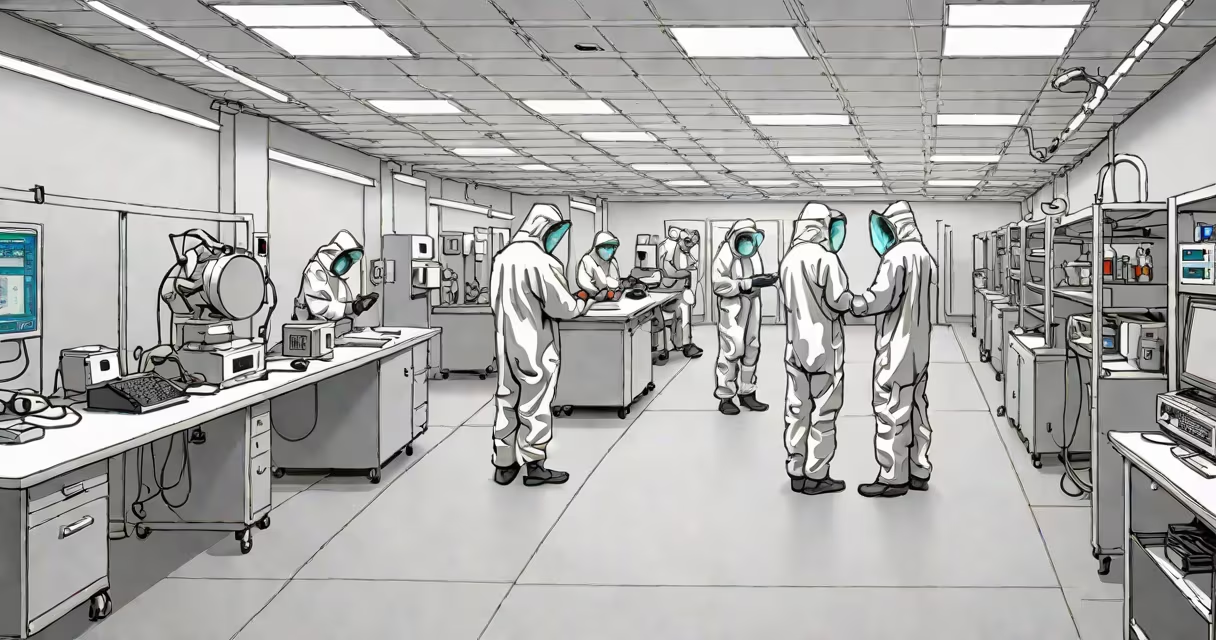
An iso 1 cleanroom is a controlled environment with a maximum allowable concentration of ten particles larger than 0.1 micrometers per cubic meter of air. This level represents the strictest particle control in the ISO 14644-1 standard, designed for ultra-sensitive manufacturing processes such as advanced semiconductor fabrication and high-purity pharmaceutical production.
ISO 14644-1 defines cleanrooms based on particle counts measured at specific sizes. The scale ranges from ISO 1 (most stringent) to ISO 9 (least stringent). An ISO 1 cleanroom allows only 10 particles ≥0.1 μm per cubic meter, with fewer than 1 particle ≥5 μm per cubic meter. These limits are enforced through continuous monitoring using laser particle counters and validated airflow systems.
Such environments require laminar airflow (unidirectional flow) at high velocities, typically 0.45 m/s, to prevent particle accumulation. Air is filtered through HEPA (High Efficiency Particulate Air) or ULPA (Ultra Low Penetration Air) filters, which remove 99.999% of particles down to 0.1 μm. Personnel wear full-body cleanroom suits, including hoods, gloves, and boots, to minimize human-generated contamination.
ISO 14644-1 specifies particle size thresholds and maximum allowable concentrations. For ISO 1, the upper limit is 10 particles per cubic meter for particles ≥0.1 μm. As particle size increases, the permissible count drops sharply: ≤1 particle per cubic meter for ≥5 μm particles. This reflects the higher risk of large particles disrupting micro-scale processes.
Airflow design is critical. Laminar flow systems move air uniformly across the workspace, minimizing turbulence and deposition. In a typical ISO 1 cleanroom, air enters through ceiling-mounted HEPA filters and exits via floor grilles. The system maintains positive pressure to prevent unfiltered air from entering.
Monitoring occurs continuously. Sensors detect particle levels in real time, triggering alarms if thresholds are exceeded. Data logs are retained for compliance audits. Facilities must undergo regular certification testing, including particle counting and airflow velocity verification, to maintain ISO 1 status.
ISO 1 cleanrooms rely on specialized construction materials. Walls and ceilings are made of smooth, non-shedding panels such as epoxy-coated steel or aluminum composite. Flooring uses conductive, static-dissipative tiles to prevent electrostatic discharge (ESD) damage during semiconductor processing.
Equipment must be certified for cleanroom use. Tools like robotic arms, wafer handlers, and inspection stations are designed with minimal moving parts and sealed motors to reduce particulate shedding. All materials introduced into the room must pass outgassing tests to ensure they do not release volatile organic compounds (VOCs).
Personnel access is tightly restricted. Entry requires air showers, gowning rooms, and multiple layers of protective clothing. Even minor deviations-like a loose thread from a glove-can trigger a contamination event. Training includes protocols for movement, tool handling, and emergency response.
These facilities are essential in industries where microscopic defects cause catastrophic failure. In semiconductor manufacturing, a single particle on a 3nm chip can short-circuit a transistor. ISO 1 cleanrooms are used in photolithography, etching, and deposition stages where precision is measured in nanometers.
In biopharmaceuticals, ISO 1 environments support the production of gene therapies and viral vector vaccines. Contamination risks include endotoxins, DNA fragments, and microbial cells. A 2021 study published in *Nature Biotechnology* found that particle contamination during viral vector manufacturing reduced product yield by up to 37% in non-ISO 1 settings.
Medical device manufacturers also use ISO 1 zones for implantable devices like pacemakers and neurostimulators. The FDA's guidance on sterile product manufacturing emphasizes environmental controls, citing ISO 14644-1 as the benchmark for sterility assurance.
Many assume that ISO 1 cleanrooms are only for electronics. While semiconductor fabs are the most visible users, their application extends to life sciences, aerospace, and advanced materials research. NASA's Jet Propulsion Laboratory uses ISO 1 environments for assembling Mars rover instruments due to sensitivity to dust and static.
Another misconception is that ISO 1 means "zero particles." That is false. The standard permits up to 10 particles ≥0.1 μm per cubic meter. The term "clean" refers to relative control, not absolute purity. Even in ISO 1, particles exist-they are simply kept below a defined threshold.
A third error is equating cleanroom grade with facility size. A small lab can achieve ISO 1 status with a single workstation and a HEPA-filtered enclosure. Conversely, a large fab may have ISO 1 zones within larger ISO 5 or ISO 7 areas. The classification applies to the local environment, not the entire building.
The following table shows particle concentration limits across ISO classes. Values are maximum allowable counts per cubic meter at specified particle sizes.
| ISO Class | Particles ≥0.1 μm | Particles ≥0.5 μm | Particles ≥5 μm |
|---|---|---|---|
| 1 | 10 | 1 | 1 |
| 2 | 100 | 10 | 1 |
| 3 | 1,000 | 100 | 1 |
| 4 | 10,000 | 1,000 | 10 |
| 5 | 100,000 | 10,000 | 100 |
For context, a typical office has ~35 million particles ≥0.5 μm per cubic meter-equivalent to ISO 8 or worse. The jump from ISO 5 to ISO 1 represents a 10,000-fold reduction in particle load.
At Intel's Fab 45 in Arizona, the photolithography area operates at ISO 1 conditions. The process involves projecting light patterns onto silicon wafers to create circuit features as small as 2 nm. A single 0.1 μm particle landing on the wafer during exposure causes a defect that renders the chip non-functional.
To maintain ISO 1, the facility uses dual HEPA filtration, continuous airflow monitoring, and automated door interlocks. Personnel enter through three-stage airlock systems. Every tool is cleaned with solvent wipes before insertion. Over a 12-month period, the facility recorded 0.002 particle events per hour-well below the ISO 1 threshold.
I once observed a contamination incident during a visit to a cleanroom at a medical device startup. A technician accidentally dropped a screwdriver. Despite immediate cleanup, the team had to halt production for 48 hours while the area was re-certified. The event highlighted that even low-energy actions can breach ISO 1 integrity.
Compliance with ISO 1 requires documented procedures, staff training, and third-party audits. The International Organization for Standardization (ISO) publishes the full standard, and accredited laboratories perform certification testing. Facilities must revalidate every six months to maintain accreditation.
Understanding iso 1 cleanroom requirements ensures accurate planning for high-risk operations. Whether in chipmaking or vaccine development, maintaining this level of control prevents costly failures and protects patient safety.