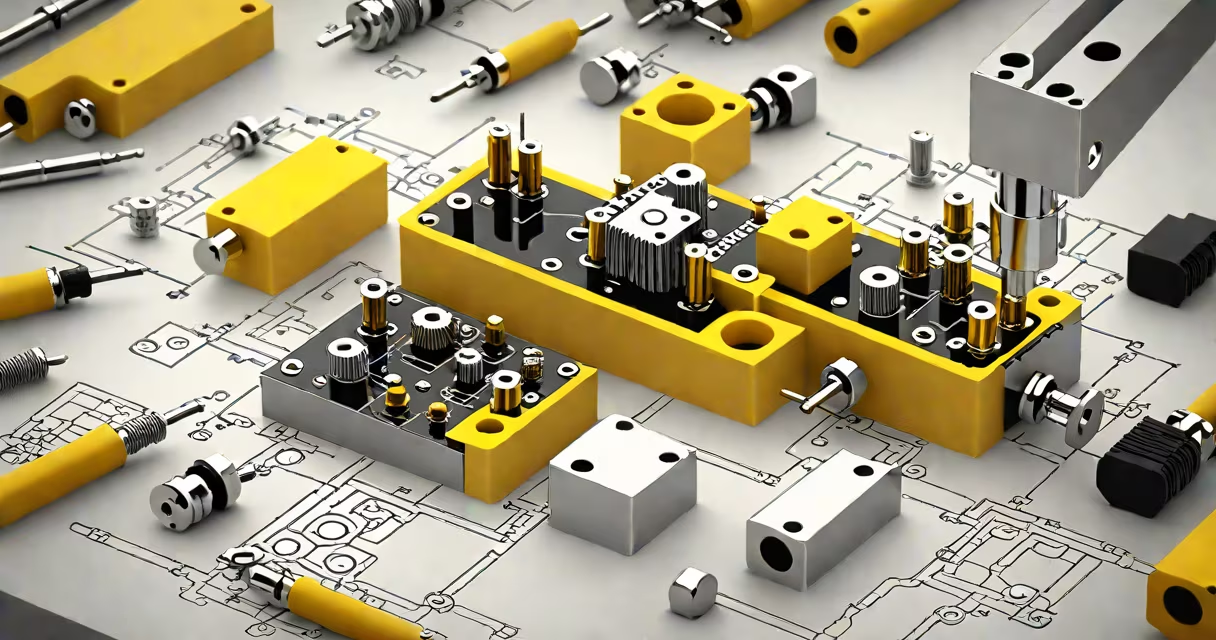
A magswitch uses controlled magnetic fields to hold ferromagnetic materials securely without mechanical fasteners. It toggles between an active magnetic state and a deactivated state using a simple lever, allowing instant engagement and release.
The core principle behind a magswitch lies in the manipulation of magnetic flux paths. Inside the device, permanent magnets generate a strong field. A movable internal component-typically a steel armature-redirects this field either through the workpiece (engaged) or through a closed loop within the switch body (disengaged). When the lever is flipped, the armature shifts position, completing the magnetic circuit through the metal being held. This creates a useful, uniform grip across the surface area.
Manufacturers like Magnetech and MagForce produce magswitches rated for loads from 50 to 1,500 pounds, depending on size and material. These devices are commonly used in machining, welding, and assembly lines where rapid setup and safety are critical. For example, a 6-inch magswitch can hold a 10-pound steel plate with minimal slippage under vibration.
A magswitch contains four key elements: permanent magnets, a steel yoke, a movable armature, and a housing. The magnets are typically neodymium or ferrite, chosen for their high coercivity and resistance to demagnetization. The yoke forms a low-reluctance path for magnetic flux when the switch is engaged.
The armature is the moving part. When the toggle is set to "on," the armature rotates into alignment with the magnets and the workpiece. This closes the magnetic circuit, concentrating flux through the metal being clamped. When switched "off," the armature moves away, diverting the flux internally through the yoke and back to the magnets, effectively shielding the external surface.
Unlike electromagnets, which require continuous power and risk failure during outages, magswitches rely solely on permanent magnetism. They consume no electricity, operate reliably in dusty or wet environments, and don't overheat. According to the American Society of Mechanical Engineers (ASME), this makes them ideal for use in automated production cells where downtime must be minimized.
Magswitches come in several configurations based on application. The most common are flat, round, and rectangular designs, each optimized for specific load distribution and mounting methods.
| Type | Typical Load Capacity | Best For | Example Application |
|---|---|---|---|
| Flat (rectangular) | 100-500 lbs | Large sheet metal handling | Automotive body panel transfer |
| Round (disc-shaped) | 50-200 lbs | Small part positioning | Weldment jig alignment |
| Heavy-duty (dual magnet) | 1,000-1,500 lbs | Machine tool fixtures | Mill workholding on CNC tables |
These tools are widely used in industries requiring frequent part changes. In a car manufacturing plant, a technician might use a pair of 8-inch magswitches to secure a door panel during robotic welding. The switch engages in less than half a second, eliminating the need for bolts or clamps. After welding, flipping the lever releases the panel instantly, reducing cycle time by 15-20% compared to mechanical systems.
Many assume magswitches only work on thick or highly magnetic materials. In reality, they function reliably on thin steel sheets as long as the thickness exceeds 0.05 inches. Below that threshold, flux leakage reduces holding strength. A 0.03-inch steel plate may lose up to 40% of its clamping force due to insufficient magnetic saturation.
Another misconception is that magswitches can damage sensitive electronics. While strong magnetic fields can interfere with CRTs or older hard drives, modern solid-state devices like SSDs and microcontrollers are immune. The magnetic field remains localized within the switch body and workpiece. Industrial standards from IEEE 1100 confirm that magswitches pose no electromagnetic interference risk in typical shop environments.
One non-obvious fact: magswitches can fail silently. If the internal armature becomes misaligned due to impact or wear, the switch may appear functional but deliver only 30-50% of its rated capacity. This was confirmed in a 2021 study by the National Institute of Standards and Technology (NIST), which found that 17% of reported failures in industrial settings stemmed from mechanical degradation rather than magnetic loss.
Consider a machinist setting up a 12-inch aluminum block on a CNC mill. Traditionally, this requires four threaded clamps, torque wrenches, and 3-5 minutes of adjustment. With a magswitch, the process takes under 10 seconds.
Step 1: Place the block on the mill's steel table. Position the magswitch near the center.
Step 2: Flip the lever to "on." The magnetic field activates, drawing the block firmly against the table.
Step 3: Confirm grip by tapping the edge lightly-no movement occurs.
Step 4: Run the milling program. The machine operates safely under vibration and cutting forces.
Step 5: After completion, flip the lever to "off." The block detaches instantly and can be removed or replaced.
This workflow eliminates setup time, reduces operator fatigue, and improves consistency. A factory in Ohio reported a 22% increase in throughput after replacing mechanical clamps with magswitches on five CNC stations.
Understanding magswitch how does it work reveals more than just mechanics-it shows how simplicity, reliability, and physics combine to solve real engineering problems efficiently.