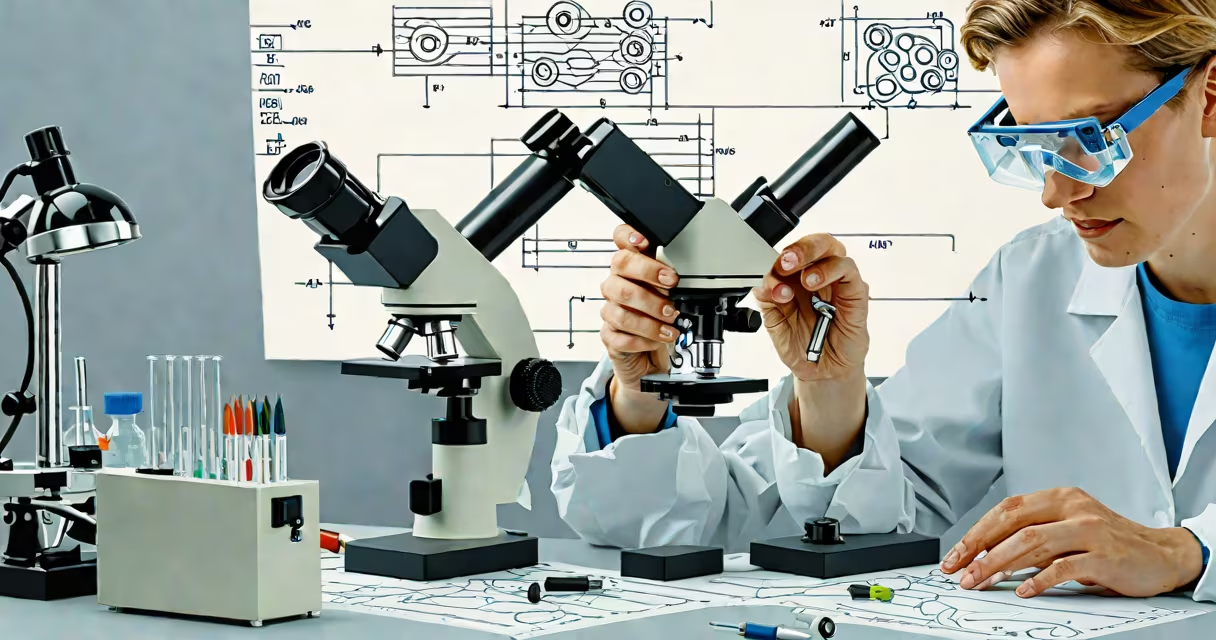
Medical laboratory technician education trains individuals to perform diagnostic tests on blood, tissue, and bodily fluids in clinical laboratories. Programs typically last 12 to 24 months and lead to a certificate or associate degree. Graduates work under supervision to support disease diagnosis and treatment planning.
These programs combine classroom instruction with supervised lab practice. Students learn to operate centrifuges, microscopes, and automated analyzers. They study hematology, microbiology, chemistry, and urinalysis. Most programs require completion of prerequisite courses in biology, chemistry, and math before enrollment.
Accredited programs follow guidelines set by the National Accrediting Agency for Clinical Laboratory Sciences (NAACLS). NAACLS accredits over 500 programs in the U.S., ensuring curricula meet national standards for safety, competency, and ethics. Graduates from NAACLS-accredited programs are eligible to take the certification exam administered by the American Society for Clinical Pathology (ASCP).
Students begin with foundational science courses: general biology, human anatomy, and general chemistry. These courses build the scientific literacy needed to understand test results and biological systems. Math skills are applied in calculating dilutions, concentrations, and reference ranges.
Core technical training includes specimen collection, handling, and processing. Technicians learn proper labeling, storage, and transport protocols to prevent contamination. They practice identifying abnormal cells under a microscope and interpreting results from automated analyzers used in chemistry and immunology testing.
Fieldwork is a required component. Students complete rotations in hospital labs, reference labs, and public health facilities. A typical internship lasts 160 hours and is supervised by a certified medical laboratory scientist (MLS). This hands-on experience ensures technicians can apply theory in real-world settings before certification.
Medical laboratory technician education is offered in three formats: certificate, diploma, and associate degree. Certificate programs are often 12 months long and focus exclusively on technical skills. They are ideal for career changers seeking quick entry into the field.
Diploma programs last 18 to 24 months and include more general education credits. Associate degree programs are the most common path. They award an AA degree and include liberal arts courses such as communication and ethics. These programs better prepare graduates for advancement and continuing education.
| Program Type | Duration | Credit Hours | Typical Entry Requirements |
|---|---|---|---|
| Certificate | 12 months | 30-40 | High school diploma or GED |
| Diploma | 18-24 months | 60 | High school diploma, basic science coursework |
| Associate Degree | 24 months | 60-70 | High school diploma, college algebra, biology |
Many institutions offer hybrid models combining online lectures with in-person lab sessions. For example, a student in Texas might take microbiology theory online while completing blood smear preparation in person at a local hospital lab. This format supports working adults balancing education with employment.
Medical laboratory technician education is essential in hospitals, outpatient clinics, research centers, and forensic labs. Technicians process samples daily-over 1 million blood tests are performed annually in U.S. hospitals alone. Their work enables early detection of conditions like diabetes, kidney failure, and cancer.
In a typical hospital lab, a technician draws blood from a patient, labels the sample, and runs a complete blood count (CBC) using an automated analyzer. Results appear within 30 minutes. The physician uses the white blood cell count and hemoglobin levels to assess infection risk or anemia severity. Without accurate technician input, diagnosis delays occur.
Technicians also support infectious disease surveillance. During the 2020-2021 pandemic, lab techs processed over 100 million SARS-CoV-2 PCR tests in the U.S. Their role in rapid testing helped reduce community transmission rates by enabling timely isolation and contact tracing.
Medical laboratory technician education is not the same as medical laboratory technologist training. Technologists hold bachelor's degrees and perform complex analyses requiring advanced interpretation. Technicians perform routine tests under supervision. The ASCP defines this difference: technologists are licensed to interpret results; technicians are not.
A common error is assuming all lab tech programs are equivalent. Only NAACLS-accredited programs qualify for certification. Non-accredited programs may lack standardized curricula or clinical placements. In 2022, the U.S. Department of Education reported that 37% of unaccredited programs failed to place 50% of graduates in jobs within six months.
At Central State Community College in Ohio, the medical laboratory technician program spans two years. Year one covers fundamentals: lab safety, pipetting techniques, and basic microscopy. Students spend 120 hours in the lab learning to identify parasites in stool samples and detect bacteria in throat swabs.
Year two focuses on specialized areas. Students rotate through hematology, coagulation, and serology labs. In the hematology rotation, they run a manual differential count on a blood smear. They classify 100 white blood cells into neutrophils, lymphocytes, monocytes, eosinophils, and basophils. This skill takes 150 hours of practice to master.
Upon graduation, students take the ASCP certification exam. The pass rate at Central State was 94% in 2023, above the national average of 87%. Graduates secure jobs at regional hospitals, private labs, and public health departments. One graduate, Maria Lopez, now works at a rural clinic where she processes 40 blood samples daily and reports abnormalities to physicians.
Most employers require certification from the ASCP Board of Certification (BOC). The exam covers five domains: general laboratory procedures, hematology, clinical chemistry, immunology, and microbiology. Candidates must have completed an NAACLS-accredited program and passed a background check.
Non-certified technicians cannot legally perform diagnostic testing in most states. In California, for example, the Department of Public Health mandates certification for all lab staff involved in patient testing. Violations result in fines up to $10,000 and suspension of lab operations.
Even experienced professionals must recertify every five years. Continuing education units (CEUs) are required-typically 30 hours per cycle. This ensures ongoing competence in evolving technologies like mass spectrometry and molecular diagnostics.