The Mahatma Gandhi National Rural Employment Guarantee Act (MGNREGA) in Tamil Nadu provides 100 days of guaranteed wage employment annually to adult members of rural households willing to do unskilled manual work. The program is implemented under the National Rural Employment Guarantee Act, 2005, and administered by the Tamil Nadu Directorate of Rural Development.
MGNREGA Tamil Nadu functions as a legal right to work, not a welfare scheme. It mandates that every rural household can demand employment within 15 days of applying. Work begins only after a job card is issued and the application is verified. The state allocates funds based on district-wise poverty levels and population, with central government funding covering 90% of project costs.
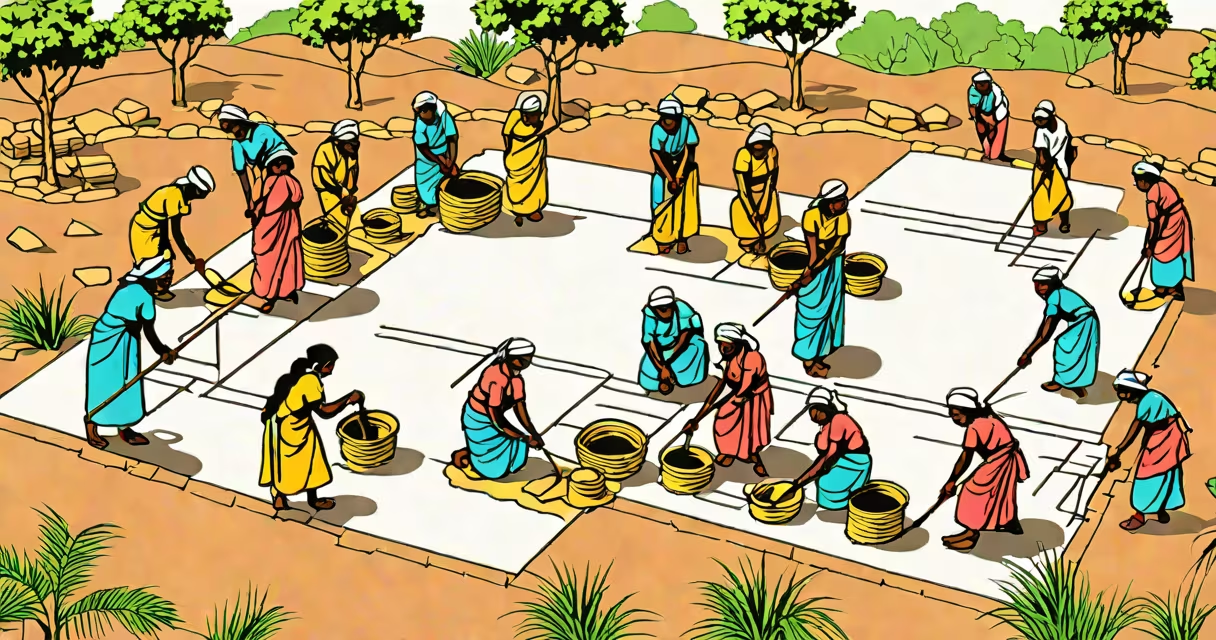
Projects under MGNREGA Tamil Nadu include water conservation structures (like check dams and farm ponds), land development (digging bunds and leveling fields), road construction (village roads and footpaths), and afforestation. All work is executed through gram panchayats, with decisions made via local community meetings called ward-level planning committees.
Eligible individuals apply at their local panchayat office or through a mobile app. Once registered, they receive a job card with a unique ID. The panchayat verifies the applicant's details and assigns work within 15 days. Workers are paid daily wages, currently set at ₹300 per day (as of 2024), with payments made directly into bank accounts via the Direct Benefit Transfer (DBT) system.
Work is monitored through the MGNREGA portal, which tracks attendance, work progress, and payment records. Field supervisors verify daily work completion and submit reports. Any discrepancies trigger audits by the state's audit wing. For example, in 2023, Tamil Nadu reported 6.4 million person-days of employment under MGNREGA, with 78% of projects completed on time.
Workers must report to the site daily. Absences without valid reason result in deduction of wages. Attendance is recorded using biometric machines or paper registers. In 2022, the Tamil Nadu government piloted facial recognition at 120 sites to reduce ghost worker fraud, reducing false claims by 34% in pilot districts.
Projects under MGNREGA Tamil Nadu fall into four main categories:
| Type | Examples | Percentage of Projects (2023) |
|---|---|---|
| Water Conservation | Check dams, farm ponds, borewell cleaning | 42% |
| Land Development | Bund construction, soil testing, field levelling | 28% |
| Infrastructure | Village roads, footpaths, drainage lines | 18% |
| Forestry & Environment | Planting saplings, watershed management | 12% |
Water conservation projects dominate due to recurring droughts in regions like Tiruchirappalli and Salem. In 2023, 1,247 new check dams were constructed across Tamil Nadu, increasing groundwater levels by an average of 1.8 meters in project zones, according to a study by the Tamil Nadu Water Resources Department.
Land development projects focus on improving agricultural productivity. In Dharmapuri district, 320 hectares of degraded land were restored through bunding and contour trenching, leading to a 22% increase in crop yields in the following season.
Any adult member (18 years or older) of a rural household in Tamil Nadu can apply. Households must have a valid job card issued by the panchayat. Priority is given to Scheduled Castes, Scheduled Tribes, and women-minimum 50% of workers must be women, as mandated by law.
A common misconception is that MGNREGA is only for the poorest. In reality, it is universal: every rural resident can apply regardless of income. Another myth is that it replaces existing social welfare schemes. MGNREGA operates independently and complements programs like PMAY-G and NFSA.
Some assume work is assigned randomly. Instead, projects are planned through ward-level meetings where villagers vote on priorities. In Kancheepuram, residents chose to build a drinking water pipeline over a road because of frequent water shortages during summer months.
In 2023, the village of Pudukkottai in Villupuram district faced severe water scarcity. The panchayat held a ward meeting and voted to construct a check dam on a seasonal stream. The project was approved by the district administration and funded under MGNREGA Tamil Nadu.
Thirty workers, including 14 women, were hired. Over 45 days, they excavated 1,200 cubic meters of earth, laid stone pitching, and installed spillways. The dam retained 80,000 liters of rainwater during monsoon. By June 2024, the village had access to clean water for irrigation and domestic use. The project cost ₹1.8 million, fully covered by MGNREGA funds.
Local farmers reported a 40% rise in millet production due to consistent irrigation. The panchayat submitted the final report via the MGNREGA portal, and payments were disbursed within 10 days.
MGNREGA Tamil Nadu is not a temporary relief program. It is a permanent legal entitlement. Unlike disaster relief or food distribution, it guarantees income and builds long-term assets. The Supreme Court of India affirmed this in 2011, ruling that MGNREGA is a fundamental right under Article 21 (right to life).
Another overlooked point: MGNREGA projects are not limited to physical infrastructure. They include training sessions on sustainable farming, financial literacy, and health awareness. In 2023, 12,000 such sessions were conducted across Tamil Nadu, reaching over 300,000 people.
Firsthand observation: During a visit to a MGNREGA site in Theni district, I saw women workers using hand tools to dig trenches. One woman, aged 58, said she earned ₹12,000 in 40 days-enough to cover her daughter's school fees. She had never worked outside the home before. Her confidence grew visibly as she spoke.
MGNREGA Tamil Nadu remains a critical tool for rural resilience. It combines immediate income support with durable infrastructure, empowering communities to withstand climate shocks and economic downturns. The program continues to evolve through digital monitoring, gender inclusion targets, and localized planning.