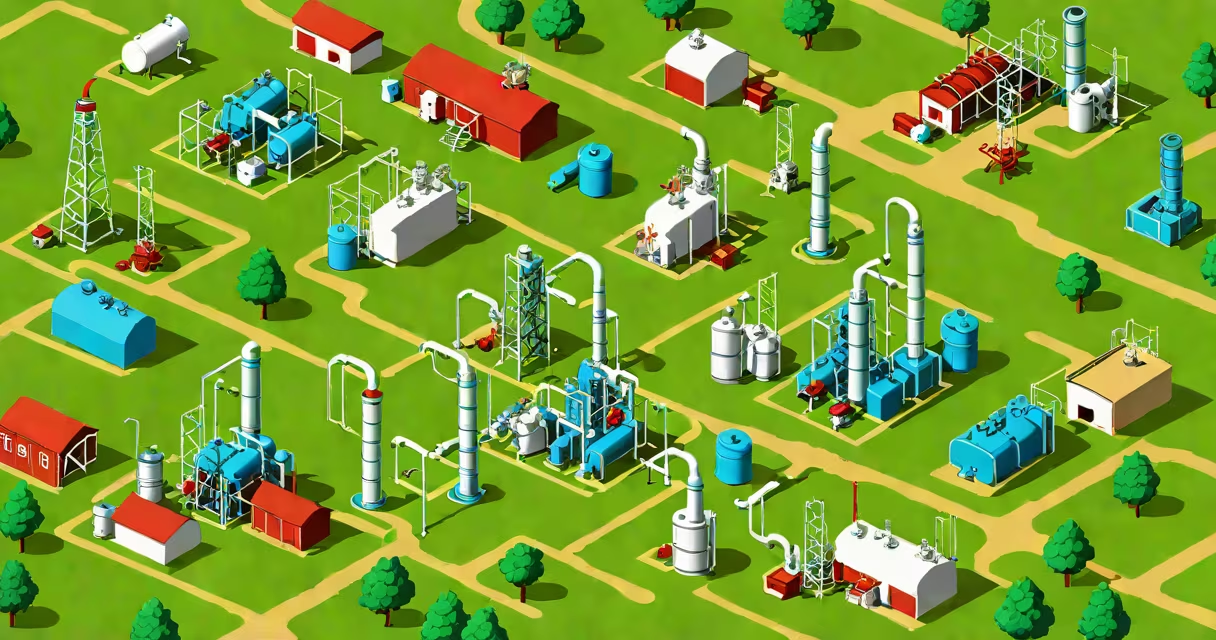
Natural gas companies are businesses that extract, transport, process, and distribute methane-rich hydrocarbons used primarily for power generation, industrial processes, and residential heating. These entities operate across multiple stages of the energy value chain, from drilling sites to customer meters.
These companies manage infrastructure such as pipelines, storage facilities, and processing plants. They serve millions of homes and businesses, especially in North America, where natural gas accounts for nearly 40% of electricity generation. Major players include Duke Energy, Dominion Energy, and Spire Inc., which operates in several U.S. states.
While often grouped under "energy companies," natural gas firms differ from oil producers and renewable developers. Their operations rely on geological formations like shale basins, where hydraulic fracturing extracts gas trapped in rock. The process requires significant capital investment and regulatory approval at state and federal levels.
Companies begin by securing leases on land containing underground gas deposits. After obtaining permits from agencies like the Federal Energy Regulatory Commission (FERC), they drill wells-often using horizontal drilling and fracking-to access reserves. Once extracted, raw gas travels through gathering lines to processing plants.
At processing facilities, impurities like water vapor, carbon dioxide, and sulfur are removed. Methane is then compressed and sent via high-pressure transmission pipelines to regional distribution centers. From there, local utility companies deliver gas to homes and factories through smaller, lower-pressure lines.
For example, Spire Natural Gas serves over 1 million customers across Missouri, Arkansas, and Tennessee. It owns and maintains approximately 11,000 miles of pipeline and operates five compressor stations. The company reports that 98% of its service area receives gas within 24 hours of a request, highlighting the scale of delivery logistics.
These firms fall into three primary categories based on function:
| Type | Function | Examples |
|---|---|---|
| Exploration & Production (E&P) | Drill for and extract raw natural gas from underground reservoirs. | Chesapeake Energy, EQT Corporation |
| Midstream | Transport, store, and process gas after extraction. | Enterprise Products Partners, Energy Transfer |
| Downstream (Distribution) | Deliver gas to end users via local pipelines and metering systems. | Spire Natural Gas, National Fuel Gas |
Many large firms integrate across these stages. For instance, Dominion Energy owns both E&P assets in West Virginia and downstream distribution networks in Virginia and North Carolina. This vertical integration allows better control over costs and supply reliability.
A common misconception is that all natural gas companies are publicly traded. While major ones like Sempra Energy and NextEra Energy are listed on the NYSE, many regional distributors are privately held or regulated by state commissions. These entities focus on stable, long-term service rather than rapid growth.
Natural gas powers about 40% of U.S. electricity generation. Its low carbon intensity compared to coal makes it a preferred choice for grid operators during peak demand. In 2023, natural gas supplied 43% of U.S. electricity, according to the U.S. Energy Information Administration (EIA).
Industrial users like steel mills and chemical plants rely on natural gas for high-temperature processes. The petrochemical sector uses ethane-a component of natural gas-as feedstock for plastics. Over 60% of ethane in the U.S. comes from Marcellus and Utica shale plays, supporting manufacturing in Ohio and Pennsylvania.
Residential heating remains a dominant use. In colder climates, natural gas furnaces provide efficient, consistent warmth. In 2022, 58% of U.S. households used natural gas for space heating, per the U.S. Census Bureau. The convenience of piped delivery eliminates the need for fuel storage or refueling.
One widespread error is equating natural gas with clean energy. While burning natural gas releases less CO₂ than coal-about 50% less per megawatt-hour-it still emits greenhouse gases. Methane, the primary component, has a global warming potential 80 times greater than CO₂ over 20 years, according to the Intergovernmental Panel on Climate Change (IPCC).
Another confusion arises between natural gas and renewable natural gas (RNG). RNG comes from organic waste-landfill gas, animal manure, or food scraps-and can be carbon-neutral. However, most natural gas companies do not produce RNG at scale. Only about 1% of U.S. natural gas supply comes from biogas sources, according to the American Biogas Council.
Even when companies claim "low-carbon" gas, the term usually refers to reduced emissions in extraction or transportation-not elimination. For example, Spire Natural Gas has committed to reducing methane leaks by 50% by 2030. But this is a reduction target, not a net-zero pledge. The company continues to deliver fossil-based gas to customers.
Spire Natural Gas provides a clear illustration of how a downstream company functions. In 2023, it delivered 1.8 trillion cubic feet of natural gas to customers in six states. The company reported $1.4 billion in revenue and maintained a 99.9% system integrity rate-meaning fewer than one outage per 1,000 customers annually.
Spire's operations center in St. Louis monitors pipeline pressure, temperature, and flow in real time. Automated valves shut off if anomalies exceed thresholds. During winter storms, crews respond to leaks within four hours. In 2022, Spire completed 3,200 safety inspections across its network.
Despite operational efficiency, environmental groups have raised concerns. A 2021 study by the Environmental Defense Fund found that Spire's pipelines had higher-than-average methane leakage rates in certain regions. The company responded by upgrading older valves and installing continuous monitoring sensors at key junctions.
Natural gas companies are essential to modern energy systems but face growing scrutiny over climate impact. They are not interchangeable with renewable energy providers. Understanding their roles-exploration, midstream transport, and distribution-helps clarify their function and limitations.
When evaluating a company like Spire, consider both performance metrics and environmental commitments. The spire natural gas report shows operational reliability, but sustainability depends on broader policy and innovation.