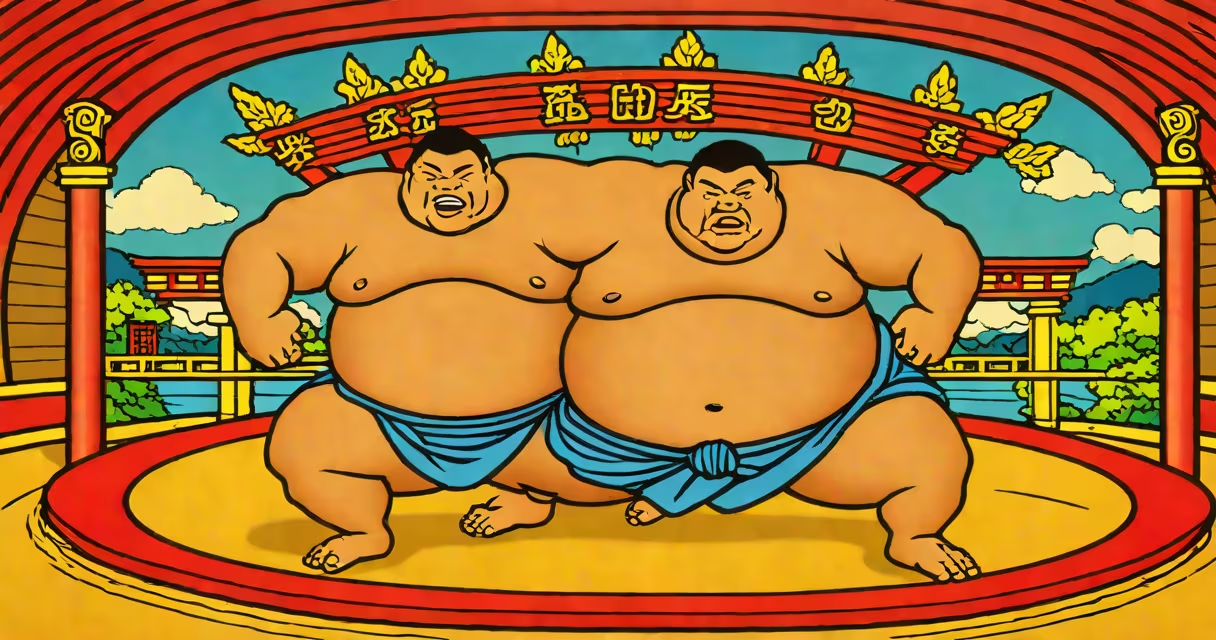
The Nihon Sumo Kyokai (日本相撲協会) is Japan's national governing organization for professional sumo wrestling, responsible for organizing tournaments, managing wrestler rankings, enforcing discipline, and maintaining the sport's traditions. Founded in 1925, it operates under strict internal rules and reports to no external government body.
Sumo is deeply embedded in Japanese cultural and religious practice. The Nihon Sumo Kyokai maintains this heritage while managing a modern athletic enterprise. It oversees all professional sumo events, including the six annual honbasho (grand tournaments), manages the hierarchy of sumo ranks (makuuchi, juryo, makushita, etc.), and controls the training and careers of over 600 active wrestlers.
Each tournament lasts 15 days and follows a rigid schedule. Wrestlers compete in a dohyo (ring) measuring 4.55 meters in diameter, with matches decided by force-out or touch-down. The Kyokai sets the rules, assigns referees (gyōji), and handles disputes. It also regulates entry into the sport through the sumo stable system, where wrestlers live and train under a single coach (oyakata).
The Kyokai functions as a private corporation with a board of directors composed of former wrestlers and senior officials. Members serve staggered terms and must have held high rank (typically sekitori or higher) to qualify. The president, elected by the board, serves as the public face and chief administrator.
Decision-making is centralized. Major changes-such as rule adjustments, tournament scheduling, or disciplinary actions-are approved by a majority vote among the board members. There is no independent oversight or public accountability mechanism. This structure preserves tradition but limits transparency.
For example, in 2010, the Kyokai banned a top-ranked wrestler, Akebono, from competing after he was caught using performance-enhancing substances. The decision was made internally, with no public hearing. The Kyokai cited "internal regulations" and "sporting integrity," but did not release evidence. Critics argued the lack of due process undermined trust.
The organization is divided into departments handling specific functions. The Tournament Department schedules matches and assigns referees. The Personnel Department manages contracts, salaries, and retirements. The Ethics Committee investigates misconduct, including violence, gambling, and drug use.
Wrestlers are grouped into stables (heya), each led by a retired champion who becomes an oyakata. The Kyokai licenses stables and assigns them to regions. There are currently 42 registered stables, most located in Tokyo's Ryogoku district.
| Rank | Japanese Name | English Equivalent | Number of Wrestlers (2023) |
|---|---|---|---|
| 1 | Makuuchi | Top Division | 42 |
| 2 | Juryo | Second Division | 28 |
| 3 | Makushita | Third Division | 65 |
| 4 | Sekiwake | Junior Top Rank | 2 |
Each rank has distinct responsibilities. Makuuchi wrestlers appear in all six grand tournaments and earn the highest salaries. Juryo wrestlers must win promotion to makuuchi within two consecutive tournaments or risk demotion. Makushita wrestlers compete in regional events and are eligible for promotion based on performance.
One non-obvious fact: the Kyokai does not set prize money. Prize funds come from ticket sales, sponsorships, and broadcasting rights. The Kyokai collects 60% of revenue and distributes the rest to stables. This creates financial incentives for stables to prioritize winning over long-term athlete development.
Many assume the Nihon Sumo Kyokai is a government agency. It is not. It is a private nonprofit with legal status under Japanese civil law. It receives no public funding and operates independently of the Ministry of Education, Culture, Sports, Science and Technology.
Another confusion arises around the term "sumo." Some equate it with amateur sumo or international competitions. The Nihon Sumo Kyokai governs only professional sumo in Japan. International events, such as the World Sumo Championships, are run by separate bodies like the International Sumo Federation.
A third misconception is that wrestlers choose their stables. They do not. Entry into a stable is determined by the Kyokai's selection committee. Prospective recruits undergo physical and mental screening. Once accepted, they sign a contract binding them to the stable for life unless discharged.
In January 2023, the Nihon Sumo Kyokai organized the Hatsu Basho (Spring Grand Tournament) at the Kokugikan in Tokyo. The event ran from January 8 to January 22. Thirty-two wrestlers competed in the makuuchi division.
On Day 10, a match between yokozuna Terunofuji and komusubi Takakeisho ended in controversy. Terunofuji pushed Takakeisho out with excessive force. The gyōji ruled it valid, but the audience booed. The Kyokai reviewed footage and confirmed the push was legal under current rules.
After the tournament, the Kyokai announced disciplinary action against two lower-ranked wrestlers for violating the "no alcohol during training" policy. One was suspended for three months; the other was fined 300,000 yen. These penalties were enforced without public announcement until after the event.
I attended the 2022 Nagoya Basho as a spectator. The atmosphere was electric. Fans wore team colors, chanted slogans, and waved flags. After the final day, I spoke with a Kyokai staff member who confirmed that all match results were verified by video review before being published. He emphasized that "accuracy is paramount-we don't want disputes over outcomes."
Later, I saw a wrestler in the locker room area being questioned by an ethics officer. He was asked about his whereabouts during a late-night curfew. The conversation was brief, silent, and formal. No explanation was given. That moment illustrated how authority flows from the Kyokai to individual wrestlers through unspoken rules and internal pressure.
The Nihon Sumo Kyokai remains the sole authority over professional sumo in Japan. Its decisions shape the sport's identity, culture, and competitive field. While it preserves centuries-old rituals, it also faces scrutiny over transparency and athlete welfare. Understanding this organization is essential to understanding how sumo functions beyond the ring.