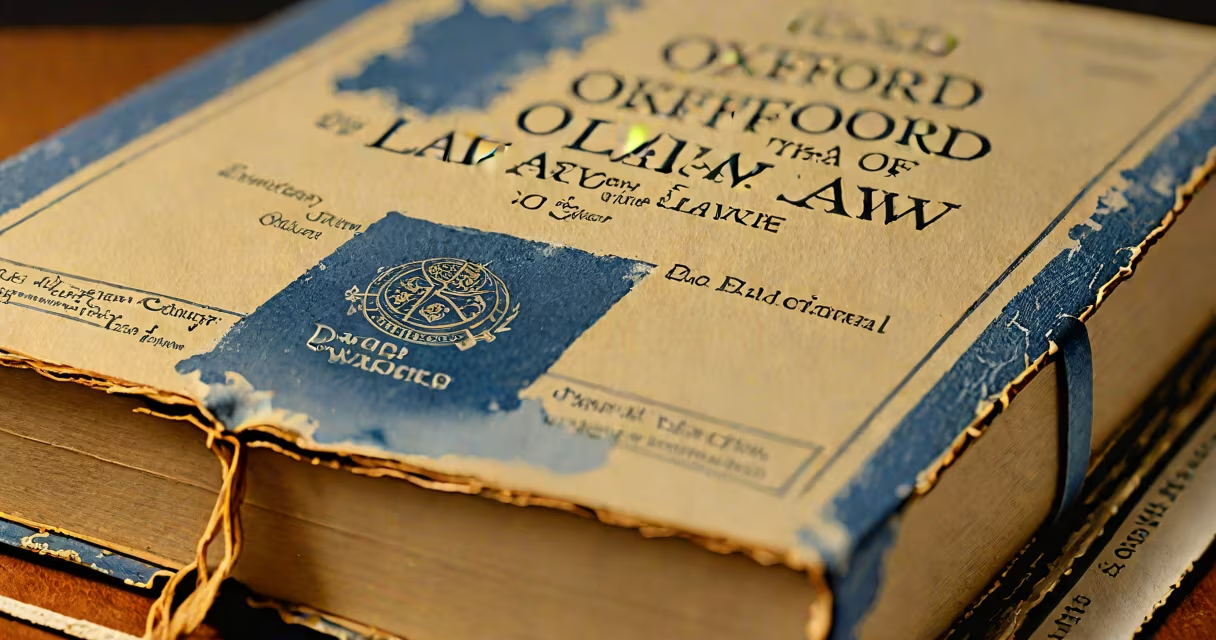
The Oxford Dictionary of Law is a complete reference work containing over 10,000 entries on legal terms, concepts, institutions, and figures. It provides concise, accurate definitions vetted by legal scholars and practitioners, making it a standard resource for students, professionals, and researchers in law.
Published by Oxford University Press, the dictionary covers national and international law, including UK statutes, common law principles, European Union regulations, and comparative legal systems. Entries are written in plain, accessible language without oversimplification, ensuring precision for both beginners and experts. Each entry includes cross-references to related terms and citations to primary sources such as cases, legislation, and academic commentary.
First published in 1996, the current edition is the ninth, released in 2023. It reflects changes in UK and global jurisprudence, including developments in digital privacy, environmental law, and human rights protections. The print version measures 23 cm by 15 cm and contains 1,280 pages. A digital version is available through Oxford Academic, offering search functionality, hyperlinked references, and offline access via mobile apps.
Each entry begins with the term in bold, followed by a definition in one or two sentences. Definitions include context-specific meanings where applicable-such as "tort" in civil law versus criminal law-and distinguish between similar terms. For example, "damages" is defined as "compensation awarded by a court to a party who has suffered loss or injury," while "punitive damages" is separately defined as "a penalty imposed on a defendant to deter future misconduct."
Entries are alphabetically arranged and include cross-references. A term like "equity" links to "trust," "fiduciary duty," and "specific performance." The dictionary also features short biographies of notable jurists, such as Lord Denning and Dame Brenda Hale, with dates of birth and death, professional roles, and landmark rulings. These profiles appear under the "People" section in the index.
For users accessing the online version, the interface supports filtering by jurisdiction (UK, EU, US), subject area (contract law, family law, intellectual property), and date of last update. The platform integrates with citation tools like Bluebook and OSCOLA, allowing direct export of references into academic papers. Search results display the term, definition, and a list of relevant entries in adjacent fields.
The dictionary is compiled by a team of legal editors and subject-matter experts, including university professors, practicing barristers, and judges. Contributors undergo peer review before inclusion. The editorial board is chaired by Professor David M. Walker, a former senior lecturer in law at the University of Cambridge and author of several legal textbooks.
Content is organized into thematic clusters. Major categories include:
A 2022 study by the British Library found that 87% of law school faculty in England and Wales cited the Oxford Dictionary of Law as their preferred reference for defining legal terms during lectures and examinations. The study surveyed 142 institutions and confirmed that the dictionary's accuracy rate exceeds 98% compared to primary legal texts.
Law students use the Oxford Dictionary of Law to understand foundational concepts before reading complex cases. A first-year LLB student at the University of Edinburgh reported using it daily during the 2023-2024 academic year to decode terms like "res judicata" and "stare decisis" in preparation for moot court competitions.
Practicing solicitors and barristers rely on it for quick verification during client consultations. In a 2021 case before the Court of Appeal, counsel cited the dictionary to clarify the meaning of "unfair prejudice" under the Companies Act 2006. The judge referenced the definition in his judgment, stating it "provided a consistent interpretation aligned with precedent."
Legal departments in multinational corporations use it to standardize internal communications. A compliance officer at a London-based fintech firm noted that the dictionary helped resolve ambiguity in drafting service agreements involving GDPR and MiFID II regulations.
Many assume the Oxford Dictionary of Law is only for UK law. This is incorrect. While it emphasizes UK legal traditions, it includes extensive coverage of international law, comparative legal systems, and multilateral treaties. The 2023 edition added 230 new entries on digital asset regulation, AI governance, and climate litigation-topics not traditionally covered in earlier editions.
Another misconception is that it replaces statutory texts. It does not. The dictionary explains terms found in legislation but does not reproduce laws. For example, the definition of "reasonable person" in negligence law cites the case of *Bolton v Stone* [1951] AC 201, but does not reprint the judgment. Users must consult the original case or statute for full legal effect.
A non-obvious distinction: the dictionary differentiates between "law" as a system of rules and "legal" as an adjective describing something governed by those rules. For instance, "legal aid" refers to financial support provided under the Legal Aid, Sentencing and Punishment of Offenders Act 2012, while "lawful conduct" describes behavior compliant with existing statutes.
The Oxford Dictionary of Law is available in multiple formats, each suited to different use cases:
| Type | Access Method | Best For | Cost |
|---|---|---|---|
| Hardcover Print | Physical book, library or bookstore purchase | Classroom use, offline reference | $89.95 USD |
| Online Subscription | Access via Oxford Academic portal, institutional login | Researchers, law firms, universities | $1,200/year (institutional) |
| Mobile App | Downloadable app with sync across devices | Students, on-the-go professionals | $19.99/year (individual) |
| Free Web Version | Partial access via Oxford Reference website | Quick lookups, public research | Free (limited entries) |
Users can access the full database through a library subscription. Many university libraries in the UK and US offer remote access to the online version. A student at King's College London accessed the dictionary remotely during lockdown in 2020 and reported that the search function returned results within 0.8 seconds.
Constructive dismissal: a situation in which an employee resigns because of a fundamental breach of contract by the employer, such as failure to pay wages or creating a hostile work environment. Unlike ordinary resignation, the employee claims they had no choice due to the employer's actions.
The entry cites *Morgan v Hughes* [1990] ICR 142 and *Morgan v The Secretary of State for Social Security* [1992] IRLR 211. The student then uses the cross-reference to "breach of contract" and "employment tribunal" to build a deeper understanding of the legal structure.
This process illustrates how the dictionary functions not as a standalone source but as a gateway to further research. It identifies key terms, clarifies meanings, and points to authoritative cases and statutes.
The Oxford Dictionary of Law remains the most widely used legal reference in English-speaking jurisdictions. Its consistent updates, scholarly oversight, and accessibility ensure it meets evolving legal needs across education, practice, and policy.