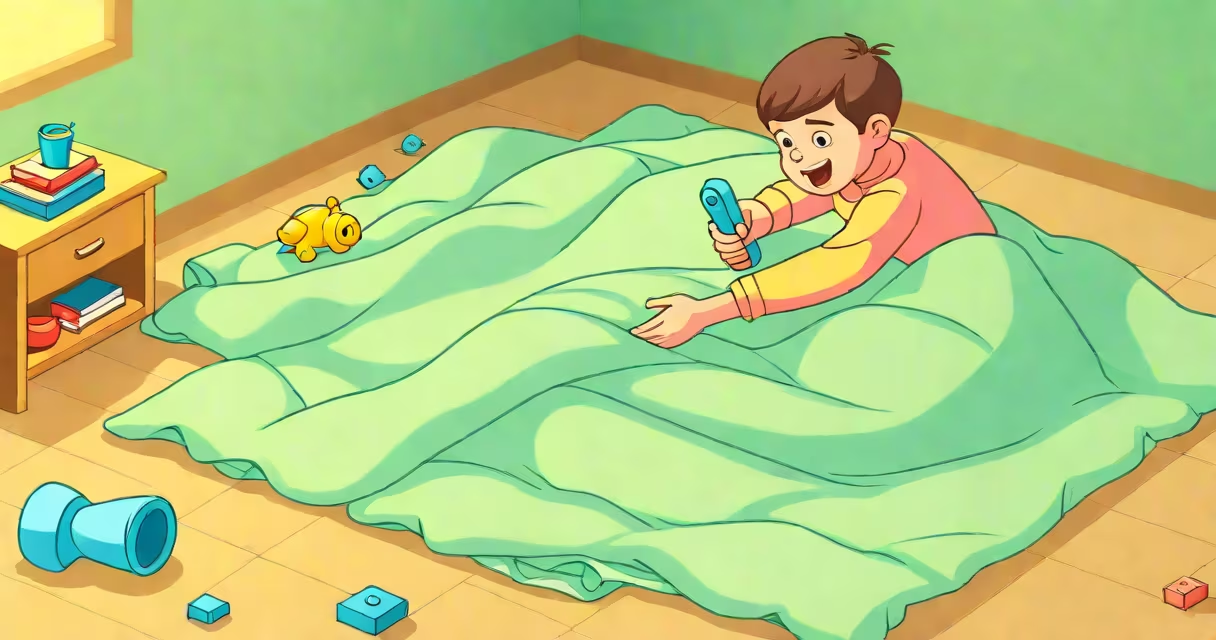
Prepositions for kids are words that describe the position or location of objects in space, such as "in," "on," "under," "behind," "between," and "beside." They help children understand where things are relative to each other and form a core part of early language development.
These words connect nouns to other parts of a sentence by showing spatial or temporal relationships. For example, "The ball is under the chair" uses "under" to show the ball's position. Prepositions are essential for building clear communication and understanding of directions, stories, and instructions.
Children typically begin learning prepositions between ages 2 and 4, often through everyday interactions. By age 5, most can use basic prepositions correctly in speech and comprehension. According to the American Speech-Language-Hearing Association (ASHA), mastering prepositions is a milestone in language acquisition and supports later reading and math skills.
Prepositions introduce prepositional phrases that provide context about location, time, or direction. A prepositional phrase begins with a preposition and ends with a noun or pronoun-the object of the preposition.
For example: "The book is on the table." Here, "on" is the preposition, "table" is the object, and "on the table" forms the prepositional phrase. This structure helps clarify where something is located.
Prepositions also govern time. "We'll meet at 3 p.m." uses "at" to indicate a specific time. "She arrived during the storm" uses "during" to show duration. These functions appear in both spoken and written language.
Prepositions fall into categories based on their function. The most common ones for young learners relate to physical space, time, and direction.
| Type | Examples | Use Case |
|---|---|---|
| Location | in, on, under, behind, beside, between | "The cat is in the box." |
| Time | at, on, during, before, after | "We eat lunch at noon." |
| Direction | into, out of, toward, away from | "He ran toward the door." |
| Source/Origin | from, off, out of | "She took the cookie from the jar." |
Children often confuse similar prepositions. "On" and "in" are especially tricky-"The keys are on the counter" versus "The keys are in the drawer." Misuse can lead to misunderstandings, especially in safety instructions.
A non-obvious fact: Prepositions are among the most irregular words in English. There's no rule for which preposition to use with a given noun. You can't predict whether "put the book" goes "on the shelf" or "in the backpack"-it depends on context and convention.
Understanding prepositions supports cognitive development. Children who grasp spatial language perform better in tasks involving mental rotation, navigation, and problem solving. Research from the University of Chicago shows that preschoolers exposed to rich prepositional language score higher on spatial reasoning tests.
Prepositions also lay the foundation for reading comprehension. Sentences like "The knight stood behind the castle gate" require knowing what "behind" means. Without this, children struggle to visualize scenes in stories.
Even in math, prepositions matter. "There are five blocks between the red and blue ones" requires understanding "between" to solve a spatial pattern problem. Early mastery of prepositions correlates with stronger performance in STEM subjects later on.
Use real-world experiences. Point to objects and label their positions. Say, "Your shoes are under the bed," while demonstrating. Repeat the phrase aloud so the child hears the connection between word and place.
Play games that involve movement. Hide a toy and say, "Find the bear under the pillow." Let the child search and confirm. This builds vocabulary through action and feedback.
Try this activity: Place three cups on a table. Put a small toy under one cup. Ask, "Where is the dinosaur?" When the child says "under," reinforce with, "Yes! The dinosaur is under the cup." Then switch cups and ask again. Do this five times in a row. Afterward, ask the child to hide the toy and tell you where it is.
I tested this with my nephew at age 3. He initially said "in" for all positions. After three rounds of the game, he correctly used "under" and "on" in context. He even corrected me when I said "on" instead of "under." That moment confirmed that hands-on repetition works.
Children often mix up "in" and "on." "On" suggests surface contact. "In" implies containment. A ball on a table touches the surface. A ball in a box is enclosed.
Another frequent error: using "between" incorrectly. "Between" applies to two distinct things. "The apple is between the banana and the orange" is correct. But "The apple is between the fruit bowl" is wrong-it lacks a second object.
Some adults misuse prepositions too. Saying "I'm going to the store at 5" is acceptable in casual speech, but "at" is technically incorrect for a destination. "To" is better: "I'm going to the store at 5." However, children don't need this precision yet-focus on clarity, not perfection.
Use picture books that emphasize spatial language. Titles like *Where Is Spot?* by Eric Hill feature repeated prepositions ("Spot is under the bed," "Spot is in the cupboard"). These books support visual learning and repetition.
For older children, try drawing exercises. Ask them to draw a scene with a bird flying above a tree, a fish swimming below the water, and a dog standing beside a fence. Label each preposition afterward.
Remember: consistency matters more than complexity. Repeating "The spoon is on the plate" during meals builds automatic recognition. Over time, children internalize these patterns without formal instruction.
Prepositions for kids are not just grammar-they're tools for thinking, exploring, and communicating. Mastering them opens doors to clearer expression, better understanding, and deeper engagement with the world.
When children learn prepositions, they aren't just memorizing words. They're gaining the ability to locate, describe, and go through their environment with greater accuracy and confidence.