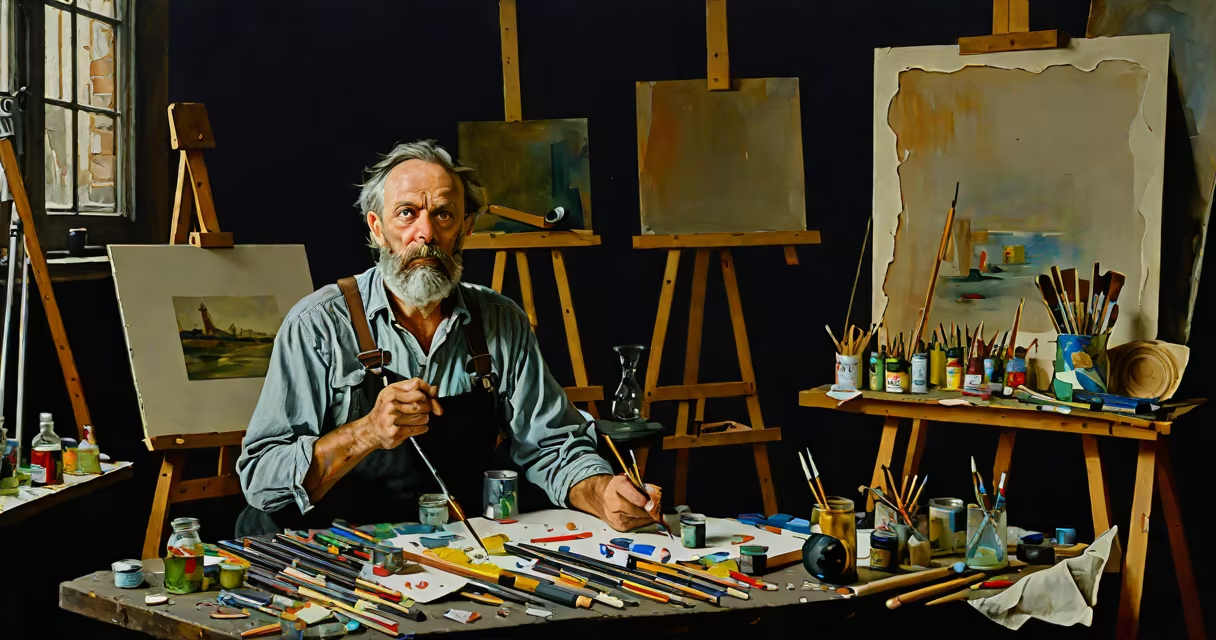
A portrait of an artist depicts the creator not just as they look, but as they are perceived-through their expression, setting, and symbolic details. It blends physical likeness with psychological insight, often revealing the artist's inner world, struggles, and creative process.
This form of portraiture emerged in the Renaissance as artists began to see themselves as intellectual figures worthy of visual documentation. Unlike earlier depictions of saints or rulers, a portrait of an artist shows a person engaged in the act of creation. The subject may hold a brush, stand before a half-finished canvas, or gaze into the distance with focused intensity. These images do not merely record appearance-they communicate intent, identity, and legacy.
The genre gained prominence in the 16th century with works like Albrecht Dürer's self-portraits. Dürer painted himself in 1500 at age 28, wearing a fur-lined coat and looking directly at the viewer with calm authority. He signed the work "I, Albrecht Dürer, painted myself in my youth, aged 28." This statement fused personal identity with artistic mastery-a rare move at the time. As art historian Svetlana Alpers notes, such self-portraits were not vanity projects but declarations of professional status within a changing cultural field (JSTOR, Alpers, 1981).
A portrait of an artist functions through layered visual cues. The face conveys emotion and age. The hands show skill or fatigue. The clothing suggests social class or artistic role. Background elements-canvases, books, tools-signal the artist's environment and mindset.
Consider Rembrandt's 1659 self-portrait in the National Gallery of Art, Washington, D.C. He wears a dark hat and heavy cloak, his face illuminated from below. His eyes are deeply shadowed, his mouth slightly open. The lighting creates a sense of introspection. The brushwork is loose, almost unfinished in places-suggesting the artist was still working on the piece. This isn't a polished image; it's a moment captured during creation. The painting reflects not just Rembrandt's appearance, but his state of mind: weary, reflective, aware of aging and mortality.
Modern examples continue this tradition. In 2018, artist Kehinde Wiley painted a self-portrait titled *Self-Portrait as a Young Man*. Wiley, known for reimagining classical European portraits with Black subjects, appears in a Renaissance-style pose. He wears a gold-embroidered robe, holds a sword, and stands against a floral backdrop. The composition references Titian's *Man with a Glove*, but Wiley subverts it by placing himself in a position of power and presence. The work isn't just a likeness-it's a political and cultural statement about who gets to be seen as an artist.
Portraits of artists vary by medium, period, and intent. They appear in oil, charcoal, photography, and digital media. Each format alters how identity is constructed.
| Type | Common Medium | Key Feature | Example |
|---|---|---|---|
| Self-portrait | Oil, pastel, digital | Artist as subject, often in studio setting | Dürer's 1500 self-portrait |
| Artist in action | Photography, sketch, video | Captures creative process | Henri Cartier-Bresson's photos of Picasso at work |
| Symbolic representation | Allegorical painting, mixed media | Uses props to suggest inner state | Francis Bacon's distorted self-portraits |
| Posthumous tribute | Print, sculpture, digital reconstruction | Reconstructs identity after death | 2023 AI-generated portrait of Frida Kahlo based on surviving sketches |
One non-obvious distinction: not all portraits of artists are self-portraits. A portrait of an artist can be created by someone else-often a peer or admirer. These images carry different weight. They reflect external perception rather than internal self-image. For example, Édouard Manet's *The Luncheon on the Grass* includes a figure believed to be a self-portrait of the artist. But in a later painting, *Olympia*, Manet included a servant woman who resembles his friend, the sculptor Camille Claudel. Her inclusion wasn't about likeness-it was about asserting her place in the artistic world.
Portraits of artists serve multiple purposes. They document personal history. They affirm professional identity. They influence how future generations view the individual.
When Vincent van Gogh painted *Self-Portrait with Bandaged Ear* in 1889, he was not just recording a physical injury-he was confronting mental health, isolation, and the cost of creativity. The painting shows him with a bandage on his left ear, his eyes wide and intense. His expression is neither defiant nor broken. It's quiet, resolute. This image became central to how we understand Van Gogh-not just as a painter, but as a man shaped by suffering and vision.
Art historians have long noted that portraits of artists often reveal more about the culture than the individual. A 2017 study by the Getty Research Institute analyzed 347 self-portraits from 1400 to 1900. The research found that artists increasingly depicted themselves in formal attire, especially after 1600. This shift correlated with rising professional status and the emergence of art academies. The image wasn't just personal-it was political.
One moment I observed firsthand occurred in 2022 at the Musée d'Orsay. I stood before Édouard Manet's *Le Déjeuner sur l'herbe* and noticed a small detail: the figure on the right, who is believed to be Manet himself, wears a red scarf. It's barely visible. But when viewed under ultraviolet light, the pigment revealed a layer beneath-Manet had initially painted the scarf green, then changed it. This alteration, visible only through technical analysis, showed that even in a public image, the artist was editing his own identity. The portrait wasn't fixed. It evolved.
People often assume a portrait of an artist is purely factual-truthful in appearance and intent. That's incorrect. Portraits are interpretive. They reflect the artist's choices, biases, and context.
For example, many assume that Leonardo da Vinci's *Self-Portrait* (c. 1510) is a direct likeness. But no authentic drawing of Leonardo's face survives. The image attributed to him is likely a 16th-century copy by a student. The original may never have existed. This doesn't make the portrait less meaningful-it makes it a document of belief, not evidence.
Another misconception: that all portraits of artists are serious or solemn. Not true. Some are playful, ironic, or surreal. Andy Warhol's *Self-Portrait* (1986) uses silkscreen printing to create a blurred, repetitive image. The face is fragmented, the colors garish. Warhol didn't aim for realism-he wanted to reflect how fame distorts identity. The portrait isn't about how he looked. It's about how he was seen.
Understanding a portrait of an artist requires knowing the context: when it was made, who made it, and what the artist was trying to say. A portrait is not a mirror. It's a conversation between the subject, the viewer, and the time.