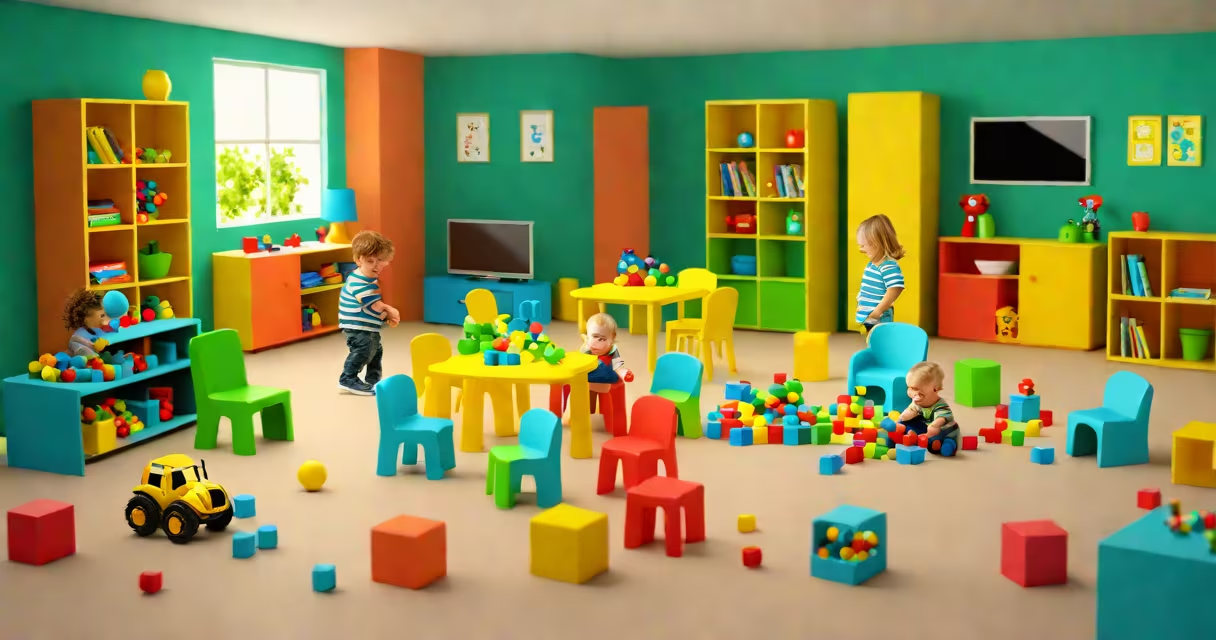
Preposition for preschool refers to simple words like "in," "on," "under," "beside," and "between" used to teach young children how objects relate to each other in space. These words form the basis of spatial reasoning and are introduced through play, movement, and visual cues.
Children learn prepositions by experiencing them physically. A child placing a toy car "under" the bed or stacking blocks "on" a table learns the meaning through action. This hands-on approach aligns with research from the National Association for the Education of Young Children (NAEYC), which states that preschoolers develop language best through sensory-rich, interactive experiences rather than rote memorization.
Prepositions are not just vocabulary-they are tools for understanding. When a child says "The ball is behind the couch," they're not just naming a location; they're demonstrating mental mapping of their environment. This skill supports later learning in math, reading comprehension, and problem-solving.
Prepositions describe position, direction, or time relative to something else. They connect nouns to other elements in a sentence. For example, "The book is on the shelf" uses "on" to show location. In preschool, these words are taught through repetition, gesture, and context.
Teachers often use songs, stories, and games to reinforce prepositions. The song "Where Is the Cat?" uses phrases like "The cat is in the box" and "The cat is under the bed." Children respond by pointing or moving to demonstrate understanding. This multimodal approach strengthens memory and retention.
A 2021 study published in *Early Childhood Research Quarterly* found that preschoolers exposed to rich prepositional language during storytime showed better spatial reasoning scores six months later compared to peers who heard fewer spatial terms. The difference wasn't in intelligence-it was in exposure.
Not all prepositions are equally easy for young learners. Some are more concrete and easier to visualize. The following list includes the most frequently used prepositions in preschool classrooms, grouped by clarity and developmental readiness.
| Preposition | Meaning | Example in a preschool context | Developmental ease (1-5) |
|---|---|---|---|
| on | above and touching | Place the red block on the blue one. | 5 |
| under | beneath, below | Find the toy hidden under the blanket. | 5 |
| in | contained within | Put the crayon in the pencil case. | 4 |
| behind | at the back of | Hide behind the curtain when the monster comes. | 4 |
| beside | next to, side by side | Stand beside me during circle time. | 3 |
| between | in the middle of two things | Place the bear between the two chairs. | 2 |
"Between" is typically harder because it requires understanding two reference points simultaneously. Children often confuse it with "in" or "beside." Teachers address this by using physical demonstrations-placing a toy between two chairs while saying, "This is not in the chair. It's not beside either. It's between."
Adults sometimes assume that children understand prepositions simply because they've heard them. But understanding is not the same as correct usage. A child may say "The dog is on the floor" when the dog is actually sitting on a rug. The error isn't in the word-it's in the spatial awareness.
Another common mistake is treating prepositions as interchangeable. For example, a child might say "I put the cup in the box" when they meant "on the box." This reflects a lack of precision in spatial thinking, not poor grammar. Correcting such errors with gentle clarification-"Yes, it's on top. That's different from being inside"-builds accuracy over time.
One non-obvious fact: Prepositions are among the earliest words children produce in multi-word sentences. According to the *MacArthur-Bates Communicative Development Inventories*, children begin using prepositions like "in" and "on" around 18 months, often before verbs like "go" or "eat." This shows that spatial language develops earlier than many realize.
Consider a morning activity at a public preschool in Portland, Oregon. The teacher asks children to place their stuffed animals in designated spots: "Put your bear on the pillow," "Place your rabbit under the chair," and "Set your duck beside the basket."
Afterward, the teacher walks around and asks, "Where is the green frog?" A child points to the shelf. The teacher confirms: "Yes, the frog is on the shelf. Good job!" She then adds, "Now, where is the red car?" Another child says, "In the box." The teacher checks: "Is it really in the box? Let's look." She opens the box-nothing. "Oh! It's on the box. Not in it."
This moment demonstrates how prepositions are learned-not through drills, but through guided exploration. The child corrected their own misunderstanding by comparing the actual placement to the word used. This kind of feedback is far more effective than correcting with "No, that's wrong."
I once observed a similar lesson in a Head Start program in Chicago. A child said, "My doll is behind the door." The teacher didn't correct her. Instead, she opened the door slightly and asked, "Can you see your doll?" The child looked and said, "No. So it's not behind." She then moved to the side and pointed: "It's here, on the floor." The teacher smiled and said, "Yes. Behind means not visible. Now you know."
Preposition for preschool is not a formal grammar lesson. It is not about identifying parts of speech or diagramming sentences. It is not about memorizing lists. It is not about perfect syntax.
It is about meaning-making through experience. A child doesn't need to know that "under" is a preposition to use it correctly. They only need to know what it feels like to be under something. This is why teachers avoid worksheets with blank lines for "fill in the preposition." Instead, they use tactile activities-hiding objects, building towers, sorting toys into bins labeled "in," "on," "under."
One common confusion: people think "as a preposition" means the word functions as a preposition in a sentence. But "as a preposition" is a grammatical label. In preschool, we don't label words-we use them. A child might say, "The bird is on the tree," without knowing the term "preposition." That's fine. The goal is communication, not terminology.
Preposition for preschool is not a single word. It is a set of tools for understanding space, movement, and relationship. It is a foundation for language, cognition, and social interaction. When taught through play, movement, and real-world context, it becomes intuitive, lasting, and deeply useful.