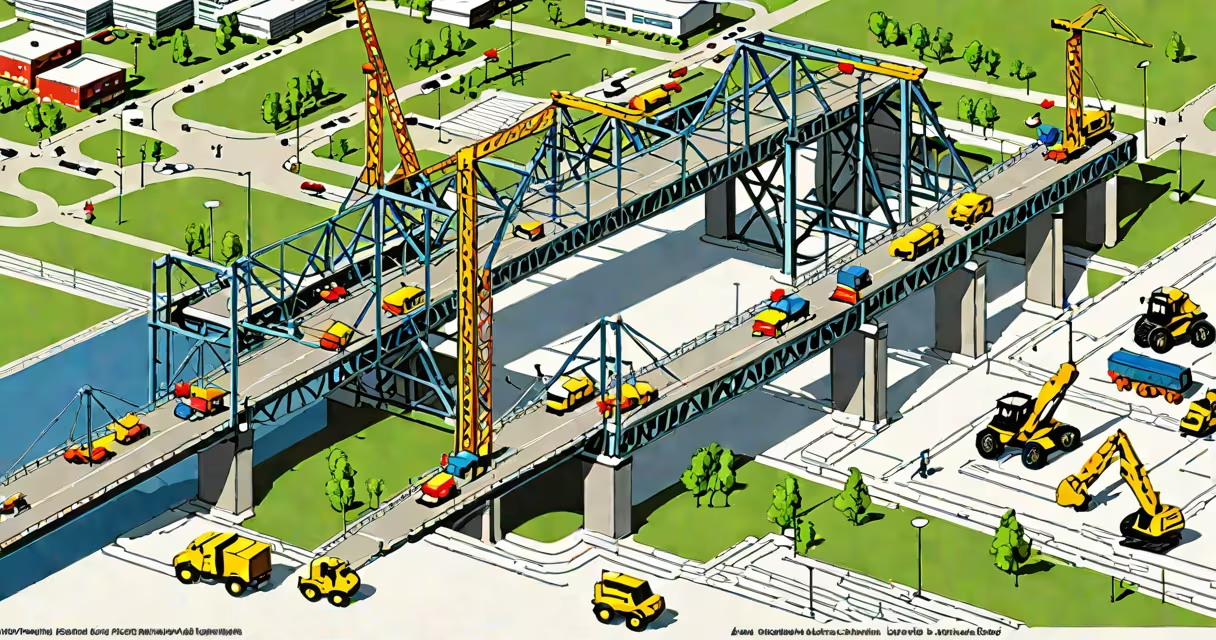
Public private partnerships (PPPs) are collaborative arrangements between government entities and private companies to finance, build, operate, and maintain public infrastructure projects such as highways, hospitals, and transit systems. These agreements transfer risk and responsibility from the public sector to the private sector while using private capital and expertise.
PPPs function through long-term contracts-typically 15 to 30 years-where the private partner designs, builds, and often operates the asset. In return, the government pays the private entity through user fees, availability payments, or a combination of both. This model shifts upfront capital costs from public budgets to private balance sheets, allowing governments to deliver services without immediate fiscal strain.
The U.S. Department of Transportation defines PPPs as "agreements between federal, state, or local governments and private sector organizations to deliver public infrastructure and services." The World Bank notes that PPPs have been used in over 120 countries since the 1990s, particularly in transportation and energy sectors. A 2021 OECD report confirmed that PPPs can improve project delivery speed by up to 25% compared to traditional procurement methods.
A typical PPP begins with a government identifying a public need-such as a deteriorating bridge or a growing urban transit gap. Instead of issuing bonds or raising taxes, the government issues a request for proposals (RFP) to private firms. These firms submit bids detailing their technical design, financial structure, timeline, and operations plan.
If selected, the private partner forms a special-purpose vehicle (SPV)-a legally separate company-to manage the project. The SPV raises debt and equity, signs performance contracts with the government, and assumes operational risk. Payments from the government are tied to performance metrics: for example, a toll road may receive payments based on traffic volume and road condition inspections.
When the contract ends, ownership typically transfers back to the public sector. Maintenance obligations remain with the private operator throughout the term. This ensures accountability and incentivizes long-term reliability. For example, the I-66 Express Lanes in Virginia, a PPP project completed in 2017, uses changing pricing and real-time monitoring to adjust congestion charges and maintain service levels.
PPPs vary by structure, risk allocation, and payment mechanism. The most common models include:
| Type | Payment Mechanism | Risk Allocation | Use Case Example |
|---|---|---|---|
| Design-Build-Finance-Operate (DBFO) | Government pays based on availability and performance | Private sector bears construction and operational risk | London's Crossrail project (2010-2022) |
| Tolling Model | User fees collected directly | Private sector bears revenue and demand risk | Indiana Toll Road lease (2006-2020) |
| Management Contract | Fixed fee paid by government | Public sector retains ownership and major risks | Los Angeles County Jail operations (2015-2023) |
Not all PPPs involve full privatization. Some, like the management contract model, keep assets publicly owned while outsourcing operations. Others, such as the DBFO model, transfer ownership and control during the contract period. The choice depends on political priorities, risk tolerance, and available private capital.
One widespread misunderstanding is that PPPs always save money. In reality, they can increase long-term costs due to higher interest rates on private debt and profit margins. A 2019 study by the National Bureau of Economic Research found that PPPs in U.S. highway projects cost 11% more over 20 years than traditional public procurement, primarily due to higher financing fees.
Another misconception is that private partners automatically deliver better results. While efficiency gains are possible, poor contract design leads to failures. The 2012 failure of the UK's PFI (Private Finance Initiative) school projects revealed that vague performance clauses and lack of oversight led to delayed openings and substandard facilities. The UK government later abandoned the model for most new projects.
Contrary to popular belief, PPPs do not eliminate public oversight. Governments retain regulatory authority and can terminate contracts for non-performance. In 2018, the city of Chicago canceled a $1.2 billion PPP deal to lease parking meters after audits showed inflated revenue projections and inadequate transparency.
In 2007, Miami-Dade County faced a critical need to reduce traffic congestion around the port. The county issued an RFP for a tunnel linking the port to the interstate system. After evaluating 14 bids, the county selected a consortium led by Fluor Corporation and Vinci Construction.
The project was structured as a DBFO PPP. The private consortium raised $420 million in private financing and built the 1.2-mile tunnel beneath downtown Miami. The government agreed to pay $12 million annually for 30 years, contingent on safety, traffic flow, and maintenance standards.
Construction began in 2012 and finished in 2014. The tunnel reduced average commute times by 37% and increased freight throughput by 22%. By 2022, the project had generated $1.8 billion in economic benefits, according to a Miami-Dade County audit. The success stemmed from clear performance benchmarks, independent monitoring, and regular public reporting.
This case shows that PPPs work when contracts are transparent, risks are properly allocated, and oversight is consistent. It also highlights that private investment doesn't replace public accountability-it complements it.
PPPs are most effective for large, complex, long-term projects requiring specialized engineering, ongoing maintenance, and stable revenue streams. They are frequently used in:
They are less suitable for short-term or highly localized projects. For example, building a single bus stop or repairing a minor road segment rarely justifies the legal and administrative overhead of a PPP.
Public private partnerships are not a substitute for public investment. They are a tool to stretch limited funds and improve delivery. As the Brookings Institution noted in 2020, "PPPs succeed when they align incentives, not when they obscure them."
Public private partnerships differ from standard government contracting. In traditional procurement, the government owns the asset, hires a contractor for a fixed price, and manages operations. In a PPP, the private partner assumes design, construction, financing, and often long-term operation responsibilities.
PPPs also differ from outright privatization. In privatization, the government sells an asset permanently to a private entity. In a PPP, the asset remains public property, and ownership transfers back at contract end. This preserves public control and allows for future reinvestment.
Public private partnerships are not inherently good or bad-they are tools shaped by design. When structured with clear performance metrics, competitive bidding, and strong governance, they can deliver high-quality infrastructure efficiently. When poorly designed, they risk cost overruns, corruption, and public distrust.
Understanding public private partnerships requires seeing beyond slogans like "private sector efficiency" or "public sector responsibility." The real test lies in contract terms, enforcement mechanisms, and transparency. As the Federal Highway Administration states, "The value of a PPP is not in its form-but in its outcomes."
Public private partnerships remain a important mechanism for delivering essential infrastructure in an era of constrained public budgets. Their success depends not on ideology, but on rigorous planning, fair risk sharing, and continuous evaluation.