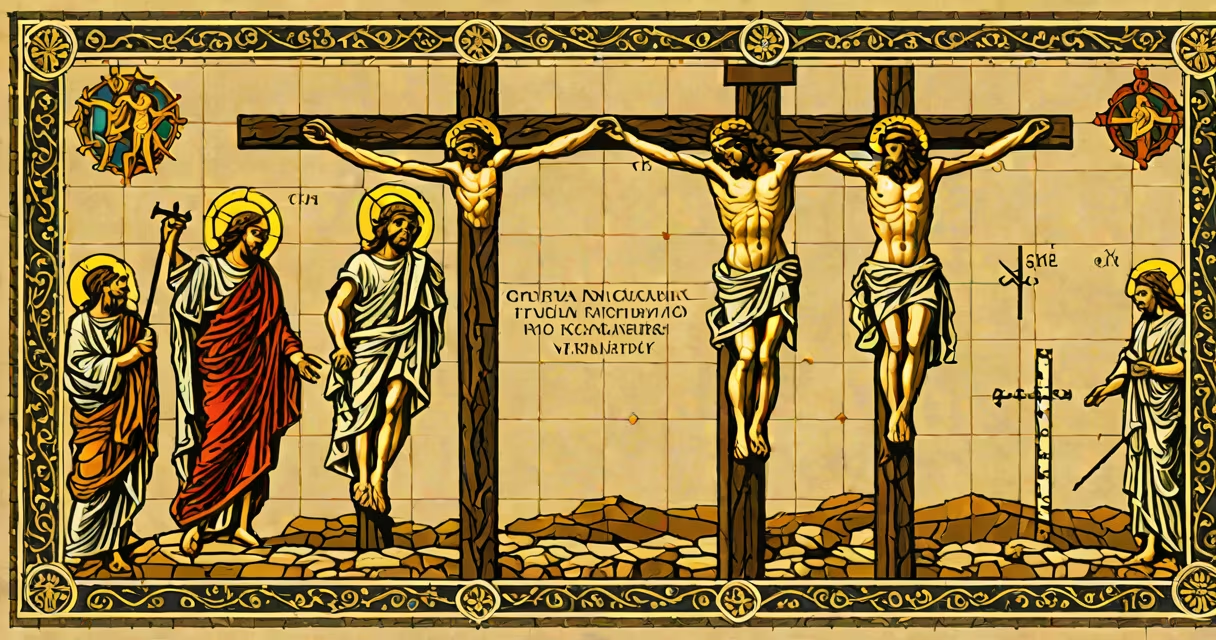
Romans 6:1-11 teaches that Christians have died to sin and risen to new life through union with Christ's death and resurrection, making ongoing sin incompatible with their identity in Him. This passage uses baptism as a symbolic act reflecting a deeper spiritual reality: believers are spiritually buried with Christ and raised to walk in newness of life.
The Apostle Paul writes this letter to the church in Rome around 57 CE, addressing theological confusion among Gentile and Jewish Christians. He confronts the idea that grace permits continued sinning, stating: "Shall we continue in sin that grace may abound?" His answer is emphatic: "By no means!" (Romans 6:2). Sin no longer holds dominion over those who have died with Christ.
Baptism serves as a visible sign of an invisible transformation. Paul says believers were "baptized into Christ Jesus" (Romans 6:3), meaning they participated in His death and burial. This is not ritual magic-it reflects a spiritual reality. Just as Christ was raised from the dead by the Father's glory, so too are believers raised to walk in newness of life (Romans 6:4).
Paul structures Romans 6:1-11 around a central contrast: death to sin and life in Christ. He begins with a rhetorical question to shut down a potential misunderstanding-some may think God's grace allows unrepentant sin. His immediate rejection of that notion establishes the urgency of the argument.
He then introduces the concept of being "united with Him in the likeness of His death" (Romans 6:5). The Greek word *synapxō* (συναπχώ) means "to be joined together." This union is not metaphorical-it is a spiritual bond established at conversion. Believers do not merely imitate Christ's death; they participate in it.
Paul's logic follows a pattern: Christ died to sin once and for all (Romans 6:10), so those united with Him must live as though they too have died to sin. Their old self was crucified with Christ so that the body of sin might be destroyed (Romans 6:6). This destruction is not physical but moral and spiritual-the power of sin over the believer is broken.
The passage rests on four core ideas: union with Christ, spiritual death to sin, resurrection to new life, and the authority of grace. These elements form a theological structure that shapes Christian ethics.
Union with Christ is the foundation. Without it, baptism lacks meaning. As theologian N.T. Wright notes, "The Christian life is not about becoming better people; it's about being transformed by participation in Christ's story." This union makes believers heirs of God's promises and participants in His victory over death.
Death to sin is not a suggestion-it is a fact. Paul doesn't say "you should die to sin," he says "you have died." The past tense indicates completed action. This is not a process to begin; it is a state already achieved. The believer's identity is now rooted in Christ's finished work, not personal effort.
Resurrection to new life follows logically. If Christ rose, believers will too-not just in the future, but in the present. They are called to "walk in newness of life" (Romans 6:4), which means living differently: avoiding habits that dishonor God, resisting temptation, and serving others.
Some interpret Romans 6:1-11 as advocating literal immersion as a requirement for salvation. That view misreads the text. Paul uses baptism symbolically, not literally. He assumes the Roman believers were already baptized, not that baptism saves them. Salvation comes through faith in Christ, not ritual performance.
A common mistake is treating this passage as a call to perfectionism. Some assume that because believers are "dead to sin," they must never sin again. But Paul acknowledges human weakness later in Romans: "I do not do the good I want, but the evil I do not want" (Romans 7:15). The passage calls for a changed orientation, not flawlessness.
Another error is separating Romans 6 from the rest of Paul's theology. This section connects directly to chapters 5 and 7. In chapter 5, Paul discusses justification by faith. In chapter 6, he shows how that justification changes behavior. Chapter 7 reveals the ongoing struggle with sin, yet chapter 8 restores hope: "There is therefore now no condemnation for those who are in Christ Jesus" (Romans 8:1).
Christians cite Romans 6:1-11 during baptisms, especially in Protestant and Catholic traditions. Pastors use it to explain the significance of immersion or pouring. The passage gives theological weight to the rite, showing it as a public declaration of inner transformation.
It also appears in sermons on sanctification-the process of growing in holiness. Preachers emphasize that believers are not just forgiven; they are renewed. The passage challenges complacency: if you've died with Christ, why return to old patterns?
In Bible study groups, Romans 6:1-11 often sparks discussion about identity. Members ask: "Who am I now?" The answer lies in Christ. A man I met at a church retreat in Nashville described his struggle with alcohol. After studying this passage, he said, "I stopped seeing myself as a sinner and started seeing myself as someone who died to that life." He hasn't relapsed in five years.
Consider a person who once lived in constant anger. After conversion, they still feel anger-but now they recognize it as a remnant of their old self. Romans 6:6 says the "body of sin" is destroyed. Not erased completely, but rendered powerless. The believer is no longer ruled by it.
Compare Romans 6:1-11 with Galatians 2:20: "I have been crucified with Christ. It is no longer I who live, but Christ who lives in me." Both passages affirm the same truth: the old self is gone, replaced by Christ's presence. But Romans 6 emphasizes collective identity ("we were baptized into Christ"), while Galatians focuses on personal transformation.
Here's a breakdown of key differences:
| Aspect | Romans 6:1-11 | Galatians 2:20 |
|---|---|---|
| Focus | Corporate identity in Christ | Personal union with Christ |
| Key verb | "Were buried" (past passive) | "Crucified" (past active) |
| Implied audience | Church community | Individual believer |
One non-obvious fact: Paul does not say "you must be baptized to be saved." He assumes baptism has already occurred. The sequence is: faith → baptism → new life. Baptism is the response, not the cause. This aligns with Acts 16:31-33, where the jailer believes and is baptized immediately.
Romans 6:1-11 is not a call to self-improvement. It is a declaration of divine transformation. You are not trying to become holy-you already are. Your old self is dead. Your new self is alive in Christ.
When tempted, remember: "Do you not know that all of us who have been baptized into Christ Jesus were baptized into His death?" (Romans 6:3). That truth is not for reflection-it is for daily application. Every time you choose obedience over indulgence, you live out this passage.