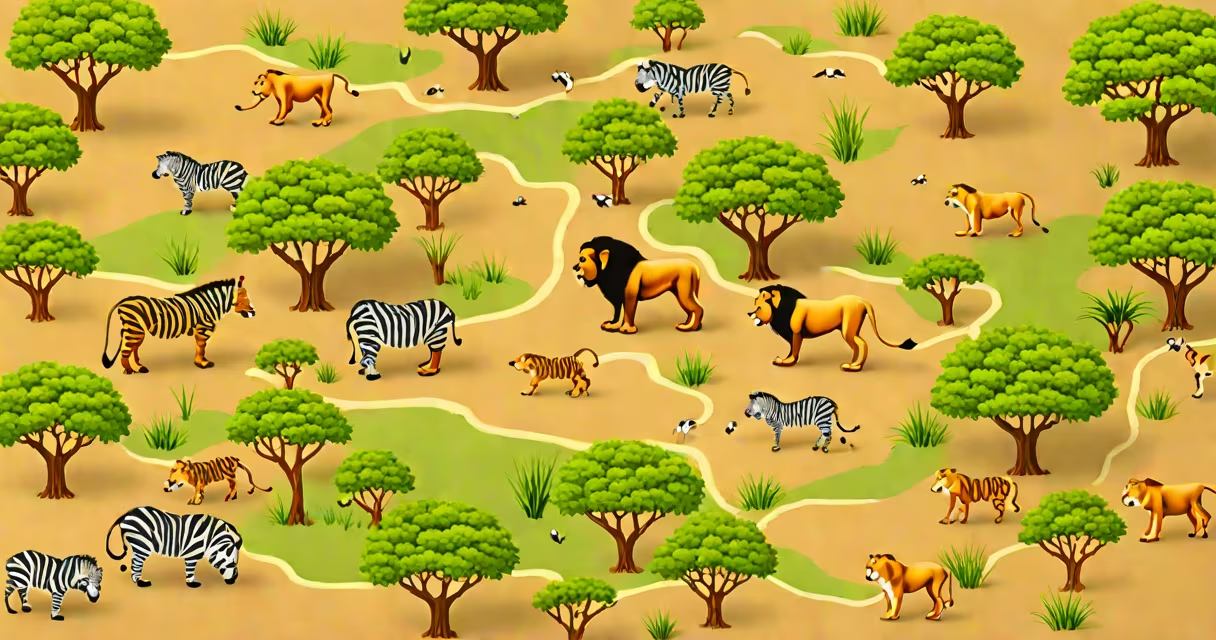
The savanna food web is a network of feeding relationships among organisms in tropical grasslands with scattered trees, where energy flows from producers like grasses to consumers including herbivores and apex predators. It reflects interdependence between species across multiple trophic levels.
Savannas span sub-Saharan Africa, parts of South America, and northern Australia. They support high biodiversity due to seasonal rainfall patterns. In these ecosystems, plants form the base of the food web, converting sunlight into energy via photosynthesis. Grasses dominate, but trees such as acacias provide shade and habitat. Herbivores like zebras, wildebeest, and elephants consume plant material. Carnivores such as lions, cheetahs, and hyenas feed on herbivores. Decomposers-including termites, fungi, and bacteria-break down dead matter, returning nutrients to soil.
Energy transfer between levels follows the 10% rule: only about 10% of energy from one level moves to the next. A zebra eating grass captures roughly 10% of the grass's stored energy. A lion eating that zebra retains only 10% of the zebra's energy. This limits the number of top predators in any system. For example, a single lion pride may require 600 km² of territory to sustain itself.
Each organism occupies a specific niche. Grasses grow rapidly during the rainy season, supporting large herds of grazers. These animals migrate seasonally to follow fresh growth. Their movement prevents overgrazing and maintains plant diversity. When herbivores die, scavengers like vultures and jackals consume soft tissue quickly. Termites then dismantle bones and wood, recycling carbon and nitrogen.
Fire plays a critical role. Natural and human-caused fires clear dead vegetation, reduce woody encroachment, and stimulate new grass growth. Fire-resistant species like certain grasses thrive after burns. Without fire, savannas gradually turn into forests. Research from the University of California, Berkeley shows that fire suppression leads to a 40% decline in grassland-dependent species within 15 years.
Human activity disrupts this balance. Overgrazing by livestock reduces plant cover, leading to soil erosion. Poaching targets apex predators, causing mesopredator release-hyenas and jackals increase when lions are removed. This cascades down to smaller mammals and birds. In Tanzania's Serengeti, lion population declines correlate with increased disease transmission in prey populations due to higher contact rates.
The savanna food web consists of four primary trophic levels:
| Trophic Level | Examples | Energy Source |
|---|---|---|
| Primary Producers | Grasses (e.g., *Panicum maximum*), acacia trees | Photosynthesis |
| Primary Consumers | Zebra, wildebeest, impala, elephants | Plant biomass |
| Secondary Consumers | Lion, cheetah, hyena | Herbivore flesh |
| Decomposers & Scavengers | Termites (*Macrotermes* spp.), dung beetles, fungi | Dead organic matter |
Termites are often overlooked but important. A single termite colony can process up to 10 kg of dry grass per year. They aerate soil and improve water infiltration. In Kenya's Maasai Mara, termite mounds serve as microhabitats for reptiles, birds, and small mammals. Studies show that 30% of bird species nest exclusively on or near termite mounds.
Some species occupy multiple roles. The spotted hyena is both predator and scavenger. It kills prey but also feeds on carcasses left by lions. Its useful jaw can crush bone, releasing calcium and phosphorus back into the cycle. This dual function makes it a keystone species in many savannas.
Many assume that savannas are barren or desert-like. In reality, they host dense herbivore populations. The Serengeti supports over 1 million wildebeest and 200,000 zebra annually. These migrations are driven by rainfall patterns, not random movement. GPS tracking data from the Smithsonian Conservation Biology Institute confirms that herds move within 10 km of water sources during dry months.
Another myth is that lions eat only live prey. While they hunt, they scavenge up to 50% of their meals. A study published in *Animal Behaviour* found that lions take advantage of kills made by hyenas or leopards. This behavior increases survival rates during lean periods.
People often confuse savannas with deserts. Savannas receive 500-1,500 mm of rain yearly-enough for grasses and trees. Deserts average less than 250 mm. The Kalahari Desert, often called a savanna, actually straddles both categories. Northern regions are savanna; southern areas are arid shrublands.
Consider a wildebeest calf born in the Serengeti during the wet season. It eats grasses rich in cellulose. Its gut contains symbiotic bacteria that break down fiber. After six months, it joins a migrating herd of 100,000 animals. Predators track the group using scent and sound. A lioness hunts the weakest individual-likely a sick or young animal.
After the kill, hyenas arrive within minutes. They consume internal organs and hide the rest under soil. Vultures circle overhead, waiting for scraps. Within days, the remains are reduced to bones. Termites colonize the remains, consuming collagen and keratin. Nutrients return to the soil in 6-8 weeks.
Meanwhile, the lioness raises her cubs on meat. She loses 20% of her body weight during lactation. Her cubs learn hunting skills by observing and practicing on small prey. By age two, they disperse to find territories. One may survive to breed; another may fall to disease or conflict.
This cycle repeats annually. Over 10 years, a single lioness may produce five litters, contributing to genetic diversity. Her descendants may influence local prey behavior, shaping migration routes and grazing patterns. The entire system depends on feedback loops between species, climate, and disturbance.
Understanding the savanna food web reveals how fragile balance is. Even small changes-like removing one predator species-can alter population dynamics across multiple levels. Monitoring these interactions helps conservationists restore degraded lands. For instance, reintroducing lions to protected areas in South Africa has led to a 35% recovery in native herbivore populations over ten years, according to the World Wildlife Fund.