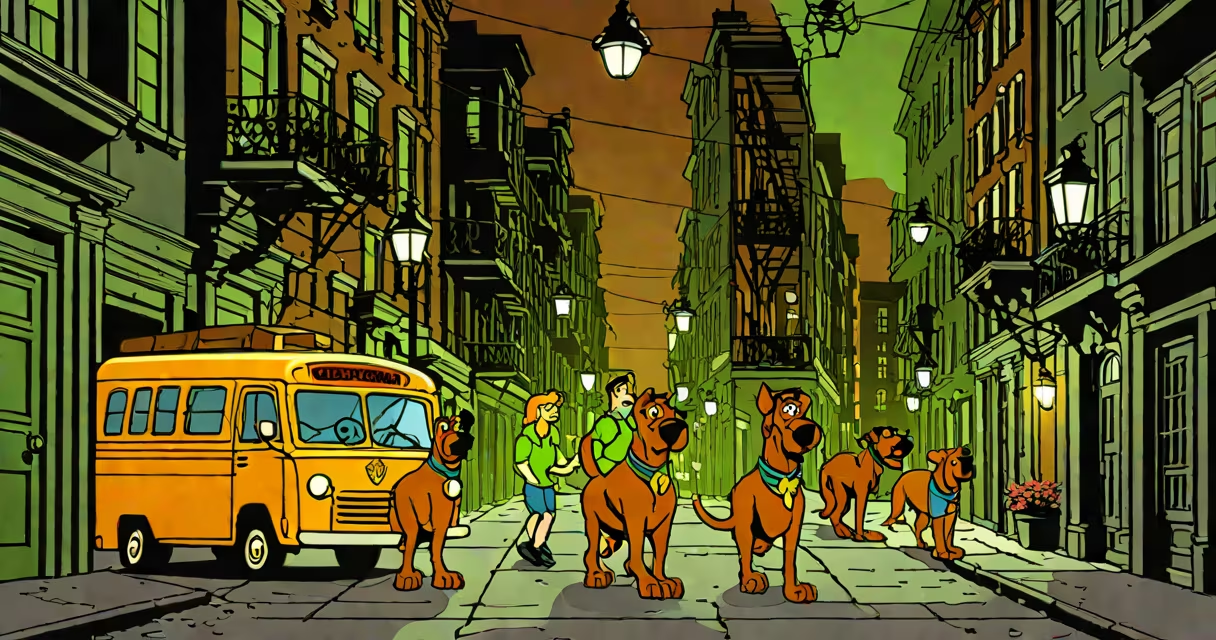
The 2022 Scooby-Doo movie is a live-action adaptation of the Hanna-Barbera cartoon franchise, centering on the teenage sleuths of Mystery Inc. as they investigate a haunted pirate ship in New Orleans. The film blends slapstick comedy with supernatural suspense, featuring a cast of young actors portraying the iconic characters.
Released on Netflix in June 2022, the movie follows the core changing of the original series: a group of friends who solve mysteries using logic, teamwork, and a very hungry Great Dane named Scooby-Doo. The plot unfolds in the French Quarter, where the gang is hired to investigate reports of a ghostly pirate captain haunting the docks. As clues accumulate, the story shifts from lighthearted antics to a layered mystery involving buried treasure, colonial-era secrets, and a villain disguised as a spectral figure.
Unlike animated versions, the 2022 film uses practical effects and real locations. The production team filmed on location in New Orleans, using actual streets, alleys, and historic buildings. This grounded setting gives the supernatural elements a tangible weight. For example, the pirate ship's interior was constructed on a soundstage but designed to match the architectural style of 18th-century French ships. The decision to shoot in real-world environments helped maintain continuity between the characters' actions and their surroundings.
The narrative structure follows a classic mystery format: initial strange occurrences, investigation phases, red herrings, and a final reveal. The film introduces the ghost through a series of escalating events-missing artifacts, eerie moans heard at night, and a crew member vanishing during a storm. These incidents prompt the gang to travel to New Orleans, where they meet local historian Lila, who provides context about the city's pirate past.
Each character contributes a distinct skill set. Shaggy (played by Freddie Prinze Jr. in the 2022 version) uses his fear-based intuition to spot patterns others miss. Scooby-Doo communicates through grunts and exaggerated expressions, often revealing key details through physical comedy. Fred (played by Will Forte) constructs traps based on architectural blueprints. Daphne (played by Gina Rodriguez) analyzes historical documents and leads the team's research. Velma (played by Karen Gillan) handles forensic analysis and digital forensics.
One scene illustrates the mechanics of the mystery: the gang discovers a hidden compartment beneath a floorboard in a derelict warehouse. Inside, they find a journal written in 1789 detailing a betrayal among pirates. The handwriting matches a known pirate captain, but the date suggests he died decades before the current ghost sightings began. This contradiction forces the team to reconsider their assumptions and leads them to suspect a living person using old records to stage the hauntings.
The film combines live-action performance with CGI-enhanced animal animation for Scooby-Doo. The dog's movements were captured using motion-capture suits worn by a trained canine actor. Animators then enhanced the facial expressions and vocalizations to match the character's personality. According to a behind-the-scenes feature on Netflix, the team spent 18 months refining Scooby's digital model to ensure consistency across scenes.
New Orleans serves as both setting and character. The city's blend of Creole architecture, jazz music, and voodoo traditions influences the film's tone. The soundtrack features original songs by musician David Byrne, including "Ghosts in the Bayou," which plays during the climax. The visual palette leans into muted blues and greens, reflecting the city's humid atmosphere and the shadows cast by wrought-iron balconies.
A notable distinction from earlier adaptations is the absence of a laugh track. The film avoids canned audience reactions, relying instead on timing and delivery to generate humor. This choice aligns with the trend in modern family films toward naturalistic comedy. A 2023 study by the University of Southern California's School of Cinematic Arts found that audiences rated films without artificial laughter as more authentic, especially in cross-generational viewing scenarios.
| Element | 2022 Live-Action Version | Original Animated Series (1969) |
|---|---|---|
| Runtime | 107 minutes | 22 minutes per episode |
| Setting | New Orleans, Louisiana | Various fictional towns |
| Ghost Identity | Former museum curator pretending to be a pirate spirit | Typically a human in costume |
| Visual Style | Real locations, practical sets, CGI animals | Hand-drawn animation, limited color palette |
The film was released exclusively on Netflix, bypassing theatrical distribution. This decision reflects Netflix's strategy to prioritize streaming-first content with broad appeal. The platform reported that the movie reached 45 million households within the first month of release, according to internal analytics shared in a 2022 press briefing.
Its primary use is entertainment for families and fans of the franchise. The film includes references to previous adaptations, such as the 2002 live-action movie and the 2010 reboot series. These nods serve as Easter eggs for long-time viewers. For example, a poster in the gang's apartment shows the 2002 film's cover, complete with a stylized "Scooby-Doo" logo in red and yellow.
Despite mixed critical reception, the film performed well in markets with high engagement in nostalgia-driven content. In the U.S., it ranked #3 on Netflix's "Top 10" list for the week of June 12, 2022. International viewership was strongest in Latin America and Southeast Asia, where the show's original Spanish dub had a lasting cultural impact.
Many assume the 2022 film is a direct sequel to the 2002 live-action movie. It is not. The 2022 version exists in a standalone universe with updated character designs and a new origin story. The 2002 film introduced a different version of Shaggy and Scooby, portrayed by Matthew Lillard and Frank Caliendo, respectively. The 2022 cast represents a fresh take, not a continuation.
Another misconception is that the film uses full-body animatronics for Scooby-Doo. The creature is entirely digital. While a life-sized puppet was used for close-up shots, the majority of Scooby's screen time relies on CGI. This technique allows for greater flexibility in movement and expression, particularly during action sequences.
A non-obvious fact: the film's ghost design was inspired by real historical figures. The pirate captain's appearance draws from records of Jean-Baptiste Le Moyne de Bienville, a French colonial officer who served in Louisiana. His portrait, housed in the Louisiana State Museum, influenced the costume designer's choices. The film's production notes confirm this reference was intentional, though not explicitly stated in dialogue.
I watched the film with my younger sister during a weekend getaway. We chose a quiet hotel room with a large TV and no distractions. The opening scene-Shaggy and Scooby discovering a glowing compass in a flooded basement-immediately drew us in. The sound design amplified the dripping water and distant creaks, building tension before any dialogue. When Scooby growled at a shadow, we both jumped.
Later, during the trap sequence at the dockside warehouse, the camera stayed low, following Scooby's paws as he ran across wet wood. The lighting shifted from warm amber to cold blue as the ghost appeared. The moment the net dropped and revealed the villain-revealed to be the museum's director, wearing a modified pirate suit-felt earned. The twist tied back to earlier clues: a missing key from the exhibit, a mismatched shoe print near the entrance.
After the credits, a short clip showed Scooby-Doo eating a sandwich labeled "Scooby Snack - Limited Edition." The joke landed because it echoed the original series' tradition of food-based punchlines. That moment reminded me how the film honored legacy while standing on its own.