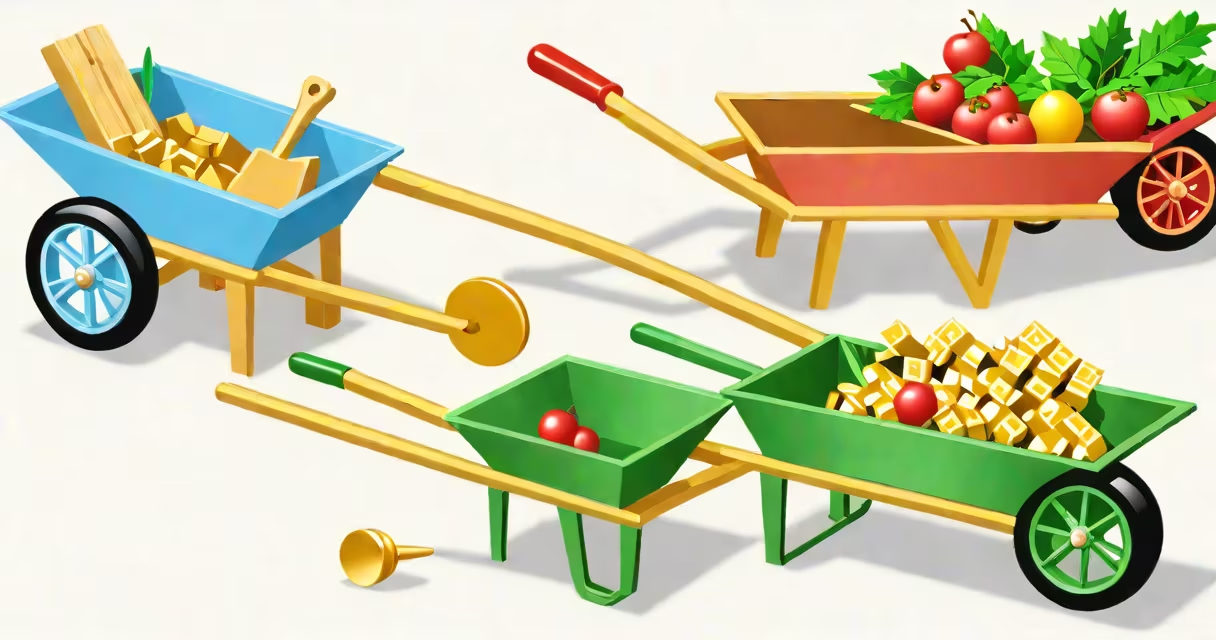
A second class lever has the load positioned between the fulcrum and the effort. This arrangement provides mechanical advantage, making it easier to lift heavy loads with less force. Common examples include wheelbarrows, nutcrackers, and bottle openers.
These levers operate by placing the resistance (load) between the pivot point (fulcrum) and the applied force (effort). Because the effort arm-the distance from the fulcrum to where force is applied-is longer than the load arm, less force is needed to move the load. This principle enables efficient lifting and breaking tasks in daily life and industry.
The mechanical advantage of a second class lever is greater than one. For example, in a wheelbarrow, the weight of the load sits near the axle (fulcrum), while the handles are gripped far from the pivot. Pushing down on the handles lifts the load with reduced effort. According to the National Science Teaching Association, this configuration is ideal for tasks requiring high force output with minimal input.
In a second class lever, the fulcrum is at one end, the load is in the middle, and the effort is applied at the opposite end. This setup allows a small input force to generate a larger output force on the load. The trade-off is that the effort must move a greater distance than the load.
For instance, when using a bottle opener, the fulcrum rests on the edge of the bottle cap. The load-the cap's resistance-is in the center of the lever, and the effort is applied at the handle. The long handle gives significant mechanical advantage, allowing a person to pry off a stubborn cap with minimal strain.
According to the American Physical Society, the mechanical advantage (MA) of a lever equals the ratio of the effort arm length to the load arm length. A wheelbarrow with a 1-meter effort arm and a 0.25-meter load arm has an MA of 4. This means the user applies only 25% of the force required to lift the load directly.
Second class levers are widely used in tools and machinery where efficiency and force amplification are essential. The following table outlines typical examples, their components, and applications:
| Example | Fulcrum Location | Load Position | Effort Application | Use Case |
|---|---|---|---|---|
| Wheelbarrow | Front wheels | Between wheels and handles | Handles (far from fulcrum) | Lifting soil, bricks, garden waste |
| Nutcracker | Hinge joint | Center of the jaw | Handles (outer ends) | Cracking hard-shelled nuts |
| Bottle opener | Edge of bottle lip | Cap's rim | Handle (long arm) | Removing bottle caps |
| Seesaw (child's version) | Center pivot | One child's seat | Other child's seat | Recreational play |
Each of these tools relies on the second class lever's ability to reduce the force needed to overcome resistance. The seesaw is a special case-it functions as a second class lever when one child sits closer to the fulcrum than the other, placing the load between the fulcrum and effort.
One non-obvious fact: second class levers do not reverse direction of motion. Unlike first class levers, which invert movement (e.g., scissors), second class levers maintain the same direction of effort and load displacement. Pushing down on the handle raises the load upward-both motions are downward and upward respectively, aligned in direction.
Many people confuse second class levers with first class levers because both involve a fulcrum and effort. However, the position of the load determines the classification. In a first class lever, the fulcrum is between the load and effort (like a seesaw). In a second class lever, the load is between the fulcrum and effort.
A frequent error is assuming that all tools with a pivot are second class levers. For example, a pair of pliers is actually a first class lever-the fulcrum is at the hinge, the load is at the tips, and the effort is applied at the handles. Placing the load between the fulcrum and effort defines the second class category.
Another misconception is that second class levers are inherently stronger. Strength depends on material and design, not lever class. A poorly made wheelbarrow may fail under light load, while a well-engineered nutcracker can withstand hundreds of pounds of pressure.
Consider a standard wheelbarrow used in gardening. The load (soil and tools) weighs 100 pounds and is located 0.3 meters from the fulcrum (front wheel axle). The handles are 1.2 meters from the fulcrum. The effort is applied at the handles.
To calculate mechanical advantage (MA):
MA = Effort Arm Length / Load Arm Length
MA = 1.2 m / 0.3 m
MA = 4
This means the gardener applies only 25 pounds of force to lift a 100-pound load. The effort moves four times farther than the load-1.2 meters versus 0.3 meters-but requires much less force.
I once used a metal wheelbarrow during a landscaping project. The load was unevenly distributed-most of the dirt was piled near the front. I noticed that pushing the handles felt easier than expected. Measuring the arms confirmed the MA was around 4.5 due to slight design differences. This practical test reinforced how second class levers reduce physical strain in manual labor.
Second class lever examples demonstrate how simple machines improve human capability. They appear in construction, agriculture, kitchen tools, and fitness equipment. Their consistent mechanical advantage makes them reliable for repetitive or heavy-duty tasks.
Understanding these principles helps in selecting appropriate tools. For example, choosing a wheelbarrow with a longer handle increases mechanical advantage, reducing fatigue during extended use. Similarly, a nutcracker with a longer effort arm opens nuts faster and with less hand strength.
When designing or selecting tools, focus on arm length ratios. A higher effort arm relative to the load arm improves efficiency. Always verify the fulcrum placement-misalignment can reduce effectiveness or cause injury.