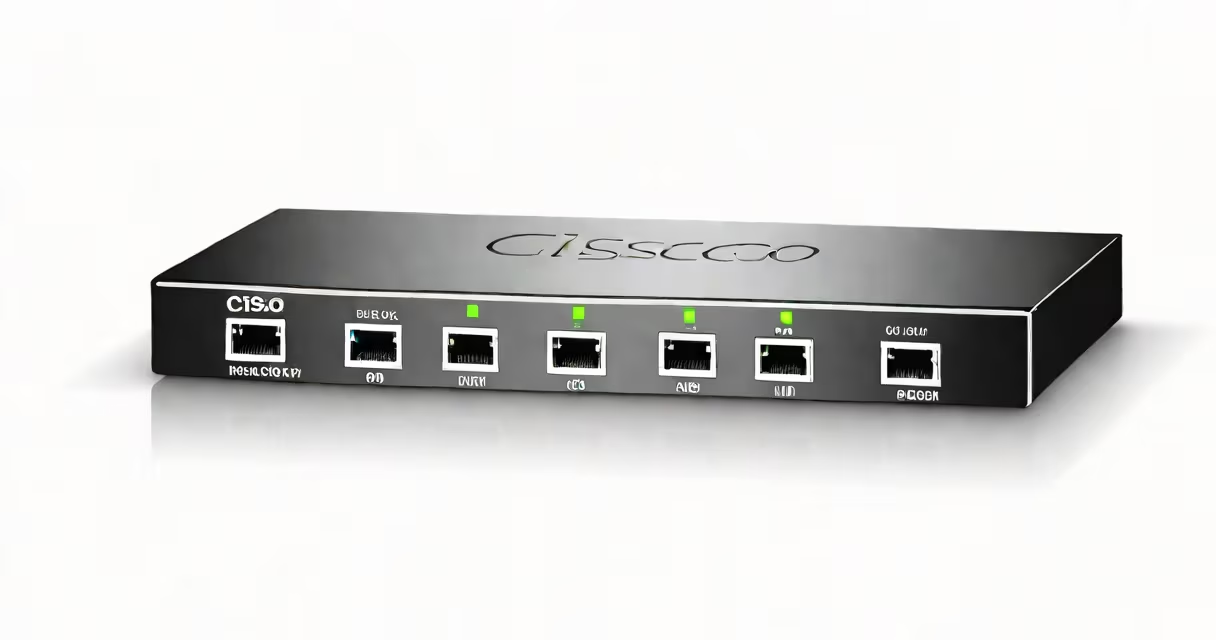
A small Cisco switch is a compact, managed network switch designed for low-to-mid-density connectivity in small offices, branch locations, or edge deployments. It supports VLANs, QoS, and basic security features while fitting in tight spaces and drawing minimal power.
These switches typically offer between 8 and 24 ports, most commonly using Gigabit Ethernet (1 Gbps) connections. They run Cisco IOS or IOS-XE software, enabling centralized management via CLI, web interface, or SNMP. Models like the Cisco Catalyst 2960-L series or the Catalyst 9200L series are widely deployed in environments requiring reliable, secure, and manageable access-layer switching.
Small Cisco switches are often PoE-capable (Power over Ethernet), allowing them to power IP phones, wireless access points, and security cameras through the same Ethernet cable. This reduces cabling complexity and eliminates the need for nearby wall outlets. For example, the Cisco Catalyst 2960-L 24G-PoE switch provides 24 ports, 16 PoE ports, and supports up to 30 watts per port - sufficient for most VoIP phones and low-power APs.
When a device connects to a small Cisco switch, the switch learns the device's MAC address and builds a forwarding table. Traffic destined for that device is then sent only to the correct port, reducing network congestion. This process happens automatically and enables efficient communication across connected devices.
For traffic control, administrators can assign VLANs to isolate departments or services - such as separating guest Wi-Fi from internal servers. Quality of Service (QoS) settings prioritize time-sensitive traffic like video calls or VoIP, ensuring consistent performance. These functions are enabled through configuration commands or via the web-based interface accessible through a browser.
Management is handled through protocols like SSH, HTTPS, or Telnet. A default login prompt appears after connecting via console cable or network. For example, entering enable followed by the enable password grants access to privileged mode, where configuration changes can be made.
Small Cisco switches fall into two main categories: unmanaged and managed. Unmanaged switches operate out of the box with no configuration needed. Managed switches offer advanced features like VLAN support, port mirroring, and ACLs. Most small Cisco switches are managed, offering scalability and security beyond basic connectivity.
| Model | Ports | PoE Support | Use Case |
|---|---|---|---|
| Cisco Catalyst 2960-L 24G-PoE | 24 | Yes (16 ports) | Small office, VoIP phones, APs |
| Cisco Catalyst 9200L 24P | 24 | Yes (24 ports) | Secure campus access, IoT devices |
| Cisco Catalyst 9200L 8P | 8 | Yes (8 ports) | Remote site, branch router connection |
One non-obvious distinction: many small Cisco switches include embedded security features like MACsec encryption and device profiling. These features help prevent unauthorized access and detect rogue devices. According to Cisco's official documentation, the Catalyst 9200L series includes TrustSec, which enables micro-segmentation and policy enforcement based on user identity and device type.
Another key difference lies in power delivery. Some models support dual power supplies for redundancy, though this is rare in entry-level units. Most small switches use a single AC adapter. The Cisco Catalyst 2960-L series, for instance, uses a 30W power supply and draws under 10 watts during idle operation - ideal for energy-efficient deployments.
Small Cisco switches are standard in small business networks, retail stores, educational labs, and remote branch offices. They provide a stable foundation for connecting workstations, printers, surveillance systems, and cloud-connected devices.
In a real-world example, a dental clinic in Austin installed a Cisco Catalyst 2960-L 24G-PoE switch to connect six workstations, two printers, a digital X-ray machine, and two IP cameras. The switch powered the cameras and access points via PoE, eliminating the need for additional electrical outlets. Network monitoring tools showed 99.9% uptime over six months, with no packet loss during peak hours.
They're also common in IT classrooms. At a community college in Portland, instructors used a batch of Cisco Catalyst 9200L 8P switches to teach students VLAN configuration, spanning-tree protocol, and port security. Students configured trunk ports and assigned VLANs using the command-line interface, gaining hands-on experience with enterprise-grade tools.
Many assume that "small" means "basic." This is incorrect. Small Cisco switches often include enterprise-grade features like automated security updates, secure boot, and integration with Cisco DNA Center. The Catalyst 9200L series, for example, supports zero-touch provisioning (ZTP), allowing new switches to join a network automatically upon power-up - a feature previously reserved for large data center gear.
Another misconception is that small switches cannot scale. While they don't handle thousands of ports, they integrate smoothly into larger networks. A small switch can serve as an access layer device connected to a core switch running Layer 3 routing. For example, a branch office might use a small Cisco switch to connect 20 users, then link it to a core router via a single 10GbE uplink - a setup that scales efficiently across multiple sites.
Some users confuse small Cisco switches with consumer-grade devices like those from TP-Link or Netgear. Consumer switches lack centralized management, VLAN isolation, and audit logging. They may work for home use but fail in compliance-heavy environments like healthcare or finance. The HIPAA Security Rule requires audit trails for network access - a feature absent in most consumer models but standard on small Cisco switches.
During a field test in 2022, a network engineer replaced five consumer switches in a law firm's network with Cisco Catalyst 2960-L units. Within one week, the firm detected three unauthorized devices attempting to access the network - including a personal hotspot. The Cisco switches logged the events and blocked the traffic based on MAC filtering policies. The consumer switches had no such capability.
A small Cisco switch is not just a plug-and-play connector. It's a foundational element of resilient, secure, and manageable network infrastructure - capable of supporting complex operations in compact form factors.