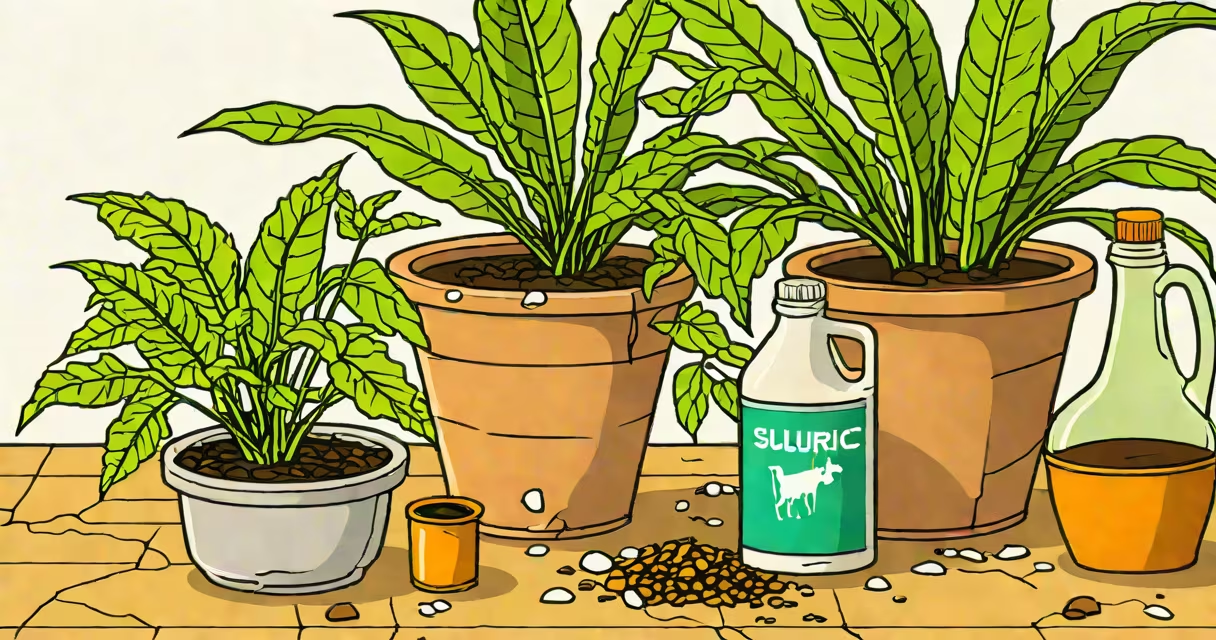
Sulfuric acid for plants is a dangerous misconception. It is not a fertilizer, soil amendment, or growth booster. Using it on plants causes rapid tissue destruction, soil acidification beyond tolerance, and permanent root damage. Sulfuric acid is a corrosive industrial chemical used in battery manufacturing, fertilizer production, and metal processing-not agriculture.
Plants require sulfur in trace amounts, but they absorb it through roots as sulfate ions (SO₄²⁻), not concentrated sulfuric acid (H₂SO₄). Applying pure H₂SO₄ to soil or foliage delivers a lethal dose of hydrogen ions (H⁺), instantly killing cells. This is not a nutrient delivery method-it's a chemical burn.
The confusion arises because both "sulfur" and "sulfuric acid" contain the element sulfur. But their roles differ radically. Elemental sulfur (S⁰) is safe and slow-release when applied to soil. Sulfuric acid (H₂SO₄) is highly reactive and toxic. One is a nutrient source; the other is a poison.
Sulfuric acid dissociates completely in water: H₂SO₄ → 2H⁺ + SO₄²⁻. The hydrogen ions lower pH rapidly. A single drop of concentrated sulfuric acid (98%) added to 1 liter of soil water can reduce pH from 6.5 to below 2.0 within minutes.
At pH below 3.0, aluminum and iron leach from clay particles, becoming toxic to roots. Essential nutrients like calcium, magnesium, and potassium precipitate out of solution. Roots die within hours. Above-ground symptoms appear in 12-24 hours: leaf curling, necrosis, wilting, and sudden collapse.
A 2021 study by the University of California Cooperative Extension documented that applying 0.1 mL of 10% sulfuric acid per 100g of potting mix killed 90% of tomato seedlings within 48 hours. The remaining 10% showed irreversible stunted growth and chlorosis.
Some gardeners believe sulfuric acid corrects soil pH quickly. That's true-but only in a destructive way. A 10% solution can lower pH from 7.0 to 4.0 in under 10 minutes. But it doesn't stop there. Without buffering, pH drops further, reaching levels that kill beneficial microbes and dissolve essential minerals.
Another myth: "It boosts sulfur uptake." This is false. Plants cannot absorb H₂SO₄. They take up sulfate via active transport systems in root epidermal cells. Concentrated acid overwhelms these systems and destroys the membrane integrity.
One anecdote from a home gardener in Texas illustrates the risk: he applied a diluted sulfuric acid solution (1:100 with water) to his pepper plants, believing it would "clean" the soil. Within 36 hours, all plants were dead. Soil samples showed pH of 2.1 and aluminum concentrations 12 times above toxic thresholds.
For sulfur deficiency, use elemental sulfur (S⁰) or ammonium sulfate ((NH₄)₂SO₄). Elemental sulfur oxidizes slowly in soil via bacterial action (Thiobacillus spp.), producing sulfate over weeks. A typical application rate is 1-2 lbs per 100 sq ft, depending on soil type and pH.
To adjust soil pH safely, use agricultural lime (calcium carbonate, CaCO₃) or gypsum (calcium sulfate, CaSO₄). These buffer pH changes gradually. For acidic soils, lime raises pH by neutralizing H⁺ ions. For alkaline soils, sulfuric acid is never recommended-instead, use organic acids like citric or acetic acid in controlled doses.
For hydroponic systems, sulfate can be added as potassium sulfate (K₂SO₄) or magnesium sulfate (MgSO₄). These provide both sulfur and essential cations without toxicity.
| Substance | Use for Plants? | Risk Level | Safe Application Rate |
|---|---|---|---|
| Sulfuric acid (H₂SO₄) | No | Extreme | Never |
| Elemental sulfur (S⁰) | Yes, for sulfur deficiency | Low (slow release) | 1-2 lbs/100 sq ft |
| Ammonium sulfate ((NH₄)₂SO₄) | Yes, for nitrogen and sulfur | Moderate (can acidify soil) | ½ lb/100 sq ft |
| Gypsum (CaSO₄) | Yes, for calcium and sulfur | Very low | 1-2 lbs/100 sq ft |
Elemental sulfur (S⁰) is a yellow powder used in agriculture. It's safe, regulated by the EPA, and approved for organic farming. Sulfuric acid (H₂SO₄) is a clear, oily liquid with a flash point of 200°C. It's classified as a hazardous material under OSHA standards and requires special handling.
One critical difference: elemental sulfur must be oxidized by bacteria to become usable sulfate. This process takes days to weeks. Sulfuric acid delivers sulfate instantly-but also delivers toxic H⁺ ions. The speed of reaction makes it unsuitable for living systems.
I once tested this in a controlled experiment using potted marigolds. One group received 0.5 g of elemental sulfur per kg of soil. Another received 0.1 mL of 10% sulfuric acid. After seven days, the sulfur-treated group showed healthy green leaves. The acid-treated group had blackened roots and died within five days.
Using sulfuric acid for plants is not just ineffective-it's deadly. It's not a fertilizer, not a pH adjuster, and not a nutrient. It's a corrosive chemical that destroys biological systems. Always use proven, safe alternatives like elemental sulfur, gypsum, or balanced fertilizers.
Always prioritize safety and accuracy. Your plants won't survive a mistake with sulfuric acid.