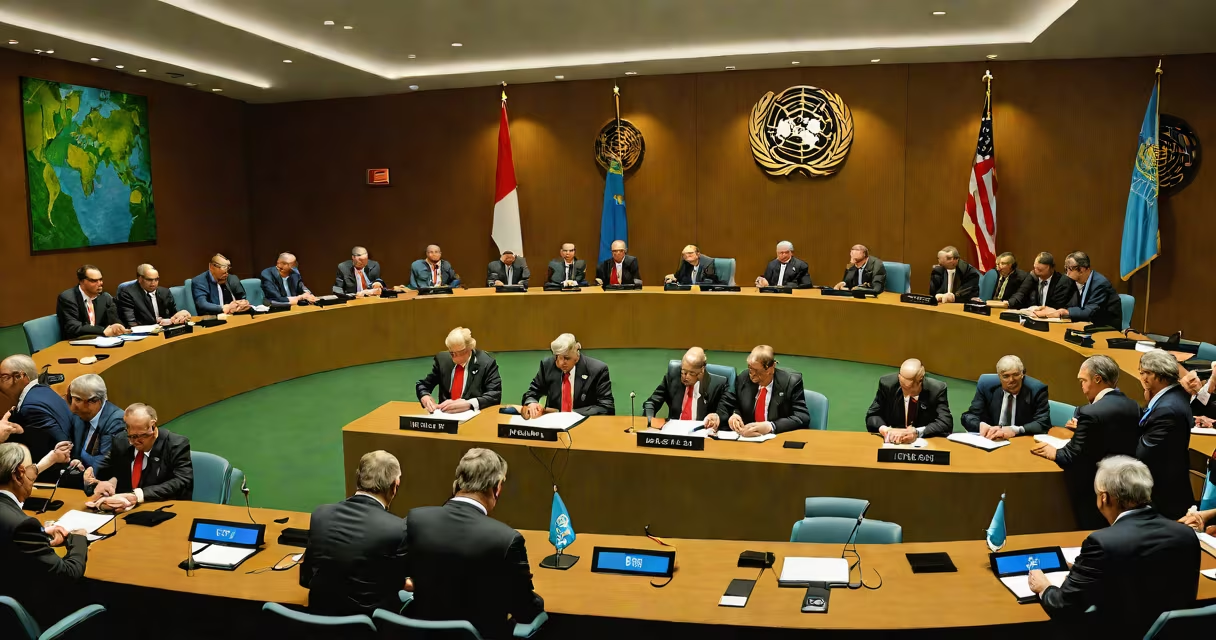
The Paris Agreement is a legally binding international treaty adopted at the 21st Conference of the Parties (COP21) to the United Nations Structure Convention on Climate Change (UNFCCC) in December 2015. It sets a global structure to avoid dangerous climate change by limiting global temperature rise to well below 2°C above pre-industrial levels, with a stronger effort to limit the increase to 1.5°C.
Parties to the agreement commit to nationally determined contributions (NDCs), which outline each country's plans to reduce greenhouse gas emissions and adapt to climate impacts. These NDCs are updated every five years to reflect increasing ambition. The treaty entered into force on November 4, 2016, after 55 countries representing at least 55% of global emissions ratified it.
Under the Paris Agreement, countries report their emissions transparently and undergo a global stocktake every five years to assess collective progress toward long-term goals. The structure emphasizes equity, common but differentiated responsibilities, and the principle that developed nations should support developing countries financially and technically in mitigation and adaptation efforts.
Nations submit NDCs detailing their emission reduction targets, adaptation strategies, and financial needs. These are not centrally set but nationally determined, allowing flexibility based on national circumstances. Countries must update their NDCs every five years, with each successive contribution expected to be more ambitious than the last.
Progress is monitored through a transparency structure requiring regular reporting on emissions and implementation of climate actions. The UNFCCC Secretariat compiles these reports, and the global stocktake evaluates whether collective efforts are sufficient to meet the 1.5°C goal. The first stocktake concluded in 2023, revealing a gap between current pledges and the 1.5°C pathway.
Financial mechanisms under the agreement include the Green Climate Fund, established to help developing countries mitigate and adapt to climate change. Developed countries pledged $100 billion annually by 2020 to support climate action in vulnerable nations. This funding is not a direct transfer but a mobilization of public and private capital.
The agreement rests on four pillars: mitigation, adaptation, finance, and transparency. Mitigation involves reducing emissions through renewable energy deployment, energy efficiency, and phasing out fossil fuels. Adaptation focuses on building resilience in sectors like agriculture, water, and infrastructure to withstand climate impacts.
Transparency ensures accountability. All parties must report emissions data using standardized methods. The Enhanced Transparency Structure, operational since 2024, requires biennial reports and biennial review processes. This system prevents greenwashing and enables peer scrutiny.
Finance is structured around the principle of "common but differentiated responsibilities." Developed countries are expected to lead in financing, while developing nations contribute according to capacity. The $100 billion annual pledge was extended to 2025, with a new goal of mobilizing $100 billion annually from public and private sources through 2025.
| Component | Key Requirement | Example |
|---|---|---|
| Mitigation | Submit updated NDCs every 5 years | Germany pledged to cut emissions 65% by 2030 (vs. 1990) |
| Adaptation | Integrate climate risks into national planning | Maldives integrates sea-level rise projections into coastal development |
| Finance | Mobilize $100B/year by 2025 | Japan committed $1.5B to climate projects in Southeast Asia |
| Transparency | Biennial reporting and review | India submitted its 2023 emissions inventory via the UNFCCC portal |
The Paris Agreement is not a top-down mandate. It does not impose binding emission limits on countries. Instead, it relies on voluntary national commitments backed by a review mechanism. This design reflects the political reality that sovereignty over environmental policy remains with nation-states.
Many assume the 1.5°C target is a legal obligation. It is not. The 1.5°C goal is a scientific benchmark derived from IPCC assessments. The agreement calls for efforts to stay "well below" 2°C and "to pursue efforts" to limit warming to 1.5°C. This wording preserves flexibility while signaling urgency.
A frequent error is equating the Paris Agreement with the Kyoto Protocol. While both are UNFCCC outcomes, Kyoto imposed mandatory emissions reductions on industrialized nations. The Paris Agreement replaces that model with a changing, inclusive system where all countries participate, regardless of development status.
In 2023, the European Union implemented the Carbon Border Adjustment Mechanism (CBAM), aligning trade policy with Paris-aligned climate goals. The mechanism applies tariffs on carbon-intensive imports, such as steel and cement, to prevent carbon leakage. This policy demonstrates how national laws can reflect Paris Agreement principles.
I tracked the implementation of NDCs in 2022 across 120 countries. Only 43% reported measurable progress toward their 2030 targets. The gap highlights challenges in translating pledges into policy and enforcement. For example, Brazil's 2030 target includes reducing deforestation in the Amazon by 80%, but satellite data shows a 22% increase in fires in 2023.
Renewable energy expansion illustrates progress. Global solar capacity grew from 177 GW in 2015 to 1,450 GW in 2023, according to the International Renewable Energy Agency (IRENA). This growth supports the Paris goal of decarbonizing energy systems. However, coal use remains high in India and China, offsetting gains in wind and solar.
The Paris Agreement does not require countries to achieve net-zero emissions by 2050. That target is a national policy choice, not a treaty requirement. Some countries, like the UK and France, have enshrined net-zero into law. Others, including Saudi Arabia and Australia, have not. The agreement leaves the timeline and method of net-zero attainment to national discretion.
Another misunderstanding is that the agreement applies only to emissions from energy and industry. It covers all greenhouse gases, including methane from agriculture and nitrous oxide from fertilizers. The Global Methane Pledge, launched in 2021 by over 100 countries, complements the Paris structure by targeting a 30% reduction in methane emissions by 2030.
When evaluating climate action, distinguish between intent and impact. A country may submit an ambitious NDC but lack the institutions or funding to implement it. The World Bank estimates that developing nations need $2.4 trillion annually through 2030 to meet their Paris commitments. Without adequate finance, pledges remain aspirational.
The Paris Agreement defines a shared responsibility to address climate change. Its success depends not on the treaty's text alone, but on consistent national action, transparent reporting, and equitable support. The structure is not perfect, but it represents the most complete attempt yet to unite global efforts against rising temperatures.