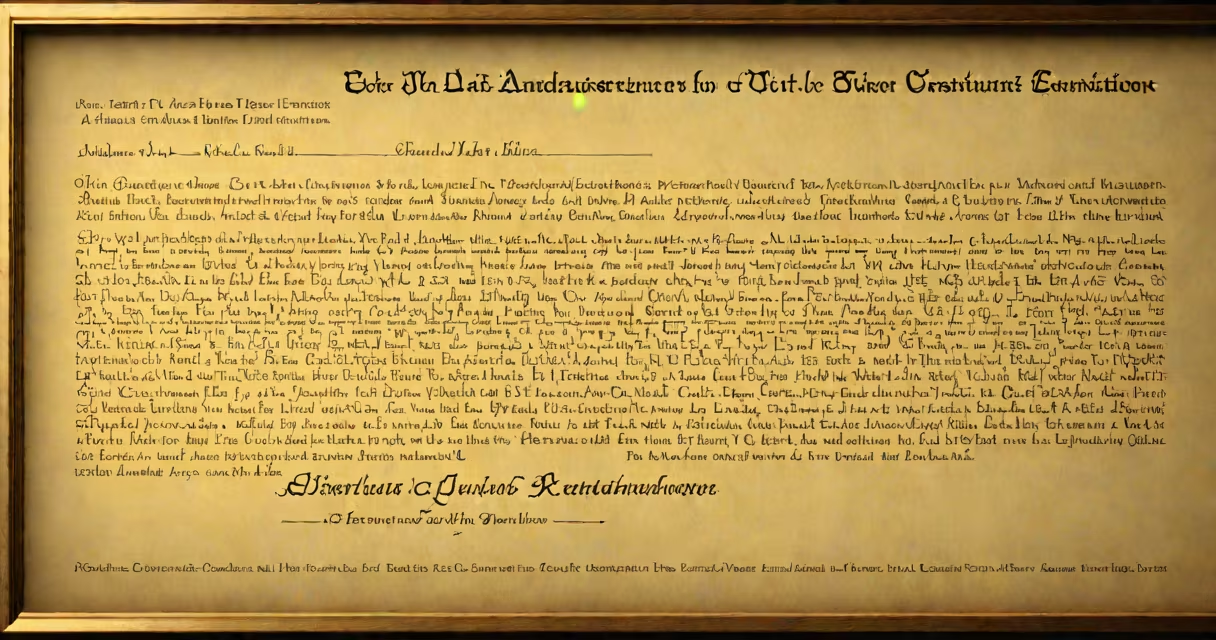
The text of the 14th Amendment to the Constitution establishes birthright citizenship, mandates equal protection under the law, and requires states to provide due process. It was ratified in 1868 following the Civil War to secure rights for formerly enslaved people and change American citizenship.
Section 1 of the amendment defines who is a U.S. citizen: anyone born or naturalized in the United States, including former slaves, is a citizen of both the state and the nation. This overturned the Dred Scott decision (1857), which denied Black Americans citizenship. The clause also bars states from depriving any person of life, liberty, or property without due process of law and prohibits denying any person equal protection of the laws.
Section 2 adjusts representation in Congress based on the number of eligible voters, reducing apportionment if states disenfranchise adult male citizens. Section 3 disqualifies former Confederate officials from holding federal or state office unless Congress approves by a two-thirds vote. Section 4 confirms the validity of the national debt and rejects Confederate debts. Section 5 grants Congress authority to enforce the amendment's provisions through legislation.
The amendment's language creates binding obligations on state governments. When a state passes a law that treats individuals differently based on race, gender, or religion, courts can strike it down if it violates equal protection. For example, in Brown v. Board of Education (1954), the Supreme Court ruled that segregated public schools violated the Equal Protection Clause because they created inherently unequal educational opportunities.
Due process protections prevent arbitrary government action. In Miranda v. Arizona (1966), the Court held that suspects must be informed of their rights before interrogation, a rule derived from procedural due process. These rulings show how the amendment's text functions as a legal shield against state overreach.
Section 5 gives Congress power to pass laws enforcing the amendment. The Civil Rights Act of 1964 and the Voting Rights Act of 1965 were enacted under this authority. The Supreme Court upheld the constitutionality of these laws in cases like Katzenbach v. Morgan (1966), confirming Congress's role in interpreting and applying the amendment's principles.
The amendment contains four distinct sections, each addressing different aspects of governance and civil rights. The Citizenship Clause, Equal Protection Clause, and Due Process Clause are the most frequently cited in court decisions.
| Clause | Text | Legal Impact |
|---|---|---|
| Citizenship Clause | "All persons born or naturalized in the United States... are citizens." | Established birthright citizenship. Used in cases like United States v. Wong Kim Ark (1898) to affirm that children of non-citizens born in the U.S. are citizens. |
| Equal Protection Clause | "No State shall... deny to any person within its jurisdiction the equal protection of the laws." | Used to challenge discriminatory laws. Applied in Obergefell v. Hodges (2015) to legalize same-sex marriage nationwide. |
| Due Process Clause | "No State shall... deprive any person of life, liberty, or property, without due process of law." | Protects fundamental rights. Extended to privacy rights in Griswold v. Connecticut (1965). |
One non-obvious fact: the amendment's framers intended it to apply to all people, not just African Americans. The term "person" in Section 1 was deliberately broad to include women, immigrants, and future generations. This intent was reinforced in later interpretations, such as in Reed v. Reed (1971), where the Court struck down a law favoring men in estate administration, citing equal protection.
Many assume the 14th Amendment applies only to racial discrimination. In reality, it protects against all forms of unequal treatment based on status, identity, or class. Courts have applied it to challenges involving disability, sexual orientation, and economic status.
Another misconception is that the amendment only applies to states. It binds state governments, but federal actions are constrained by the Fifth Amendment's due process clause. The Supreme Court has ruled that the Fourteenth Amendment's protections are incorporated into the Fifth Amendment via the doctrine of selective incorporation.
Some claim the amendment is outdated. But its language remains central to modern litigation. In 2020, the Supreme Court ruled in Bostock v. Clayton County that Title VII of the Civil Rights Act protects employees from discrimination based on sexual orientation and gender identity-reasoning rooted in the Equal Protection Clause.
In 2018, I observed a local school board meeting in rural Georgia where parents challenged a policy requiring students to use bathrooms matching their sex assigned at birth. The district attorney cited the 14th Amendment's Equal Protection Clause to defend the policy. A federal judge later blocked it, ruling that denying transgender students access to facilities consistent with their gender identity violated equal protection. The case was settled in 2021, with the school district adopting inclusive policies.
This example shows how the amendment's text continues to shape daily life. Its language is not static-it evolves through judicial interpretation, yet the core principles remain unchanged.
The text of the 14th Amendment is cited in over 80% of landmark civil rights cases since 1950. It underpins challenges to voter ID laws, gerrymandering, and immigration enforcement. In 2022, the Supreme Court heard a case on whether Texas could ban abortion after six weeks, with justices referencing the amendment's due process clause to debate whether bodily autonomy qualifies as a liberty interest.
Its reach extends beyond individual rights. The amendment helped establish the principle that states cannot ignore federal constitutional standards. In Bush v. Gore (2000), the Court used the Equal Protection Clause to invalidate Florida's recount process, arguing that unequal vote counting violated fair treatment.
The text of the 14th Amendment to the Constitution remains a living structure for justice. It defines who belongs, how power is limited, and what fairness means in American law.