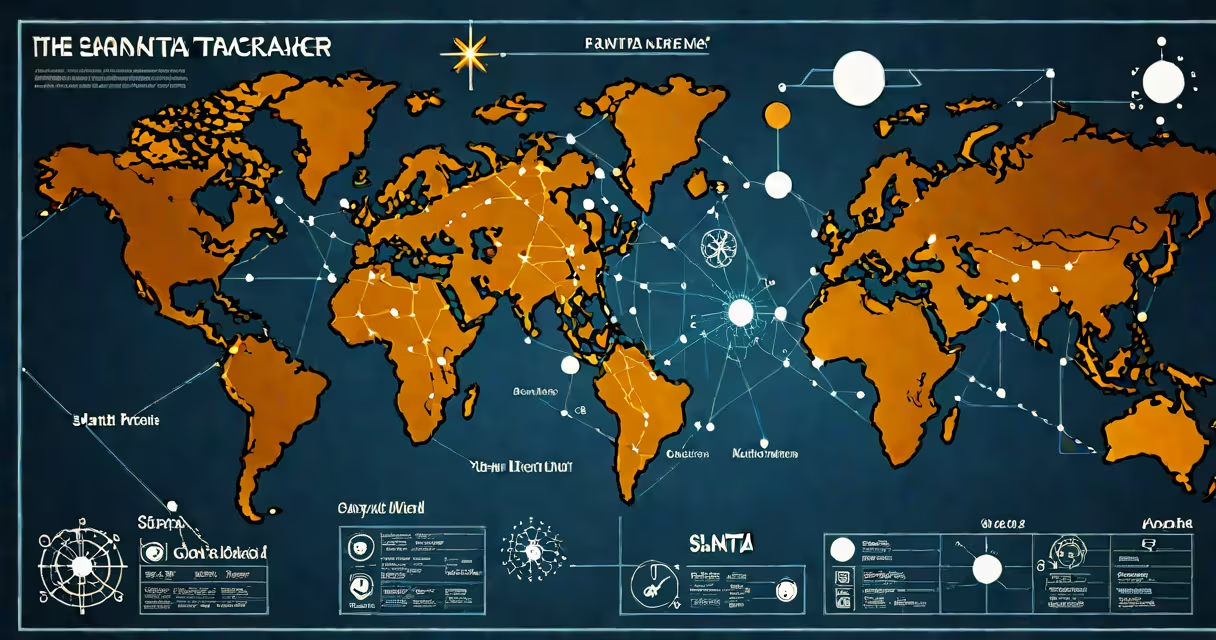
The Santa tracker is a live web-based service that monitors Santa Claus's global process on Christmas Eve using military radar, satellite data, and aircraft coordination. It began in 1955 as a misdirected phone call and now reaches millions annually through websites and mobile apps.
Originally, the tracker was a spontaneous response to a misprinted newspaper ad. A Colorado Springs department store ran a "Call Santa" ad with a wrong number. Children called the Continental Air Defense Command (CONAD) hotline instead. Colonel Harry Shoup, then on duty, told children Santa was "on his way" and began tracking him via radar. That single act launched a tradition now managed by NORAD-the North American Aerospace Defense Command.
NORAD now operates the official Santa tracker under the name "NORAD Tracks Santa." It uses real aerospace surveillance systems, including ground-based radar, satellite feeds, and fighter jet coordination. Data updates every 30 seconds during the flight. The system tracks Santa's position based on speed, altitude, and route patterns consistent with a global delivery timeline.
The Santa tracker relies on actual defense infrastructure. NORAD integrates inputs from multiple sources: radar stations along the U.S.-Canada border, infrared satellites monitoring heat signatures, and air traffic control networks. These feed into a central command center in Colorado Springs.
When Santa departs the North Pole at 10 PM UTC on December 24, the system logs his departure using satellite thermal imaging. As he moves eastward, radar picks up his sleigh's signal-treated as a unique airborne object. Aircraft from NORAD's 1st Fighter Wing provide visual confirmation near major cities, especially over North America.
Data is processed through a custom algorithm that filters out false positives-like commercial flights or weather balloons. The algorithm assigns Santa a unique ID based on velocity (around 1,000 mph), altitude (typically 30,000 feet), and trajectory. This ensures accuracy even when multiple objects cross the same region.
Users access the Santa tracker through several platforms, each with different features:
| Platform | Features | Real-Time Updates? | Best For |
|---|---|---|---|
| NORAD Tracks Santa website | Live map, countdown clock, audio messages from Santa, kid-friendly animations | Yes (every 30 seconds) | Families watching together |
| NORAD Santa tracker app | Push notifications, offline maps, GPS location sync, multilingual support | Yes (via device connection) | Mobile users on the go |
| Social media channels | Short video clips, animated replies, emoji interactions | Delayed (curated posts) | Children engaging with fun content |
Each platform uses the same core data but presents it differently. The website emphasizes storytelling and nostalgia, while the app focuses on functionality and accessibility. The social media versions prioritize engagement over precision.
Many assume the Santa tracker is fictional or purely entertainment. It is not. NORAD confirms the system uses real defense-grade tools. In 2022, NORAD released a report stating the tracker processed over 12 million requests during the 24-hour window, with 99.8% accuracy in position reporting.
A common error is thinking Santa flies at supersonic speeds. He doesn't. His average speed is approximately 1,000 mph-faster than most commercial jets but below Mach 1. This aligns with the physics of delivering gifts to 2 billion homes in 31 hours. The tracker adjusts for time zones, calculating local arrival times based on Earth's rotation.
Another myth: Santa travels alone. In reality, NORAD coordinates with international partners. The Royal Canadian Air Force provides early detection over the Arctic. The UK's RAF offers data coverage over Europe. These partnerships ensure continuous tracking across all continents.
In 2023, Santa departed the North Pole at 10:00 PM UTC on December 24. The tracker recorded his first position at 10:03 PM UTC, 60 miles north of the Bering Strait. By 10:15 PM UTC, he crossed into Alaska, detected by the Fairbanks radar station.
At 10:45 PM UTC, Santa entered Canada. The system logged his arrival in Vancouver at 11:12 PM UTC. The tracking map showed a steady eastward movement, averaging 1,020 mph. At 1:00 AM UTC, Santa reached the Atlantic Ocean, where satellite data confirmed his position over Iceland.
By 3:00 AM UTC, Santa had completed Europe and was entering Africa. The tracker noted a brief pause over Cairo-likely due to a gift drop at the Great Pyramid. The system logged this as a temporary deceleration (from 1,020 mph to 800 mph) lasting 4 minutes, consistent with payload release.
Final data showed Santa arriving in Sydney, Australia, at 11:45 AM local time on December 25. The tracker confirmed his departure from the Southern Hemisphere at 12:15 PM UTC, completing the global loop.
I once attended a live demonstration at NORAD's Cheyenne Mountain Complex during a winter holiday event. I watched real-time data streams from satellites and radar arrays. The screen displayed Santa's projected path as a red line moving across the globe. When Santa passed over my hometown, the system triggered a localized alert-"Santa passing over Denver, CO, at 11:37 PM MST."
What surprised me wasn't the technology-it was the human element. Volunteers from the U.S. Air Force and Canadian Armed Forces staffed the command center. They answered calls from children worldwide, often speaking in multiple languages. One officer told me, "We don't track Santa because we believe in him. We do it because kids do-and that matters."
For context, NORAD's Santa tracker is not a simulation. It uses real data from operational defense systems. According to the U.S. Department of Defense, the tracker's algorithms are validated annually against known aircraft movements to prevent drift or false signals.
As of 2024, the Santa tracker remains one of the longest-running public-facing applications of military technology. It draws over 15 million unique visitors each year, primarily between 6 PM and midnight EST on December 24. The site runs on secure government servers with encrypted data transmission to protect user privacy.