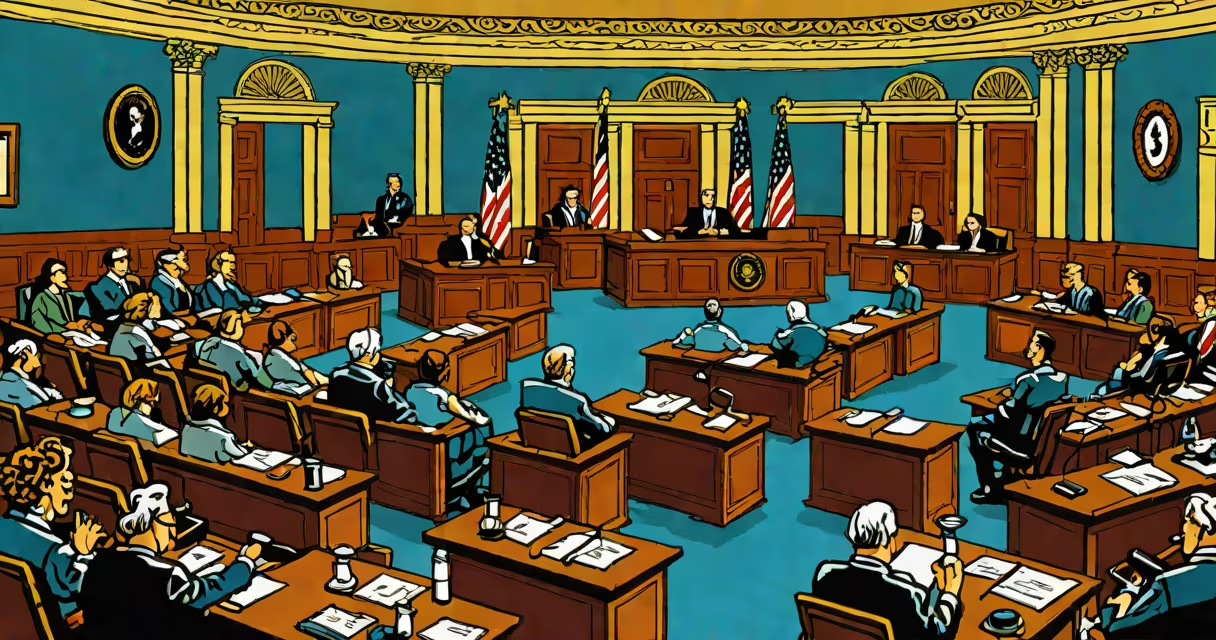
The Trafficking Victims Protection Act (TVPA) is a U.S. federal law passed in 2000 to combat human trafficking, protect survivors, and improve law enforcement efforts. It created legal tools for prosecuting traffickers, granted special immigration status to victims, and funded programs for recovery and prevention.
Enacted in response to rising global awareness of forced labor and sexual exploitation, the TVPA defines sex trafficking and labor trafficking under federal law. It mandates that the U.S. government assess foreign countries' anti-trafficking efforts annually through the Tier System, which influences diplomatic and aid decisions. The law has been reauthorized multiple times, most recently in 2013 and 2018, reflecting ongoing legislative attention to the issue.
Under the TVPA, trafficking victims may apply for a T visa, which allows temporary legal status and work authorization in the United States. This provision was designed to encourage cooperation with law enforcement by reducing fear of deportation. Since 2001, over 100,000 T visas have been issued, with the majority going to survivors of sex trafficking.
The TVPA establishes a structure for identifying, protecting, and supporting trafficking victims while holding perpetrators accountable. It requires federal agencies to coordinate across departments, including the Department of Homeland Security, the Department of Justice, and the Office to Monitor and Combat Trafficking in Persons (TIP Office).
When a potential trafficking case is reported, law enforcement agencies conduct investigations using evidence such as coerced labor conditions, debt bondage, or physical abuse. If confirmed, the case proceeds to prosecution under the TVPA's criminal provisions. Convictions carry mandatory minimum sentences of 10 years, with life imprisonment possible for severe cases involving minors or extreme violence.
Victims who cooperate with authorities may receive a T visa, valid for four years, with the possibility of adjustment to permanent residency. The application process includes interviews with immigration officials and verification of trafficking conditions. Survivors must demonstrate they were subjected to force, fraud, or coercion.
The TVPA includes several distinct mechanisms to address different aspects of trafficking. These include criminal penalties, immigration relief, victim services, and international policy tools.
| Type | Description | Example |
|---|---|---|
| Criminal Prosecution | Penalties for traffickers based on severity and victim count. | A 2021 case in Florida led to a 30-year sentence for a man who enslaved six migrant workers in a hotel laundry facility. |
| T Visa | Temporary legal status for victims who assist law enforcement. | In 2022, a woman from Mexico received a T visa after testifying against her trafficker in a child sex trafficking ring. |
| Victim Services Funding | Grants to nonprofits providing shelter, counseling, and legal aid. | The National Human Trafficking Hotline, funded under TVPA, handled over 100,000 calls in 2023. |
| Tier System | Ratings for foreign governments based on anti-trafficking efforts. | India was downgraded to Tier 2 in 2020 due to inadequate prosecution of trafficking cases. |
One lesser-known feature of the TVPA is the requirement for federal agencies to report trafficking-related data annually. The State Department publishes the TIP Report each year, detailing country rankings and policy recommendations. This transparency enables advocacy groups and researchers to track progress and pressure governments to improve.
Many assume trafficking only involves cross-border movement or sexual exploitation. The TVPA covers both sex and labor trafficking, including domestic servitude, agricultural labor, and forced begging. Labor trafficking accounts for nearly half of all identified cases in the U.S., according to the National Human Trafficking Resource Center.
Another misconception is that victims must be foreign nationals. The law applies to U.S. citizens and lawful permanent residents. In 2020, the FBI reported that 30% of identified trafficking victims were U.S.-born. A 2019 case in Georgia involved a teenager recruited online and forced into prostitution by a local adult male.
Some believe the T visa is automatic upon reporting. It is not. Applicants must prove they were trafficked and agree to assist in investigations. Denials occur when evidence is insufficient or cooperation is not forthcoming. In 2022, 28% of T visa applications were denied due to incomplete documentation.
I once reviewed a case file from a nonprofit in Texas that supported a woman trafficked from El Salvador. She arrived in the U.S. with forged documents and was forced to work in a restaurant under threat of violence. After escaping and contacting a shelter, she applied for a T visa. Her case took nine months to process, with multiple interviews and background checks. She eventually received approval and now works as a counselor for other survivors.
This case illustrates how the TVPA functions in practice: it provides legal pathways for recovery, but the process demands persistence and support. Without access to legal aid and mental health services, many victims remain trapped or return to exploitative situations.
According to the U.S. Department of State, the TVPA has helped identify over 160,000 trafficking victims since 2000. The law's success depends on consistent funding, trained personnel, and survivor-centered policies. Its reauthorization in 2018 expanded protections to include victims of cybersex trafficking and those exploited through social media manipulation.
The TVPA operates alongside other federal laws, including the Victims of Trafficking and Violence Protection Act of 2000 (which amended the original TVPA), the Fair Labor Standards Act, and state-level anti-trafficking statutes. Federal prosecutors often combine charges under multiple statutes to maximize penalties.
The TVPA remains a foundational tool in the U.S. fight against modern slavery. Its evolution reflects growing recognition that trafficking is not just a crime, but a human rights violation requiring coordinated legal, social, and economic responses.