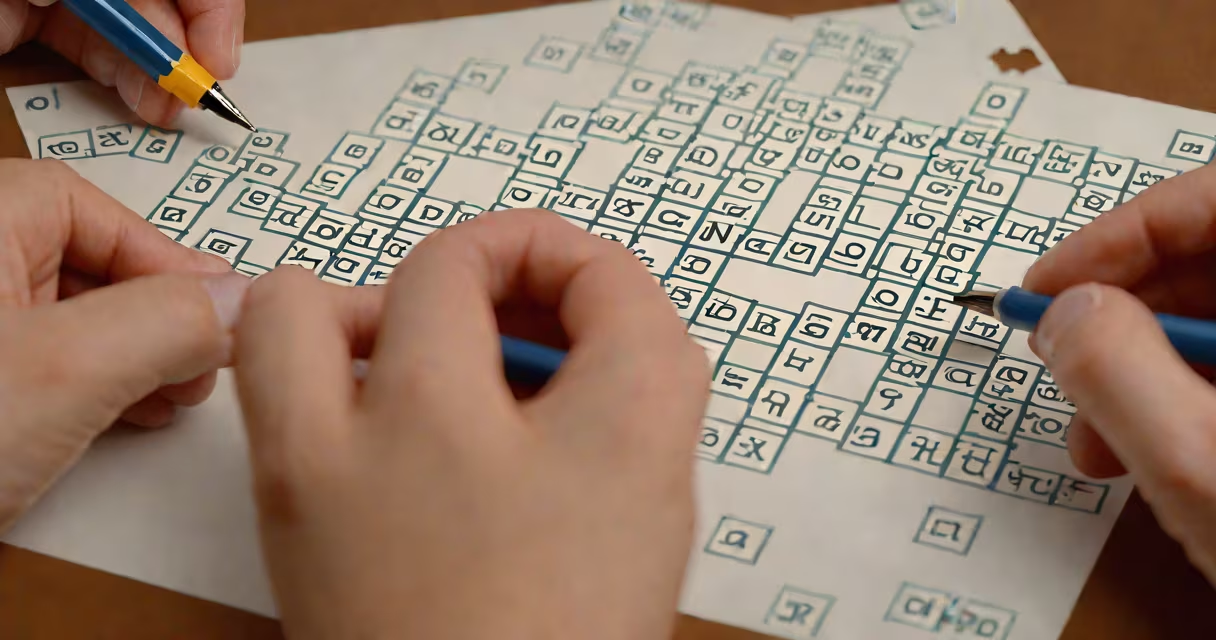
tricky word games are puzzles that challenge vocabulary, pattern recognition, and lateral thinking using letters, words, or linguistic rules. They require more than basic word knowledge-they demand creative interpretation, attention to detail, and sometimes a twist on standard spelling or grammar.
These games often involve wordplay, double meanings, anagrams, or hidden patterns. Unlike straightforward crossword puzzles, tricky word games rely on surprise, ambiguity, or misdirection to stump players. Success depends on spotting subtle cues rather than recalling common phrases.
Examples include riddles phrased as word puzzles, cryptic clues, homophones used in unexpected ways, and letter rearrangements that form unrelated words under specific constraints. The goal is not just to find the answer-but to understand how the puzzle was designed to mislead.
Each tricky word game uses a rule or structure that isn't immediately obvious. The player must identify the underlying logic-often based on phonetics, spelling, syntax, or cultural references-before arriving at the correct solution.
For instance, a clue like "I speak without a mouth and hear without ears" is a classic riddle. The answer is "echo," which relies on the sound's nature, not literal speech. This type of puzzle tests understanding of metaphorical language, not dictionary recall.
Another example: "What word becomes shorter when you add two letters to it?" The answer is "short"-adding 'e' and 'r' makes it "shorter." The trick lies in the pun on the word itself, not its definition. These puzzles exploit how words sound or look, not just their meaning.
Tricky word games fall into several categories, each relying on different cognitive skills. Understanding the format helps you anticipate the kind of thinking required.
| Type | Core Mechanism | Example |
|---|---|---|
| Anagram puzzles | Rearranging letters to form a new word | "listen" → "silent" |
| Homophone tricks | Using words that sound alike but differ in spelling/meaning | "There," "their," "they're" in a sentence puzzle |
| Cryptic clues | Wordplay with double meanings or hidden words | "A small fish in a large pond?" Answer: "minnow" (a small fish) |
| Visual word puzzles | Letters arranged to suggest a word or concept | "I A M" written vertically = "I am" (a person) |
Some formats combine multiple layers. For example, a puzzle might hide a word within a sentence using capital letters, then require you to reorder the capitalized letters to form a new word. These layered puzzles appear in escape rooms, puzzle hunts, and competitive trivia events.
A lesser-known but effective variant is the "silent letter" puzzle. Take the word "knight." The 'k' and 'gh' are silent. A clue might ask: "Which letter in 'knight' doesn't make a sound?" The answer is "k," but only because the rest of the word is pronounced without it. This confuses people who assume all letters contribute to pronunciation.
Tricky word games appear in education, entertainment, and cognitive training. Teachers use them to build critical thinking and expose students to language nuances beyond rote memorization.
The New York Times' "Spelling Bee" puzzle, for example, requires finding valid words from a set of seven letters. Some answers are obscure-like "syringe" from "syringe" letters-but the challenge lies in discovering them through trial and pattern recognition. According to the NYT's editorial team, the puzzle aims to reward both common vocabulary and rare word knowledge.
They're also central to puzzle-based entertainment. The popular game show *Jeopardy!* includes daily doubles that rely on wordplay. In 2022, a clue read: "This word is spelled the same forward and backward." The answer: "racecar." But the clue didn't specify it had to be a real word-just that it was palindromic. Players who assumed it had to be meaningful were misled.
On a personal note, I once spent 20 minutes trying to solve a riddle posted on a community board: "I have keys but no locks. I have space but no room. You can enter but not leave. What am I?" The answer-"a keyboard"-only clicked after I stopped thinking about physical keys and doors and focused on the metaphor. That moment of realization is the core appeal of tricky word games.
Many assume tricky word games are purely about vocabulary size. That's incorrect. A person with a vast word list may fail if they don't recognize the puzzle's structural trick.
For example, consider this riddle: "The more you take, the more you leave behind. What am I?" The answer is "footsteps." The confusion arises from interpreting "take" as removing something tangible. But "take" here means "to walk." The puzzle plays on the verb's dual meaning. Without recognizing that shift, even advanced readers struggle.
Another misconception: that all tricky word games rely on puns. While puns are common, many depend on visual layout, spacing, or syllabic stress. A famous example is the phrase "I scream, I scream, I scream!"-which sounds like "ice cream." The joke lies in auditory misinterpretation, not word substitution.
Even the term "tricky" can be misleading. Not all challenging word puzzles are tricky. A difficult crossword clue requiring obscure historical knowledge is hard-but not tricky. Tricky implies deception, misdirection, or clever framing. The difference matters when choosing puzzles for learning or entertainment.
To improve at tricky word games, focus on exposure and analysis. Try solving one daily. Start with simple riddles, then progress to cryptic clues or anagram challenges.
For example, try this: "What gets wetter as it dries?" The answer is "a towel." The paradox lies in the word "dries"-it usually describes removing moisture, but here, the towel absorbs water while being used to dry things. The contradiction forces you to rethink the meaning of "wet" and "dry" in context.
Practice resources include apps like *Wordscapes* and *The Daily Jumble*. Both feature word scrambles and cryptic hints. The *New York Times* also publishes a weekly "Spelling Bee" puzzle online. Solving these regularly builds familiarity with common patterns-such as recurring homophones or frequent anagram pairs.
Understanding tricky word games isn't just about winning. It sharpens language awareness, improves problem-solving speed, and enhances verbal creativity. The next time you see a riddle or a cryptic clue, pause before answering. Look for the twist. That's where the real challenge-and reward-lies.