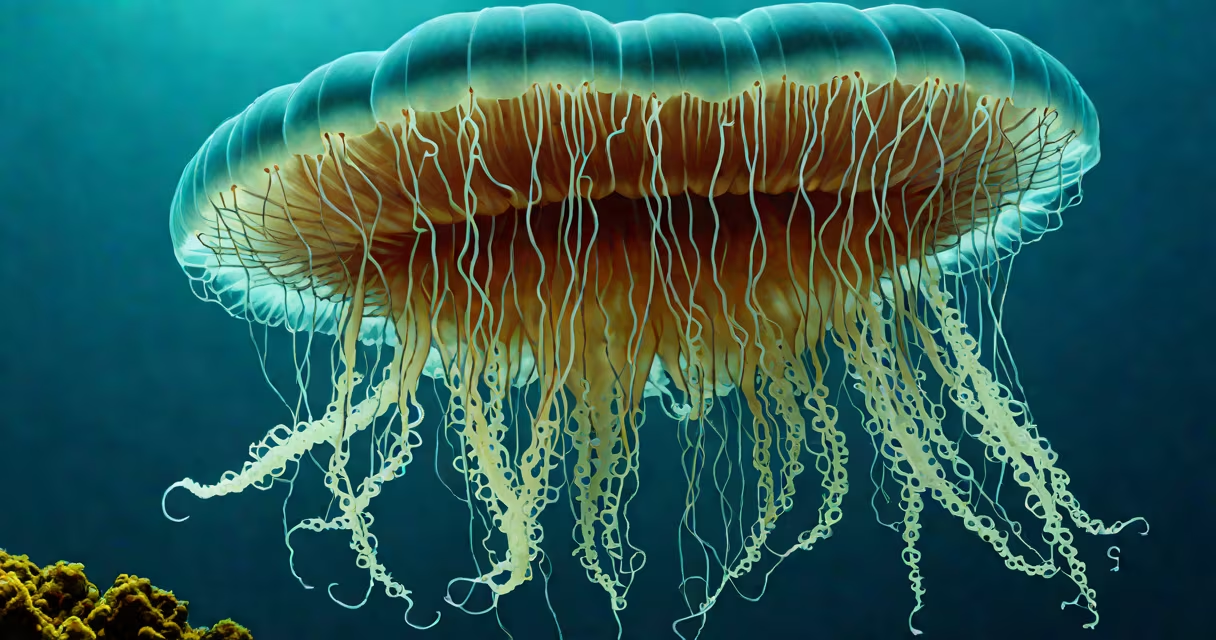
The upside down jellyfish (Cassiopea xamachana) is a small, translucent marine invertebrate that lives with its bell facing downward and its oral arms and tentacles pointing skyward. It thrives in shallow tropical and subtropical waters, particularly in mangrove swamps and seagrass beds where sunlight penetrates the water column.
This species belongs to the class Scyphozoa and is notable for its unusual orientation. Instead of swimming upright like most jellyfish, it anchors itself to the seafloor using its oral arms and remains stationary. This posture allows it to maximize exposure to sunlight, which is essential for the symbiotic algae living within its tissues.
Unlike predatory jellyfish that capture prey with stinging cells, the upside down jellyfish relies primarily on photosynthesis. Its body contains zooxanthellae-single-celled algae that live inside its epidermis and provide energy through photosynthesis. The jellyfish benefits from the oxygen and organic compounds produced by the algae, while the algae receive protection and access to nutrients such as nitrogen and phosphorus from the jellyfish's waste.
Cassiopea xamachana maintains a mutualistic relationship with the dinoflagellate algae Symbiodinium microadriaticum. These algae reside in the jellyfish's epidermal cells and convert sunlight into usable energy. The jellyfish's transparent bell and flattened body allow maximum light penetration to the algal cells, enabling efficient photosynthesis.
Despite its reliance on photosynthesis, the upside down jellyfish still captures small plankton and organic particles using its tentacles. It employs a passive feeding strategy: when water currents bring food near its tentacles, they contract and draw the material into the gastrovascular cavity. However, this feeding contributes less than 20% of its total energy intake, according to research published in Marine Biology.
A 2016 study in *Frontiers in Marine Science* found that Cassiopea individuals in high-light environments had higher metabolic rates and faster growth compared to those in low-light conditions. This confirms that light availability directly influences the jellyfish's physiology and survival.
The upside down jellyfish lacks a centralized brain. Instead, it has a nerve net-a decentralized network of neurons distributed throughout its body. This system controls basic functions like movement, feeding, and response to stimuli. When disturbed, the jellyfish contracts its bell to avoid predators, though it cannot swim long distances.
Its body consists of a bell-shaped structure measuring 5 to 15 centimeters in diameter. The bell is semi-transparent and often displays a mottled pattern of brown or green pigmentation due to the presence of algae. The oral arms-fused, frilly structures that extend from the center of the bell-are lined with nematocysts, specialized stinging cells used to subdue small prey.
One non-obvious fact: the jellyfish's "upside down" position is not accidental. Researchers have observed that it actively chooses this orientation during daylight hours. A 2020 experiment in *Journal of Experimental Biology* showed that Cassiopea reorients itself within minutes when placed in a controlled tank with variable light direction, indicating behavioral control over positioning.
Native to the western Atlantic Ocean, the upside down jellyfish inhabits coastal regions from Florida to the Caribbean and parts of Central America. It is commonly found in shallow lagoons, estuaries, and mangrove forests where water temperatures remain between 22°C and 30°C (72°F-86°F).
These jellyfish play a role in nutrient cycling. By hosting algae, they contribute to primary production in otherwise low-productivity zones. Their presence also indicates stable, low-turbulence environments-conditions necessary for algal symbiosis to thrive.
Due to climate change and rising sea temperatures, Cassiopea populations have expanded into new areas. In 2022, researchers documented a population surge in the Gulf of Mexico linked to warming waters. This expansion may disrupt local ecosystems by outcompeting native species for space and light.
| Feature | Description |
|---|---|
| Scientific Name | Cassiopea xamachana |
| Size | 5-15 cm diameter |
| Light Requirement | Requires moderate to high light for photosynthesis |
| Primary Energy Source | Photosynthesis via symbiotic algae (80-90%) |
| Reproduction | Sexual and asexual; produces planula larvae or buds off new polyps |
Many people mistake the upside down jellyfish for a sessile organism like a coral or an anemone. While it shares a similar lifestyle-remaining fixed in place-it is a true jellyfish and undergoes a complex life cycle involving both polyp and medusa stages.
Another common error is assuming that all jellyfish float upright. The upside down jellyfish is one of several species that adopt inverted postures. Others include certain members of the genus Cassiopea found in the Indo-Pacific region, such as C. frondosa and C. ornata. These species differ slightly in coloration and habitat preferences but share the same ecological niche.
The upside down jellyfish is not venomous to humans. Its stinging cells are too weak to penetrate human skin. However, direct contact can cause mild irritation in sensitive individuals, especially around the eyes or mucous membranes.
In 2021, marine biologists in the Florida Keys used the presence of upside down jellyfish as an indicator of system health. They monitored Cassiopea populations in mangrove-lined lagoons and correlated their abundance with water clarity, salinity, and algal bloom frequency.
Researchers discovered that healthy populations were associated with clear water and low pollution levels. In contrast, areas with high nutrient runoff showed reduced jellyfish numbers due to algal overgrowth and decreased light penetration. This data helped inform conservation strategies for coastal wetlands.
During a field visit to a protected mangrove reserve, I observed a dense colony of upside down jellyfish clinging to submerged roots. Their bell shapes created a mosaic of shadows under the surface. When a diver passed overhead, the group slowly rotated to maintain optimal light exposure-evidence of coordinated, light-driven behavior.
The upside down jellyfish exemplifies adaptation through symbiosis. Its reversal of typical jellyfish anatomy enables a unique survival strategy based on light, not predation. Understanding this species reveals how marine organisms evolve to exploit environmental gradients in ways that challenge conventional expectations.