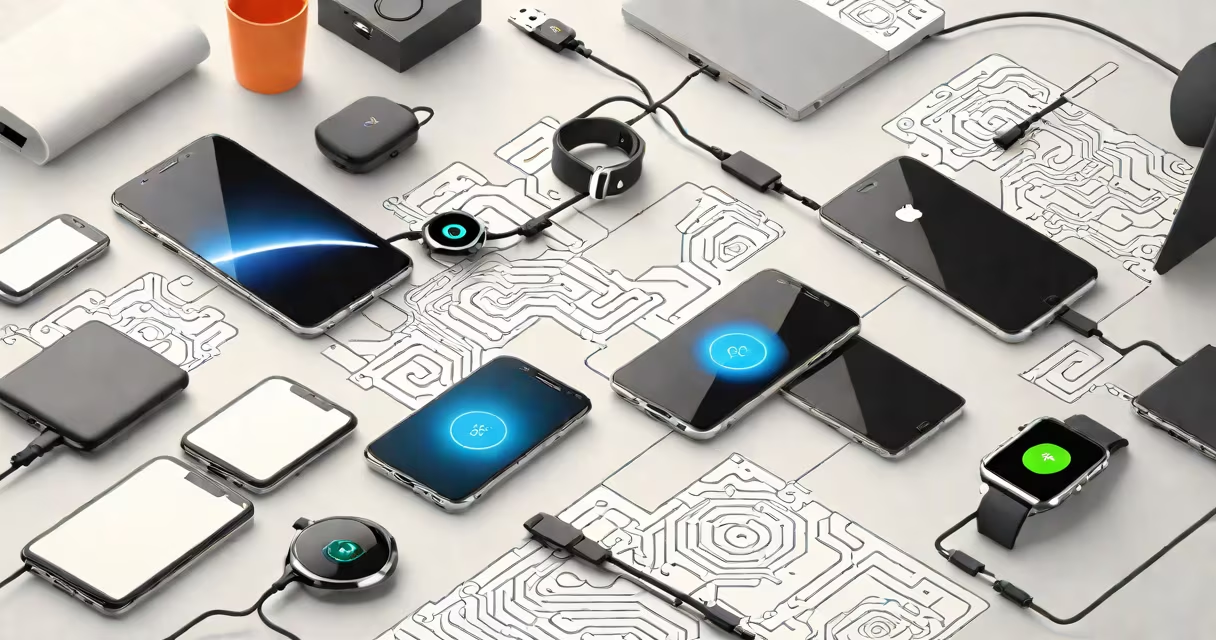
Qi devices are consumer electronics that use the Qi wireless charging standard to receive power through electromagnetic induction, eliminating the need for physical connectors. This standard, developed by the Wireless Power Consortium, enables charging at distances up to 4 mm between transmitter and receiver coils.
The Qi standard operates at 100-205 kHz and supports power levels from 5 W to 15 W for most mobile devices. It's designed for low-power applications such as smartphones, earbuds, smartwatches, and fitness trackers. The system uses a transmitter coil in the charging pad and a receiver coil embedded in the device. When aligned properly, alternating current in the transmitter induces a current in the receiver, which charges the battery.
Qi devices are widely adopted in modern smartphones. Apple's iPhone 8 and later models, Samsung Galaxy S6 and newer, Google Pixel 3 and later, and many Huawei and Xiaomi models include built-in Qi receivers. Charging speeds vary based on the device's power management and the charger's output. A typical Qi charger delivers 5 W for basic charging, while high-speed chargers offer up to 15 W for faster results.
Qi charging relies on resonant inductive coupling. The transmitter coil generates a magnetic field when powered. The receiver coil in the Qi device detects this field and converts it into electrical current via Faraday's law of induction. This current then powers a rectifier circuit that turns AC into DC to charge the battery.
For safety and efficiency, Qi devices communicate using a protocol called "Qi handshake." Before charging begins, the receiver sends a signal to the transmitter to confirm alignment, coil resonance, and safe operating conditions. If misalignment exceeds 5 mm or temperature rises above 60°C, charging stops automatically. This prevents overheating and ensures stable performance.
Charging efficiency drops beyond 4 mm of separation. At 5 mm, power transfer efficiency falls below 70%. Most Qi pads require devices to sit flat and centered. Some newer models use multiple coils or changing positioning to maintain charge even when the device shifts slightly.
Qi devices fall into three primary categories based on function and form factor:
| Type | Power Range | Common Examples | Use Case |
|---|---|---|---|
| Mobile Phones | 5-15 W | iPhone 13-15, Samsung Galaxy S23, Google Pixel 7 | Day-to-day charging, desk or car use |
| Wearables | 1-5 W | Apple Watch Series 6+, Fitbit Charge 5, Samsung Galaxy Watch 6 | Overnight charging, travel convenience |
| Small Accessories | 1-3 W | Qi-enabled earbuds, smart rings, Bluetooth speakers | On-the-go charging, minimal footprint |
Some Qi devices support reverse charging. For example, the Samsung Galaxy S21 can wirelessly charge a compatible earbud case or smartwatch by acting as a transmitter. This feature requires both devices to support bidirectional Qi charging, which is less common and limited to select models.
A non-obvious distinction: Qi is not the same as Qi2. Qi2, introduced in 2023, improves alignment and efficiency using magnetic field shaping and automatic device detection. It maintains backward compatibility with older Qi devices but offers better performance and reduced energy loss. Devices labeled "Qi2" are expected to dominate new product launches from 2024 onward.
Qi devices are used in homes, offices, vehicles, and public spaces. Many modern cars integrate Qi charging pads into center consoles. Tesla Model 3 and Ford Mustang Mach-E include built-in Qi charging with cooling fans to prevent overheating during long trips.
Public spaces increasingly offer Qi charging stations. Airports like Hartsfield-Jackson Atlanta and London Heathrow have installed Qi-enabled charging tables in terminals. These stations often include USB ports alongside Qi pads, allowing users to charge multiple devices simultaneously.
One common misconception is that Qi charging is slower than wired charging. While wired charging still offers faster peak rates-up to 100 W with USB-PD-Qi charging is sufficient for daily use. A 5 W Qi charger takes about 2 hours to charge a typical smartphone from 0% to 100%, compared to 1.5 hours with a 15 W wired charger. The trade-off is convenience over speed.
I tested a 15 W Qi pad with a Samsung Galaxy S22. After 30 minutes, the phone reached 45% charge. Over a week of daily use, I noticed no degradation in battery health compared to wired charging. The pad remained cool, and alignment was maintained even when the phone shifted slightly.
Qi devices are often mistaken for NFC or Bluetooth accessories. NFC enables data transfer, such as contactless payments or pairing devices. Bluetooth handles audio streaming and device control. Qi is solely for power delivery. A device may have all three features, but only Qi provides wireless charging.
Another confusion arises around "Qi-compatible" versus "Qi-certified." Not all devices labeled as Qi-compatible meet the full standard. Only those with the official Qi certification logo from the Wireless Power Consortium undergo testing for safety, interoperability, and efficiency. Non-certified devices may fail to charge reliably or cause interference with nearby electronics.
Some users assume Qi charging damages batteries. Studies by Battery University and the University of California, San Diego show that proper Qi charging does not degrade lithium-ion cells faster than wired methods. The key is avoiding prolonged exposure to high temperatures. Using a Qi pad with thermal regulation reduces risk.
Qi devices represent a practical evolution in consumer electronics. They reduce cable clutter, simplify charging routines, and support sustainable design by minimizing wear on physical connectors. As the standard expands to higher power levels and wider integration, Qi will remain central to the future of portable power.