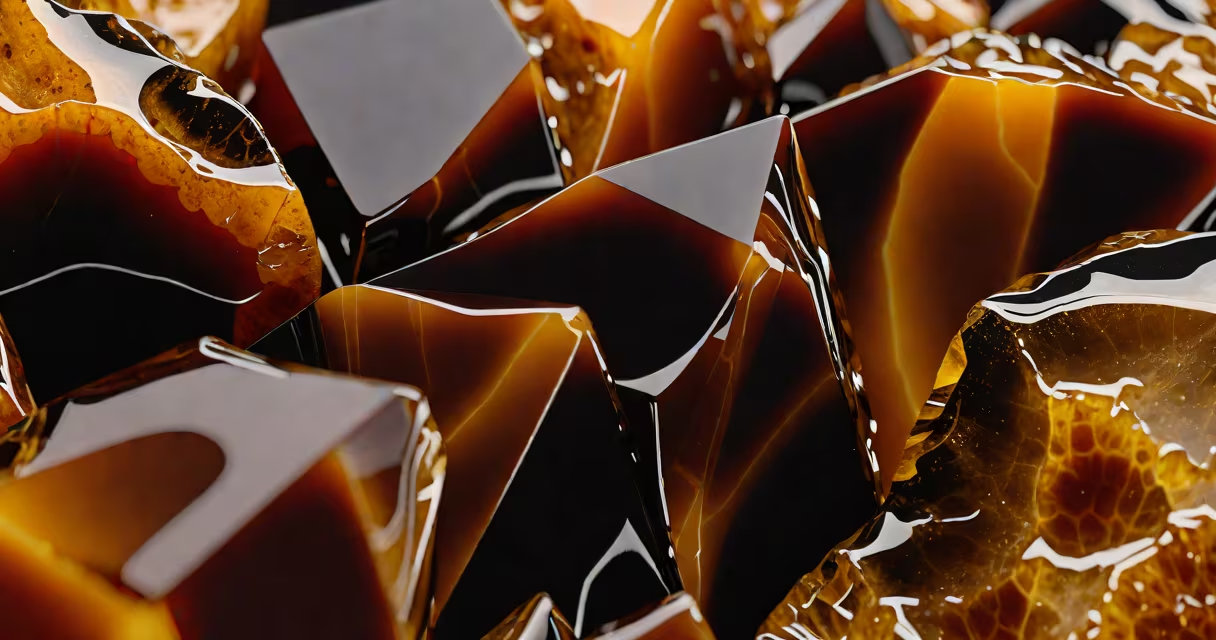
Onyx is a deep black or dark gray gemstone with a high luster, formed from microcrystalline quartz. It typically appears solid black but may show subtle banding or grayish tones due to mineral impurities.
Onyx forms through the deposition of silica-rich water in cavities within volcanic rock. Over time, layers of chalcedony-microcrystalline quartz-accumulate, creating bands. When these bands are uniform and dense, they produce the characteristic solid black appearance associated with onyx. The color results from trace elements like iron oxide and carbon, which absorb visible light across the spectrum.
According to the Gemological Institute of America (GIA), onyx is not a single mineral but different chalcedony, a form of quartz. Its hardness ranges from 6.5 to 7 on the Mohs scale, making it durable enough for use in rings, bracelets, and architectural details.
The color of onyx arises from structural and chemical factors. Pure chalcedony is colorless, but impurities during formation alter its appearance. Iron oxides create dark hues, while organic material or fine dust particles contribute to grayish or mottled patterns.
Some onyx specimens display alternating light and dark bands-known as banded onyx. These bands result from seasonal changes in the flow of mineral-laden water. Each layer represents a period of deposition, much like tree rings. Banded onyx is often cut perpendicular to the layers to reveal a striking contrast between black and white bands.
A lesser-known fact: true onyx is not always black. The term "onyx" historically referred to any banded chalcedony, including those with red, brown, or green bands. Modern commercial use restricts "onyx" to black or dark gray varieties, though some sources still reference colored onyxes.
Many assume onyx is uniformly matte black. In reality, it has a vitreous (glass-like) luster when polished. This shine enhances its depth and makes it appear richer than flat black paint or synthetic materials.
Another common error is confusing onyx with obsidian. Both are dark and glossy, but obsidian is volcanic glass, not quartz. Obsidian contains more free silica and lacks crystalline structure. While both can be jet black, obsidian often shows flow lines and a conchoidal fracture-features absent in onyx.
For visual comparison, consider this: a standard black acrylic paint has a hex code of #000000. Onyx, however, has a range of hex codes depending on the specific sample. A typical onyx shade is #000000, but deeper variants may use #0A0A0A or #1A1A1A. These slight differences affect how the color appears under different lighting conditions.
While black is dominant, onyx comes in several forms based on banding and composition:
| Type | Color Range | Use Cases |
|---|---|---|
| Black Onyx | Deep black to near-black (#000000) | Jewelry, tombstones, decorative panels |
| Banded Onyx | Alternating black and white bands | Ornamental carvings, bookends, tabletops |
| Green Onyx | Dark green to olive-gray | Art pieces, religious artifacts |
| Red Onyx | Brownish-red to maroon | Rare; used in collectible jewelry |
Green onyx, for example, gets its hue from chromium or nickel impurities. It's less common than black onyx and often mistaken for malachite or aventurine. Red onyx is similarly rare and sometimes confused with cornaline, a form of chalcedony with a reddish tint.
In ancient Rome, onyx was used in intaglio carvings-engraved gems worn as seals. The famous "Mosaic of the Seasons" in the Villa of the Papyri features onyx inlays. Today, onyx remains popular in luxury design.
A notable example is the onyx-clad lobby of the Burj Khalifa in Dubai. The stone's reflective surface creates a sense of depth, enhancing the building's verticality. The material choice reflects cultural associations: onyx symbolizes strength, protection, and mystery in many traditions.
When selecting onyx for a project, test samples under multiple lights. Natural onyx can shift from black to dark gray under warm lighting. A client once rejected a custom onyx countertop because it looked "too gray" under indoor lighting-only to accept it after seeing it in daylight.
Onyx is frequently misrepresented online. Search results often show images of black glass or resin labeled "onyx." These materials mimic the look but lack durability and authenticity. For accurate identification, consult a gemologist or use a refractometer to measure optical properties.
Digital displays render onyx inconsistently. A hex code of #000000 may appear as a flat black on screens, but real onyx has texture and depth. This discrepancy leads users to expect a uniform color that doesn't exist in physical form.
Understanding what color onyx is requires distinguishing between visual perception, material composition, and cultural symbolism. True onyx is not just black-it's a complex interplay of chemistry, light, and craftsmanship.