Sixth graders study core scientific concepts including ecosystems, the structure and properties of matter, energy transfer, and Earth's systems through inquiry-based labs and real-world investigations. This level aligns with the Next Generation Science Standards (NGSS), emphasizing crosscutting concepts like cause and effect, systems thinking, and stability and change.
Science in 6th grade builds on elementary experiences by introducing more complex models and explanations. Students begin to analyze data, design experiments, and explain phenomena using evidence. They move beyond memorizing facts toward understanding how scientific ideas connect across disciplines.
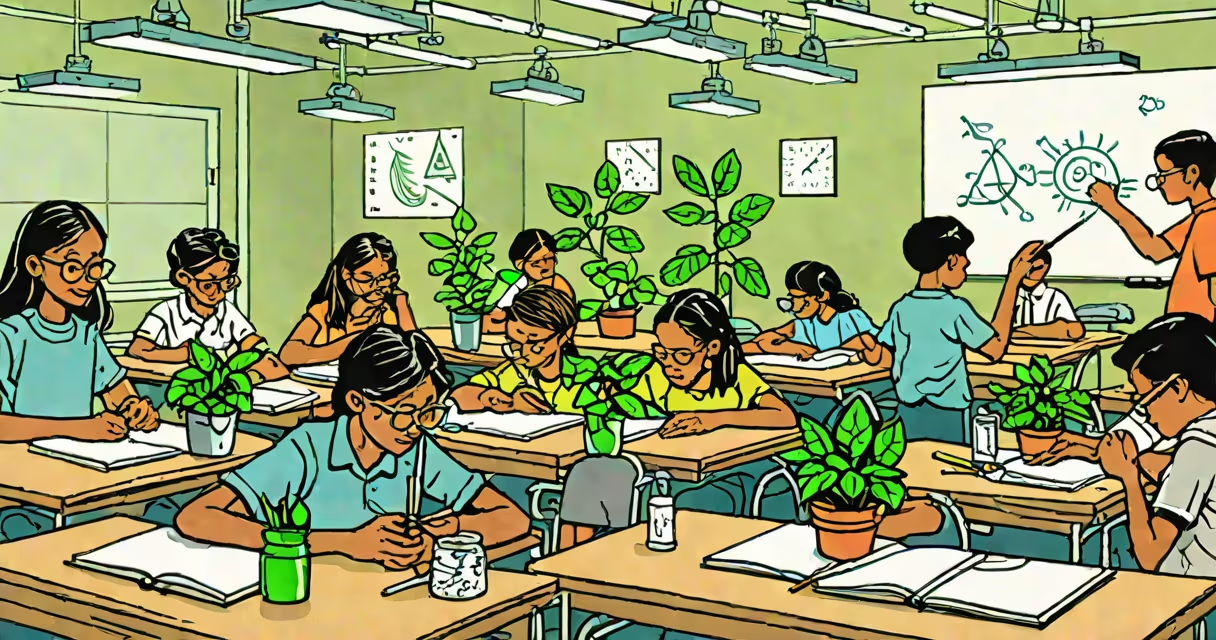
The curriculum emphasizes hands-on exploration. For example, students may grow plants under different light conditions to test hypotheses about photosynthesis. These activities develop critical thinking and reinforce scientific practices such as asking questions, planning investigations, and constructing explanations based on evidence.
Curricula typically cover four major domains: life science, physical science, Earth and space science, and engineering design. Each area uses NGSS performance expectations to guide instruction.
Life science focuses on ecosystems and interactions among organisms. Students examine food webs, nutrient cycles, and human impacts on habitats. A typical unit involves analyzing a local watershed to trace pollution sources and evaluate conservation strategies.
Physical science introduces atomic theory and chemical reactions. Students learn that matter is made of particles too small to see, and they model changes in state using particle diagrams. They explore how energy transfers during phase changes and chemical reactions, often through lab experiments measuring temperature changes.
Earth and space science covers weather patterns, climate systems, and plate tectonics. Students use real-time data from NOAA and NASA to track storm development or monitor sea surface temperatures. They build models of tectonic boundaries to predict earthquake locations.
Engineering design integrates science with problem-solving. Students identify a community issue-like reducing plastic waste-and design a reusable container prototype. They test materials for durability, cost, and environmental impact, then refine their designs based on feedback.
Teachers use phenomena-driven instruction, starting with observable events and guiding students to explain them. For example, a teacher might show a sealed bottle with a balloon attached to demonstrate air pressure. Students observe the balloon inflate when the bottle is warmed, then explain the role of thermal energy in expanding gases.
Each concept is taught through a cycle: engage with a phenomenon, explore through lab work, explain using models, elaborate with extensions, and evaluate understanding. This method ensures students don't just recall facts-they apply knowledge.
A common misconception is that 6th grade science is just "more hard" than 5th grade. But the shift is deeper: it's about changing how students think. Instead of saying "plants need sunlight," they learn to explain *how* sunlight drives photosynthesis using molecular models of chlorophyll and carbon dioxide.
Many assume 6th grade science is purely theoretical. In reality, nearly 70% of class time involves lab work, group discussions, or data analysis. According to the National Science Teaching Association (NSTA), effective science instruction requires students to "do science," not just read about it.
Another confusion is equating science with memorization. While vocabulary like "photosynthesis," "kinetic energy," and "tectonic plates" appears, students aren't quizzed on definitions alone. They must use these terms to explain processes and support arguments with evidence.
Some parents expect advanced topics like DNA or nuclear fusion. These are not covered until high school. In 6th grade, students learn that cells are the basic units of life and that energy comes from the sun-but they don't yet explore genetic coding or atomic fission.
| Grade Level | Life Science Focus | Physical Science Focus | Earth & Space Focus |
|---|---|---|---|
| 2nd Grade | Plants and animals in environments; seasonal changes | Simple machines; light and sound | Day and night; moon phases |
| 6th Grade | Ecosystems; energy flow; human impact on biodiversity | Matter composition; energy transfer; chemical reactions | Weather systems; plate tectonics; climate patterns |
| 8th Grade | DNA and genetics; evolution; natural selection | Forces and motion; waves; electricity | Earth's history; fossil records; climate change |
Students who struggle with 6th grade science often lack foundational skills in reading data tables or interpreting graphs. Teachers use formative assessments to identify gaps early. For example, a student might misread a bar graph showing temperature rise over time, leading to incorrect conclusions about climate trends.
One non-obvious fact: many 6th grade curricula now include citizen science projects. Students contribute to databases like eBird or iNaturalist by recording local species sightings. These real datasets help scientists track migration patterns and habitat shifts-giving students authentic roles in research.
In a California public school, a 6th grade class studied drought effects on native plants. They collected soil samples from nearby parks, measured moisture content, and compared growth rates of native versus invasive species. Using data from the U.S. Drought Monitor, they mapped regional dryness levels and proposed planting native drought-resistant species in school gardens.
They presented findings to the school board using visual models and statistical summaries. One group calculated that replacing 30% of lawn space with native plants could reduce water usage by 40% annually. Their project was adopted into the district's sustainability plan.
This example shows how 6th grade science connects to civic engagement and environmental stewardship. It's not just about passing tests-it's about solving problems.
After completing 6th grade science, students are prepared for more advanced topics in 7th and 8th grades. The focus shifts to deeper integration of disciplinary core ideas, such as linking cellular respiration to energy transformation in ecosystems.
By the end of 6th grade, students understand that science is a process of questioning, testing, and revising ideas. They don't just know *what* happens-they learn *why* and *how* to find out.