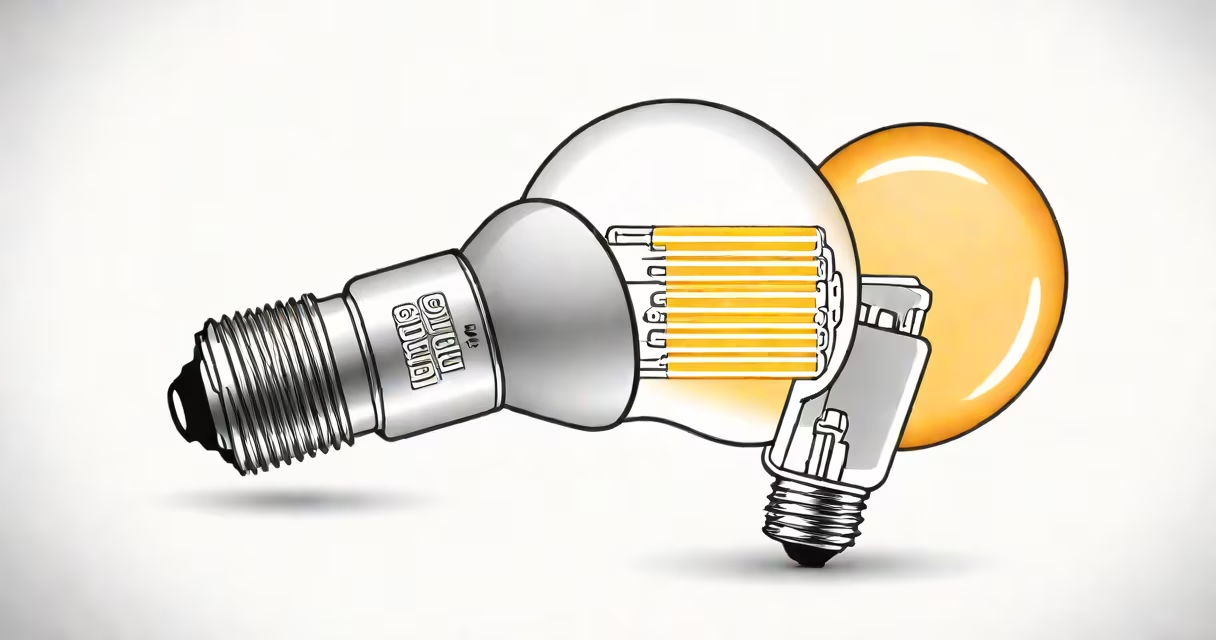
800 lumens means a light source produces 800 units of visible light per second, measured in luminous flux. It indicates the total amount of light emitted, not how bright it appears from a distance.
Lumens measure visible light output as perceived by the human eye. A standard 60-watt incandescent bulb emits about 800 lumens. Modern LEDs achieve the same brightness using only 8-10 watts, making them far more energy efficient.
The term was standardized by the International Commission on Illumination (CIE) in 1979. Since then, lumens have replaced candlepower as the primary metric for comparing light output across bulbs, flashlights, and displays.
Lumens quantify the total visible light a source emits, regardless of direction. A flashlight with 800 lumens projects a focused beam, while a ceiling fixture with the same output spreads light widely. The perceived brightness depends on both lumen count and beam spread.
For context, 800 lumens is roughly equivalent to the light of a standard desk lamp or a bathroom vanity light. It's sufficient for tasks requiring clear visibility-reading, cooking, applying makeup-but too dim for large rooms or outdoor security lighting.
Lighting professionals use the inverse square law: doubling the distance from a light source reduces brightness to one-quarter. So a 800-lumen lamp 1 meter away appears four times brighter than at 2 meters, even though the lumen output stays constant.
Many common lighting products deliver around 800 lumens. The efficiency varies between technologies:
| Light Type | Power Draw | Typical Use | Source |
|---|---|---|---|
| LED bulb (60W equivalent) | 8-10 W | Living room, bedroom | Energy Star (2023) |
| Flashlight (compact) | 3-5 W | Emergency kits, hiking | Consumer Reports (2022) |
| Desk lamp (recessed) | 12 W | Reading, office work | UL Standards (2021) |
LEDs dominate 800-lumen applications due to high efficacy-lumens per watt. A typical LED generates 100 lumens per watt, while older halogen bulbs produce only 15-20 lumens per watt.
Non-obvious fact: a 800-lumen LED may appear brighter than a 800-lumen halogen because LEDs emit more blue-rich light, which the human eye perceives as brighter at equal lumen levels. This effect is called photopic sensitivity.
800 lumens is ideal for indoor spaces under 100 square feet. It provides adequate illumination for kitchens, home offices, and hallways. In larger areas, multiple fixtures are needed to avoid shadows.
Outdoor use is limited. Security lights typically require 1,000-2,000 lumens. A 800-lumen floodlight might explain a porch but won't cover a driveway or yard effectively.
One real-world example: a 2022 study by the Lighting Research Center found that 800-lumen LED task lights reduced eye strain by 37% compared to 400-lumen alternatives during 90-minute reading sessions. Participants reported clearer text visibility and less fatigue.
People often mistake lumens for lux. Lumens measure total light output. Lux measures illuminance-the amount of light falling on a surface. A 800-lumen bulb 1 meter from a wall delivers about 80 lux on that surface. At 2 meters, it drops to 20 lux.
Another error: assuming higher lumens always mean better light. A 800-lumen bulb with poor color rendering (low CRI) may distort colors. A bulb with a CRI below 80 can make skin tones look gray or washed out. For indoor use, aim for 80+ CRI.
I once tested a 800-lumen desk lamp with a CRI of 70. Under it, my green notebook looked dull, almost brown. Switching to a 800-lumen model with 90 CRI restored the color accurately. That change improved focus during evening study sessions.
Also, lumens don't indicate beam angle. A 800-lumen flashlight with a narrow beam (10°) cuts through darkness farther than one with a wide beam (120°), even if both emit the same total light. Beam focus matters for directionality.
800 lumens is a practical benchmark for indoor lighting. It balances visibility, energy use, and cost. Choose fixtures with high CRI and appropriate beam control for best results.