Genesis 15 records God's covenant with Abraham, establishing a sacred promise of descendants and land. This chapter marks the first time God formally binds Himself to Abraham through ritual sacrifice, affirming His faithfulness despite human doubt.
Abraham, childless and anxious about his legacy, receives a vision from God. In response, he expresses fear about dying without an heir. God responds not with judgment but with reassurance: "I am your shield, your very great reward." He then leads Abraham outside to count the stars, saying, "So shall your offspring be." Abraham believes, and it is credited to him as righteousness.
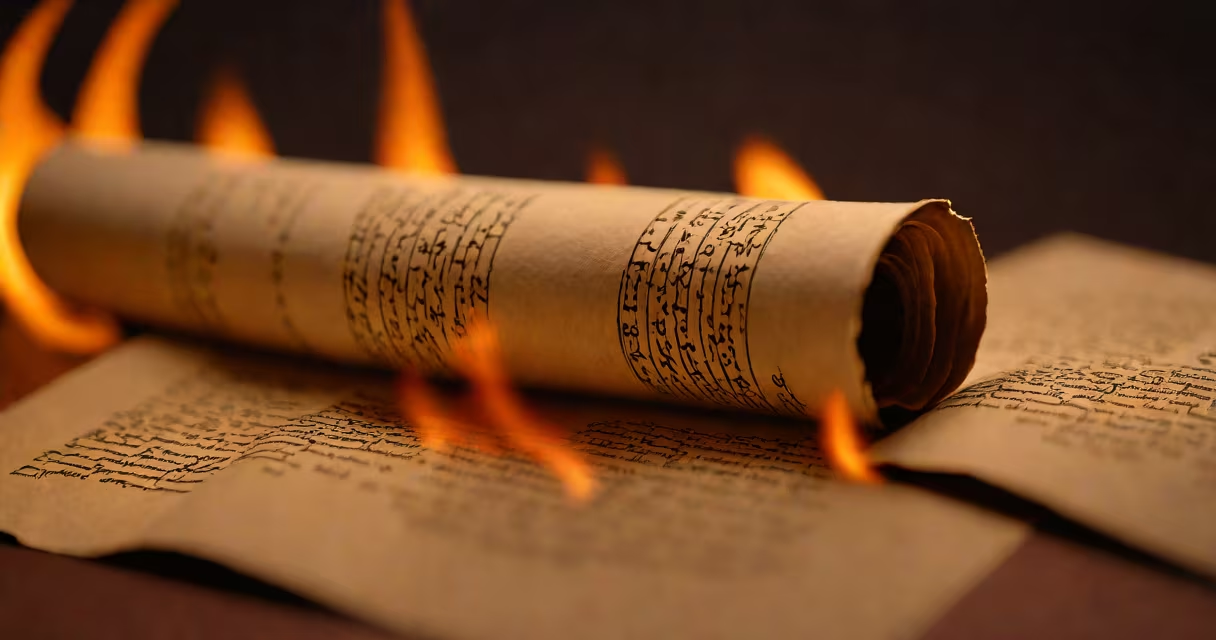
The chapter culminates in a formal covenant ceremony. God instructs Abraham to prepare animals-cattle, goats, and birds-and divide them. As twilight falls, a smoking firepot and flaming torch pass between the halves. This act symbolizes God's unilateral commitment: He alone walks through the divided pieces, declaring that He will fulfill the promise regardless of Abraham's ability to keep it. The ritual reflects ancient Near Eastern treaty practices, where the party making the vow passed through the offering.
Covenants in the Hebrew Bible are binding agreements between parties, often involving rituals. Genesis 15 is unique because God takes full responsibility. Unlike bilateral treaties requiring mutual obligations, this is a unilateral covenant-God alone swears to uphold the promise.
Abraham's role is faith. He does not perform actions to earn the promise. Instead, he trusts God's word. The text states, "He believed the Lord, and He credited it to him as righteousness" (Genesis 15:6). This verse becomes foundational in Paul's letters to the Romans and Galatians, where he argues that salvation comes through faith, not works.
Modern readers sometimes misunderstand this passage as a transactional exchange-"I'll obey, and God will bless me." But the narrative shows the opposite: God acts first. Abraham's obedience follows belief. The sequence is critical: trust precedes action.
The ritual of dividing animals was common in ancient Mesopotamian and Canaanite cultures. Scholars such as John Walton (The NIV Study Bible, Zondervan) confirm that such ceremonies were used to seal oaths, with the participants walking through the pieces to signify their willingness to be cursed if they broke the agreement.
What makes Genesis 15 distinct is that only God passes through the divided animals. Abraham sleeps during the ritual, indicating he is not required to take the oath. The burden rests solely on God. This foreshadows later biblical themes: God's initiative in salvation, His sovereignty, and the idea that redemption is a divine act, not a human achievement.
A non-obvious detail: the birds are not cut in half. Only the larger animals are divided. This aligns with ancient sacrificial customs where smaller animals represented lesser commitments. The distinction underscores the gravity of the promise-Abraham's future is tied to something far greater than personal success.
Many assume Genesis 15 is about material blessings-land, wealth, children. While those are included, the core theme is relationship. God calls Abraham "my friend" (Isaiah 41:8), and this chapter establishes the foundation of that bond. The promise is not a reward for merit but a gift of grace.
Another error is treating the vision of stars as metaphorical. The text presents it as a literal divine revelation. God says, "Look up at the heavens and count the stars-if you can." The command implies that counting is impossible, reinforcing the magnitude of the promise. Abraham's descendants will be as numerous as the stars.
Some interpret the smoking firepot and flaming torch as symbols of God's presence. That is correct-but it is also historical. These elements represent God's actual appearance in a visible form. The imagery echoes Exodus 13:21, where God leads Israel through the wilderness in a pillar of cloud and fire. The same divine manifestation appears here, centuries earlier.
Consider a modern believer facing uncertainty about their future-career, family, health. Genesis 15 offers a model: trust God's word even when circumstances contradict it. Abraham had no biological son. Yet he believed God would give him one. He did not wait for proof. He acted on faith.
Paul cites Genesis 15:6 in Romans 4:3: "Abraham believed God, and it was credited to him as righteousness." He uses this to argue that Gentiles can be justified by faith apart from law-keeping. This theological shift reshaped Christianity's understanding of salvation.
When I taught this passage in a small group, one member said, "I've read this before, but I never saw it as a promise of identity." We discussed how Abraham wasn't just promised a nation-he was promised a new name, a new lineage, a new destiny. That changed how he viewed himself. The same applies today: believing God's promises redefines who we are.
| Covenant Type | Parties Involved | Ritual Action | Promise Focus | Biblical Reference |
|---|---|---|---|---|
| Unilateral (God alone swears) | God and Abraham | Animals divided; God passes through | Descendants, land, divine protection | Genesis 15 |
| Bilateral (mutual obligation) | God and Israel at Sinai | Altar built; people swear allegiance | Law, worship, national identity | Exodus 19-24 |
| Conditional (depends on obedience) | God and David | David builds temple; God promises dynasty | Kingdom, eternal throne | 2 Samuel 7 |
Each covenant serves a purpose. Genesis 15 stands out because it is unconditional. God's promise is not dependent on Abraham's future behavior. This sets the stage for later revelations: Jesus as the ultimate fulfillment of God's promise to bless all nations (Genesis 12:3).
Genesis 15 is not merely history-it is a living declaration of God's faithfulness. When believers read it, they encounter a moment where God says, "I am with you," long before the fulfillment arrives. That is the heart of what Genesis 15 means.