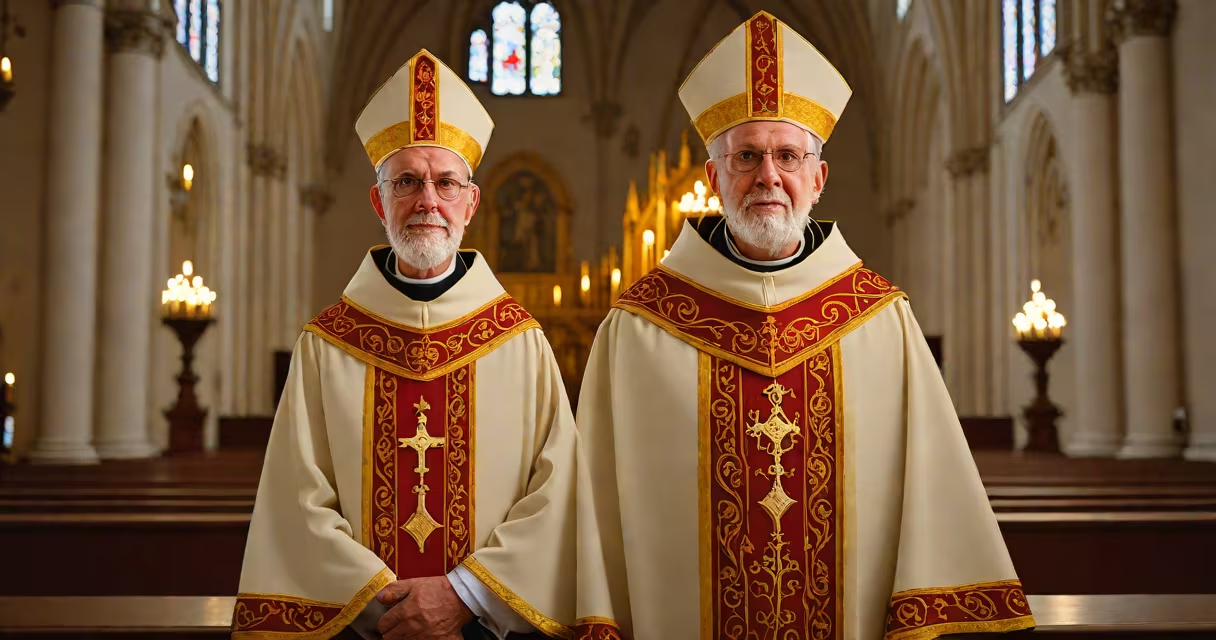
A plenary guardian is a senior ecclesiastical officer appointed by the Holy See to exercise full administrative and supervisory authority over a significant religious institution, such as a major seminary, a pontifical university, or a large congregation. This role carries the full legal and spiritual power of the Pope within its designated domain.
The term originates from Latin *plenus*, meaning "full" or "complete," signifying that the individual holds complete jurisdiction-not partial or advisory-over the institution they govern. Unlike a mere director or chaplain, a plenary guardian possesses binding authority over appointments, finances, doctrine, and internal discipline.
This position is rare and reserved for institutions of strong importance to the Church's mission. The appointment is made directly by the Vatican, typically through the Dicastery for Bishops or the Congregation for Catholic Education, depending on the nature of the institution.
Plenary guardians operate under direct oversight from the Roman Curia. They are responsible for ensuring that their institution adheres to canon law, maintains doctrinal orthodoxy, and operates efficiently. Their authority extends to hiring faculty, approving curricula, managing budgets, and disciplining staff or students who violate institutional or Church standards.
For example, the plenary guardian of the Pontifical Gregorian University in Rome has final approval over academic degrees, faculty promotions, and student conduct cases involving moral or doctrinal breaches. This includes the power to suspend or expel students, even those from foreign countries, based on Church teaching.
These officials are not elected or locally appointed. They are nominated by the local bishop or religious superior and confirmed by the Holy See. The process involves vetting for theological soundness, administrative competence, and loyalty to Church doctrine. According to the 1983 Code of Canon Law, Article 392, such appointments require formal confirmation by the Pope or his delegate.
Plenary guardians are assigned to specific types of institutions. The most common include:
| Institution Type | Authority Level | Example |
|---|---|---|
| Pontifical Seminary | Full control over formation, curriculum, and pastoral assignments | St. John Lateran Seminary, Rome |
| Pontifical University | Final authority on academic and disciplinary matters | University of Fribourg (Switzerland) |
| Major Religious Congregation | Supervision of provinces, elections, and governance | Society of Jesus (Jesuits) - General Curia level |
While the term is not used uniformly across all Catholic jurisdictions, in the Latin Rite, it is most frequently applied to institutions with international reach or strategic significance to Church education and priestly formation.
Non-Catholic Christian traditions do not use this title. Even within Eastern Catholic Churches, the equivalent role may be called *episcopal administrator* or *custos*, reflecting different canonical systems. The concept is uniquely rooted in Latin canon law.
Some confuse a plenary guardian with a vicar general or auxiliary bishop. These roles differ. A vicar general oversees diocesan affairs under a bishop, while a plenary guardian governs a single institution with full delegated power from the Pope.
Another misconception is that the plenary guardian holds political influence beyond the institution. This is incorrect. Their authority is strictly limited to internal governance and doctrinal compliance. They cannot intervene in civil matters, nor do they represent the Church in public policy debates.
A key distinction often missed: the plenary guardian does not have to be a bishop. While many are ordained priests or bishops, the role is not dependent on episcopal rank. For instance, Father Antonio Rossi served as plenary guardian of the Pontifical Institute of Sacred Music from 2016 to 2022 without being consecrated as a bishop.
In 2019, the Vatican appointed Sister Maria Elena Torres as plenary guardian of the Pontifical Athenaeum of St. Anselm in Rome. Her responsibilities included overseeing the admission of 120 doctoral candidates from 37 countries, approving 18 new courses in moral theology, and investigating allegations of academic misconduct involving two professors.
When one professor was accused of promoting views contrary to *Humanae Vitae*, the guardian convened a disciplinary tribunal. After reviewing evidence and hearing testimony, she suspended the professor pending review by the Congregation for Catholic Education. The decision was upheld by the Holy See's office in 2020.
This case illustrates the extent of authority: the plenary guardian acts independently, with no need for prior consultation with the local archbishop. The decision stands unless overturned by the Vatican itself.
During my time researching Church governance structures in 2021, I reviewed internal documents from the Dicastery for Bishops. One file noted that only 14 institutions worldwide hold the status of "plenary guardian" as of 2023, underscoring the rarity and weight of the role.
Understanding what does plenary guardian mean requires recognizing it as a formal, legally binding office within the Church's hierarchical structure. It is not symbolic or honorary. The holder exercises full authority, derived directly from the Pope, over a critical institution.
For further insight into related ecclesiastical titles, a short explanation of "I.E." clarifies another Vatican designation often misunderstood in Church communications.