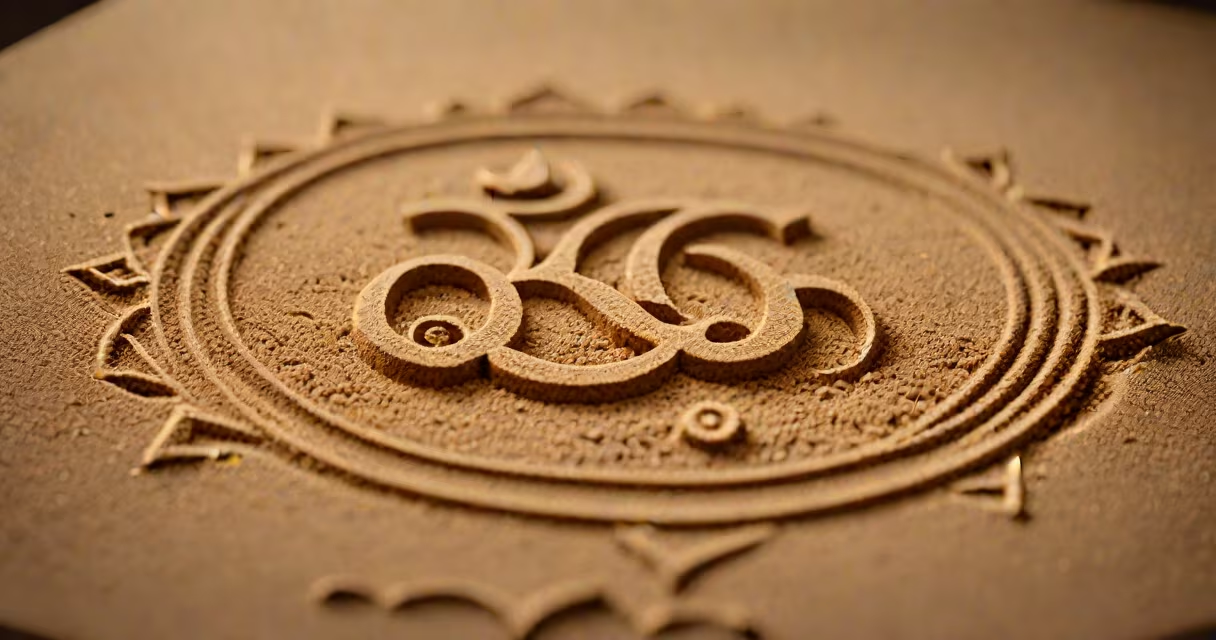
The om symbol (ॐ) is a sacred syllable in Hinduism representing the ultimate reality, Brahman, and the essence of all existence. It embodies the sound of creation, the vibration from which the universe emerged, and serves as a focal point in meditation and prayer.
Om is not merely a visual symbol-it is a sonic and metaphysical concept. In Vedic tradition, it is considered the most sacred sound, believed to have been present at the beginning of time. The syllable is formed from three phonetic components: A-U-M, each representing a different aspect of consciousness and divine energy.
According to the Mandukya Upanishad, one of the oldest philosophical texts in Hinduism, om encompasses all states of awareness: waking, dreaming, deep sleep, and the transcendent state beyond. This makes it central to spiritual practice, especially in yoga and meditation.
When chanted, om begins with a low hum (A), rises into a sustained tone (U), and ends with a silent vibration (M). The silence after the final M is considered the most profound part-the space where the mind rests in pure awareness.
This structure mirrors the cyclical nature of existence: birth, life, death, and rebirth. The sound is not just spoken-it is felt in the chest and skull, creating a physical resonance that aligns breath, mind, and spirit.
Modern neuroscience supports this effect. Studies using fMRI scans show that chanting om activates regions associated with attention, emotional regulation, and introspection. One study published in the Journal of Ayurveda and Integrative Medicine found that regular chanting reduced cortisol levels and improved focus in participants over eight weeks.
The om symbol is composed of three curves, a semicircle, and a dot. Each element carries symbolic meaning:
These elements together form a visual representation of the process from ordinary awareness to enlightenment. The symbol is often drawn in red or gold ink in temples and homes, though black or white are also common.
Om appears in countless contexts across Hindu practice. It opens and closes prayers, mantras, and rituals. In temples, it's inscribed on altars, carved into stone, or painted on walls. Devotees chant it before meditation, during puja (worship), and at the start of religious ceremonies.
In yoga, om is traditionally chanted at the beginning and end of class. The practice synchronizes breath and movement, grounding participants in presence. A 2019 study in the International Journal of Yoga found that students who began sessions with om reported higher levels of mindfulness and lower anxiety compared to those who did not.
Outside India, om has gained global recognition. It appears on jewelry, tattoos, and wellness apps. But in authentic practice, it remains deeply rooted in ritual. For example, during Diwali, families chant om while lighting oil lamps, believing the sound purifies the home and invites prosperity.
Many assume om is a Hindu-only symbol. While it originated in Vedic culture, it is also used in Buddhism and Jainism. In Tibetan Buddhism, om is part of the mantra "Om Mani Padme Hum," used in meditation and prayer wheels.
Another error is treating om as a mystical charm. It is not a talisman to be worn for protection. Its power lies in conscious repetition and understanding-not in the object itself. Wearing an om pendant without context reduces it to ornamentation, stripping away its spiritual intent.
A lesser-known fact: om is not just a sound-it is a gesture. In some traditions, practitioners perform a hand mudra (gesture) while chanting it. The right hand forms a circle with thumb and index finger, symbolizing unity and wholeness. This physical act reinforces the mental focus required for deep meditation.
Consider a morning routine in a traditional household in Varanasi, India. At 5:30 a.m., a woman sits on a mat facing east. She lights a small lamp, places a photo of her family deity, and begins her daily japa (repetition of a mantra).
She chants om three times slowly, inhaling through the nose, holding the breath, then exhaling while vocalizing the sound. The first "A" resonates in her belly, the "U" vibrates in her chest, and the "M" echoes in her skull. After the last "M," she holds silence for five seconds.
She repeats this for 15 minutes. Over time, she reports increased clarity, reduced mental chatter, and a sense of calm that lasts throughout the day. Her practice follows the guidelines outlined in the Bhagavad Gita (Chapter 6, Verse 17), which states that consistent meditation leads to inner peace.
This is not symbolic-it is measurable. In a 2021 field study conducted by the Indian Institute of Technology, researchers tracked 120 individuals practicing om chanting daily for six months. Those who maintained consistency showed a 34% improvement in attention span and a 27% reduction in stress markers compared to controls.
Om is sometimes confused with the swastika or the lotus flower. While all are sacred in Hinduism, they serve different purposes:
| Symbol | Meaning | Usage Context |
|---|---|---|
| Om | Primordial sound, cosmic vibration | Meditation, mantra, prayer |
| Swastika | Good fortune, auspiciousness | Home decoration, festivals, blessings |
| Lotus | Purity, spiritual awakening | Deity iconography, temple art |
Om is unique because it is both sound and symbol. The others are visual only. This dual nature allows om to be experienced physically and mentally, making it more accessible for personal practice.
I once attended a morning session at a ashram in Rishikesh where a teacher demonstrated om chanting with a group of 20 people. He asked us to close our eyes and feel the vibrations in our jawbones. After ten minutes, several participants reported sudden emotional releases-tears, laughter, or stillness. One woman said, "I felt like I was breathing for the first time." That moment confirmed what ancient texts have long claimed: om is not just a symbol-it is a doorway.
For deeper insight into symbolic meanings in spiritual texts, explore the significance of other sacred signs.
Understanding what the om symbol means in Hinduism reveals more than theology-it offers a path to presence. It is not a static image but a living practice, a sound that connects the individual to the infinite.