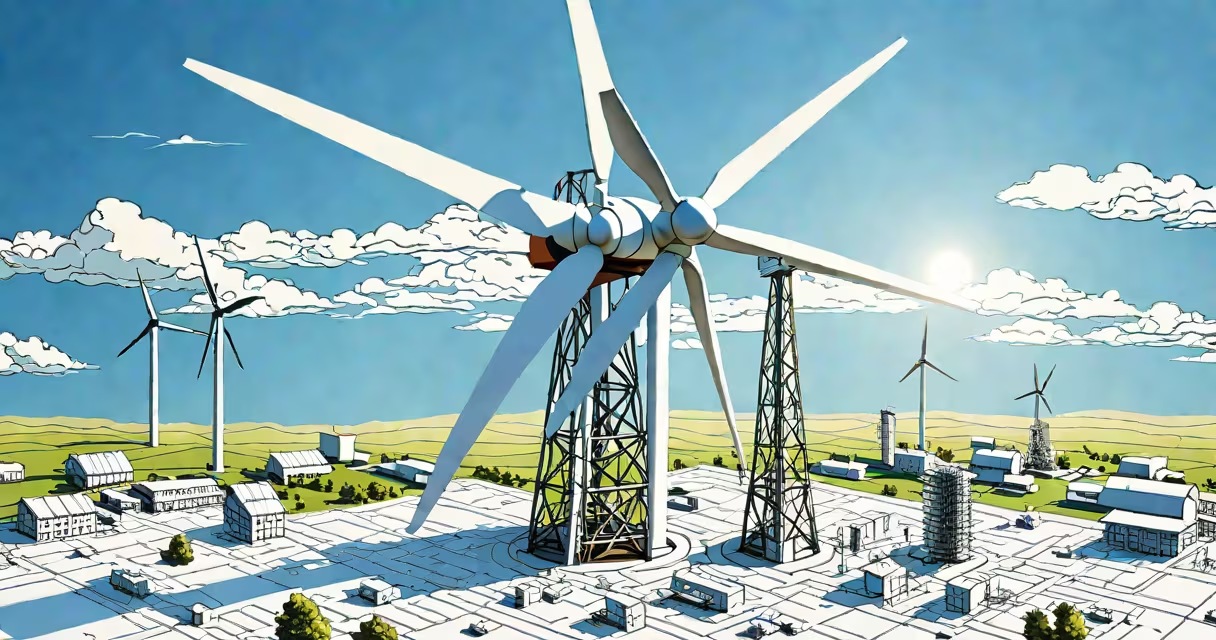
A wind turbine is a machine that converts kinetic energy from wind into electrical power through rotating blades connected to a generator. It operates on the principle that moving air exerts force on surfaces, which can be captured and transformed into usable energy.
Wind turbines are central to modern renewable energy systems. They consist of several mechanical and electrical components working together to produce electricity. The most common type is the horizontal-axis wind turbine, which has three blades mounted on a rotor hub connected to a nacelle housing the generator and gearbox.
According to the U.S. Department of Energy, a single utility-scale wind turbine can generate enough electricity to power about 1,500 homes annually. This output depends on wind speed, turbine size, and location. Modern turbines are designed to start generating power at wind speeds as low as 3 meters per second (about 6.7 mph).
When wind blows across the blades, it creates lift, similar to how airplane wings work. The pressure difference between the windward and leeward sides causes the blades to rotate. This rotation turns a shaft connected to a gearbox, which increases the rotational speed to match the requirements of the generator.
The generator then converts the mechanical energy into electrical energy. This electricity is sent through cables down the tower to a transformer, which steps up the voltage for transmission over long distances via power lines. The entire process happens automatically, with sensors adjusting blade pitch and yaw direction to face the wind optimally.
For example, a 2.5 megawatt (MW) turbine operating at 40% capacity factor-meaning it runs at 40% of its maximum output over time-produces approximately 8.7 million kilowatt-hours (kWh) per year. That's enough to supply about 800 average U.S. households with electricity annually.
Wind turbines have five core parts: blades, rotor hub, nacelle, tower, and foundation. The blades are typically made from fiberglass-reinforced polymer or carbon fiber for strength and lightness. The rotor hub connects the blades to the main shaft. The nacelle houses the gearbox, generator, brake system, and control electronics.
Towers are usually tubular steel, ranging from 60 to 120 meters tall. Taller towers access stronger, more consistent winds at higher altitudes. Foundations are either monopiles (for offshore installations) or reinforced concrete bases (onshore).
| Type | Blade Orientation | Use Case | Efficiency Range |
|---|---|---|---|
| Horizontal-axis | Parallel to ground | Utility-scale wind farms | 40-50% |
| Vertical-axis | Perpendicular to ground | Urban or low-wind areas | 20-30% |
Horizontal-axis turbines dominate the market due to higher efficiency and scalability. Vertical-axis models are less common but useful in turbulent urban environments where wind direction changes frequently. They're also quieter and require less maintenance, though they produce less power per unit size.
Wind turbines are deployed in regions with consistent wind patterns. Onshore sites include plains, hilltops, and coastal areas. Offshore wind farms are growing rapidly in Europe and North America, where wind speeds are higher and land space is limited.
Denmark generates over 50% of its electricity from wind power, according to the International Renewable Energy Agency (IRENA). In Texas, wind accounts for nearly 30% of total electricity generation. These figures show that wind turbines are not experimental-they're a proven part of national grids.
One notable example is the Hornsea Project One offshore wind farm in the UK. With 174 turbines, each rated at 7 MW, it produces over 1.2 gigawatts (GW) of power-enough for more than 1 million homes. The project uses advanced monitoring systems to adjust blade angles in real time based on weather data.
Many people assume wind turbines are noisy. Modern designs operate quietly, producing around 40 decibels at 300 meters away-comparable to a quiet conversation. The "swishing" sound often heard is actually the aerodynamic noise from blade tips moving near the speed of sound, not mechanical grinding.
Another misconception is that wind turbines harm birds. A 2020 study published in *Biological Conservation* found that bird mortality from wind turbines is far lower than from buildings, vehicles, and domestic cats. For every bird killed by a turbine, over 100 die from collisions with windows and cars.
There's also confusion between wind turbines and windmills. While both capture wind energy, windmills historically powered mechanical processes like grain milling or water pumping. Wind turbines are electric generators designed specifically for grid integration. A windmill might turn a millstone; a wind turbine powers a city.
I once visited a wind farm in Iowa during a high-wind event. The turbines were operating at near-maximum output. Standing 100 meters from one, I felt the vibration through my boots-not from the turbine itself, but from the ground transmitting low-frequency sound waves. The visual impact was striking: rows of massive blades turning slowly against a stormy sky, generating clean power despite the weather.
This experience confirmed that wind turbines are not just symbols of sustainability-they function reliably under real conditions. Their performance data shows consistent output over years, even in variable climates.
Wind turbines are a critical tool in reducing reliance on fossil fuels. They emit no greenhouse gases during operation and have a lifecycle carbon footprint lower than coal or natural gas plants. According to the National Renewable Energy Laboratory (NREL), the average wind turbine offsets about 1,800 metric tons of CO₂ annually-equivalent to removing 400 cars from the road.
As global demand for clean energy grows, wind turbines remain among the most efficient and scalable solutions available. Their role in climate mitigation, energy independence, and rural economic development continues to expand.
What is a wind turbine? It is a device that captures wind energy and transforms it into electricity using rotating blades and electromagnetic induction. Its widespread deployment proves it's not just a concept-it's a functioning, high-efficiency component of the modern energy system.