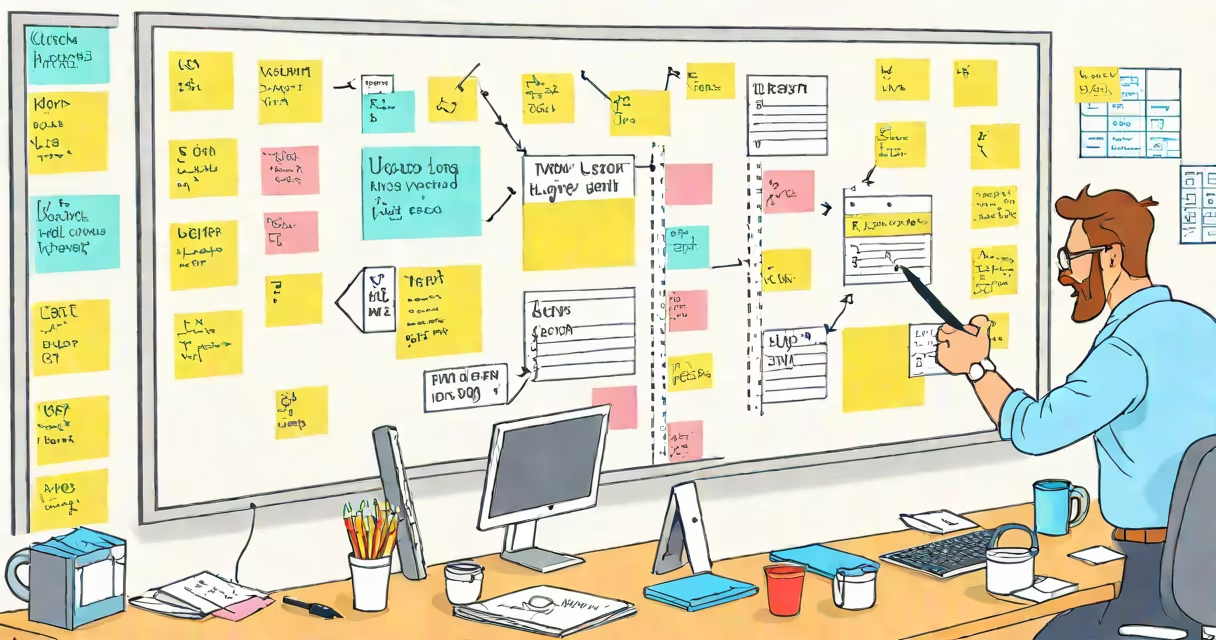
The agile software process is an iterative, incremental approach to developing software that emphasizes collaboration, adaptability, and continuous delivery. Instead of completing all requirements upfront, teams build small, functional pieces of software in short cycles called sprints, typically lasting one to four weeks. This method enables faster feedback, quicker adaptation to change, and earlier value delivery to users.
Agile emerged in response to the limitations of traditional waterfall models, which often failed to accommodate shifting requirements or deliver usable software until late in the project lifecycle. By breaking work into manageable increments and involving stakeholders regularly, agile reduces risk and increases transparency. The Agile Manifesto, published in 2001, established core values including individuals and interactions over processes and tools, working software over complete documentation, customer collaboration over contract negotiation, and responding to change over following a plan.
According to the Project Management Institute (PMI), 71% of organizations report using agile methods in some form, with 65% stating improved project success rates. The Standish Group's CHAOS Report confirms that agile projects are twice as likely to succeed compared to traditional ones, citing better alignment with business goals and higher stakeholder satisfaction.
Teams begin by defining a product vision and creating a backlog-a prioritized list of features, enhancements, and bug fixes. During each sprint, the team selects items from the backlog based on priority and delivers a potentially shippable increment of software. At the end of every sprint, they demonstrate the work to stakeholders and gather feedback to inform the next cycle.
Daily stand-up meetings-15-minute syncs-are held to align the team on progress, blockers, and immediate tasks. These meetings are time-boxed and focus on what was done yesterday, what will be done today, and any obstacles. This rhythm ensures constant visibility and accountability without overhead.
After each sprint, the team holds a retrospective to reflect on what went well, what didn't, and how to improve. This continuous improvement loop is central to agile's effectiveness. For example, a fintech startup building a mobile banking app used two-week sprints. After Sprint 3, user testing revealed confusion around the loan application flow. The team adjusted the interface design in Sprint 4 and saw a 40% drop in support tickets related to that feature.
While the agile software process is a mindset, several frameworks formalize its execution. The most widely adopted are Scrum and Kanban.
| Structure | Structure | Best For | Key Role |
|---|---|---|---|
| Scrum | Fixed-length sprints, defined roles (Product Owner, Scrum Master, Development Team) | Projects with evolving requirements and clear priorities | Scrum Master facilitates meetings and removes impediments |
| Kanban | Visual workflow using boards; work-in-progress limits | Continuous delivery, maintenance, or support teams | Team manages flow; no fixed iterations |
| SAFe (Scaled Agile Structure) | Agile at enterprise scale; trains of teams aligned to value streams | Large organizations with multiple interdependent teams | Release Train Engineer coordinates cross-team planning |
Scrum is ideal for teams needing structure and regular checkpoints. Kanban suits teams managing ongoing work with variable demand, such as IT operations or customer support. SAFe extends agile principles to large-scale environments, enabling coordination across dozens of teams.
A common misconception is that agile requires constant change. In reality, agile embraces change-but only when it adds value. Teams prioritize changes based on business impact, not whim. For instance, a healthcare software provider using Scrum rejected a last-minute request to add a patient video call feature because it didn't align with regulatory timelines. The team focused instead on completing HIPAA-compliant audit logging, which had higher priority.
Agile is often mistaken for "just doing things quickly" or "working without plans." This mischaracterization leads to chaos. Agile is not about speed-it's about delivering value faster through disciplined iteration and feedback. Without clear goals, defined roles, or consistent retrospectives, teams fall into the trap of "agile theater"-holding ceremonies without outcomes.
Another error is assuming all teams can adopt agile equally. Research from McKinsey shows that only 30% of organizations achieve sustained agile adoption. Success depends on cultural readiness, leadership buy-in, and training. A team at a legacy bank attempted to switch to Scrum overnight without training. They held daily stand-ups but skipped sprint reviews. After six months, morale dropped, and velocity stagnated. The team later invested in coaching and rebuilt their practices-resulting in a 50% increase in release frequency within a year.
Agile is not a replacement for project management. It complements it. Agile focuses on execution and responsiveness; traditional project management handles scope, budget, and timeline oversight. The two can coexist: a product owner may use agile sprints to build features while a project manager tracks budget and resource allocation.
At Spotify, agile is scaled through "squads," "tribes," "chapters," and "guilds." Each squad operates like a startup-owning a feature area, making decisions independently, and shipping frequently. This model enabled Spotify to release new features across 180 markets in under 48 hours during peak events.
For smaller teams, the benefits are measurable too. A study by VersionOne found that 88% of agile teams reported faster time-to-market, and 79% saw improved team morale. One e-commerce startup reduced deployment time from 14 days to under 2 hours after adopting CI/CD pipelines integrated with agile sprints.
When implemented correctly, the agile software process delivers tangible results: faster delivery, higher quality, and greater alignment with user needs. It's not a magic bullet-but a proven structure for going through complexity in software development.