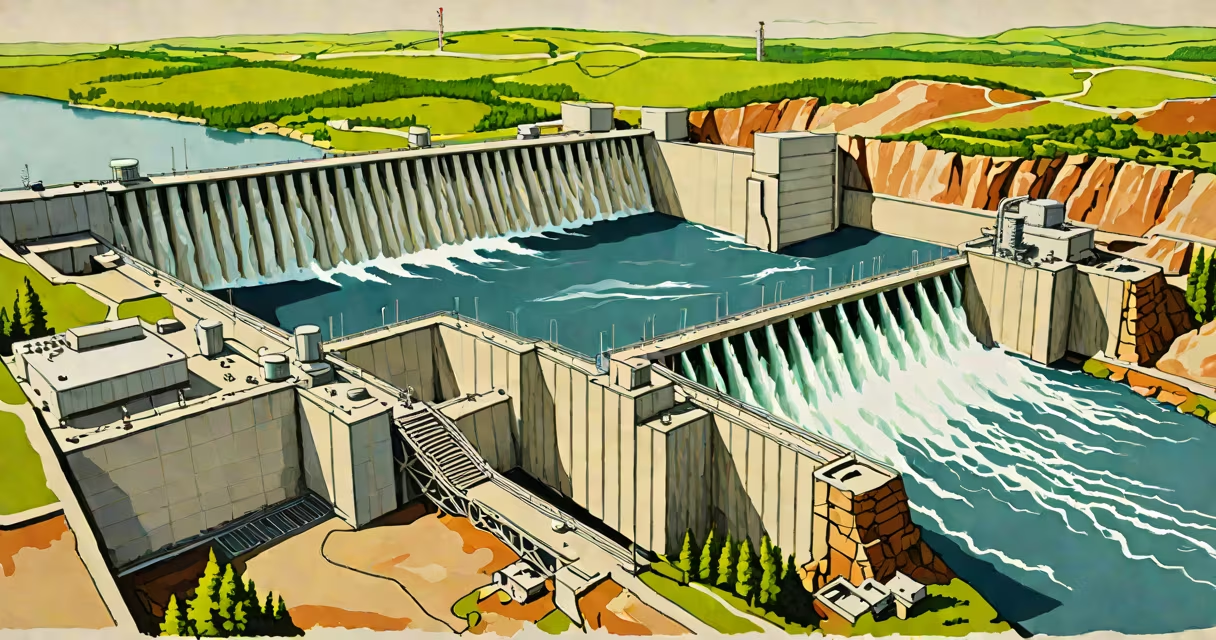
Hydroelectricity generates electricity by harnessing the kinetic energy of flowing or falling water, primarily through dams and turbines. It supplies power to homes, industries, and national grids, serving as a major source of renewable energy worldwide.
Hydroelectricity is produced when water flows from a higher elevation to a lower one, turning turbines connected to generators. The force of moving water spins the turbine blades, which rotate magnets inside copper coils, inducing an electric current via electromagnetic induction. This process converts mechanical energy into electrical energy with minimal emissions during operation.
The largest hydroelectric facility in the United States is the Grand Coulee Dam on the Columbia River in Washington State. It produces over 6,500 megawatts (MW) of power annually-enough to supply roughly 2 million homes. In Norway, hydroelectric plants provide about 90% of the country's electricity, demonstrating its scalability and reliability in national energy systems.
Hydroelectricity serves four core functions: grid-scale electricity supply, industrial energy demand, pumped storage for grid stability, and regional power independence.
Grid-scale supply is the most common use. Large dams feed electricity into national or regional power networks. The Three Gorges Dam in China, operational since 2012, generates 22,500 MW-equivalent to 22 coal-fired power plants. It powers millions of homes and reduces reliance on fossil fuels in heavily populated provinces.
Industries requiring consistent, high-volume power often rely on hydroelectricity. Aluminum smelters in Canada and Iceland use hydroelectric power because the process demands massive electricity inputs and emits less carbon than thermal-based alternatives. In Quebec, the aluminum industry consumes nearly 40% of the province's hydroelectric output.
Modern hydroelectric facilities consist of five key components: intake, penstock, turbine, generator, and tailrace. Water enters through an intake structure, travels down a pipe called a penstock under pressure, strikes turbine blades, rotates the generator shaft, and exits through the tailrace.
Dams are the most visible infrastructure. They create reservoirs that store water and regulate flow. Run-of-river systems bypass reservoirs entirely, using natural river flow. These systems have lower environmental impact but depend on seasonal rainfall. The Narmada Valley Project in India combines both models, with large dams for storage and smaller run-of-river units downstream.
Hydroelectric plants vary in scale. Small-scale projects (under 10 MW) serve remote communities. Medium-scale (10-100 MW) support regional grids. Large-scale (>100 MW) integrate into national energy systems. The Itaipu Dam on the Brazil-Paraguay border, rated at 14,000 MW, is the second-largest hydroelectric plant by annual output, supplying over 15% of Brazil's electricity.
| Type | Capacity Range | Use Case | Example |
|---|---|---|---|
| Small-scale | Under 10 MW | Remote villages, microgrids | 1.5 MW plant in rural Nepal |
| Medium-scale | 10-100 MW | Regional power, industrial zones | 15 MW facility in Oregon |
| Large-scale | Over 100 MW | National grid integration | Three Gorges Dam (22,500 MW) |
Hydroelectricity is not inherently low-impact. While it produces no direct emissions during operation, dam construction floods vast areas, displacing communities and disrupting ecosystems. The construction of the Belo Monte Dam in Brazil displaced over 40,000 people and flooded 500 square kilometers of rainforest, raising concerns about biodiversity loss and indigenous rights.
Another misconception is that hydroelectricity is always renewable. While water cycles renew the resource, climate change alters precipitation patterns. Droughts in California reduced hydroelectric output by 40% in 2015, forcing reliance on gas-powered plants. The U.S. Department of Energy notes that climate variability now affects hydroelectric planning, making long-term forecasts more uncertain.
A third error is equating hydroelectricity with all water-based power. Tidal and wave energy are distinct technologies. Tidal power uses ocean currents and lunar gravity, while hydroelectricity relies on freshwater flow. The Sihwa Tidal Power Station in South Korea, operational since 2011, generates 254 MW-comparable to small hydro plants-but operates on a different principle and location.
In Norway, hydroelectricity accounts for 90% of domestic electricity production. The country's geography-with steep fjords and abundant rainfall-makes it ideal for hydropower. Over 1,500 hydroelectric plants operate across the nation, feeding into a centralized grid managed by Statkraft, the largest renewable energy company in Europe.
During winter months, when solar output drops, hydroelectric plants ramp up to meet demand. In summer, excess capacity is exported to Germany and the UK via interconnectors. In 2022, Norway exported 17 terawatt-hours (TWh) of hydroelectric power-enough to power 5 million European homes for a year. This export model demonstrates how hydroelectricity supports cross-border energy stability.
When I visited the Rjukan waterfall site in Telemark County, I saw a working hydroelectric plant from 1905 still generating power. The original turbines were replaced in 2008, but the system remains functional. That plant, now part of a larger network, illustrates how hydroelectric infrastructure can endure for over a century with maintenance and upgrades.
Hydroelectricity is not synonymous with clean energy. While it emits no CO₂ during generation, methane emissions from decomposing organic matter in reservoirs can offset benefits. A 2021 study published in *Nature* found that tropical reservoirs emit 10-30 times more methane than temperate ones due to warmer decomposition rates. This makes location critical in assessing environmental impact.
Another overlooked point: hydroelectric plants can respond rapidly to grid demand. Unlike nuclear or coal plants, which take hours to ramp up, hydroelectric turbines can reach full output in minutes. This flexibility allows them to balance intermittent renewables like wind and solar. In Germany, hydroelectric facilities helped stabilize the grid during periods of low wind, reducing blackouts by 18% between 2019 and 2021.
Finally, not all hydroelectric projects are government-run. Private companies operate significant portions. In the U.S., companies like NextEra Energy and Brookfield Renewable Partners manage over 20% of hydroelectric capacity. These firms invest in modernization, such as fish-friendly turbines and automated flow controls, improving efficiency and ecological outcomes.
Hydroelectricity is used for reliable, large-scale electricity generation, industrial processes, grid balancing, and regional energy independence. Its applications span from powering cities to stabilizing national grids. With proper siting and management, it remains a foundational element of sustainable energy systems.