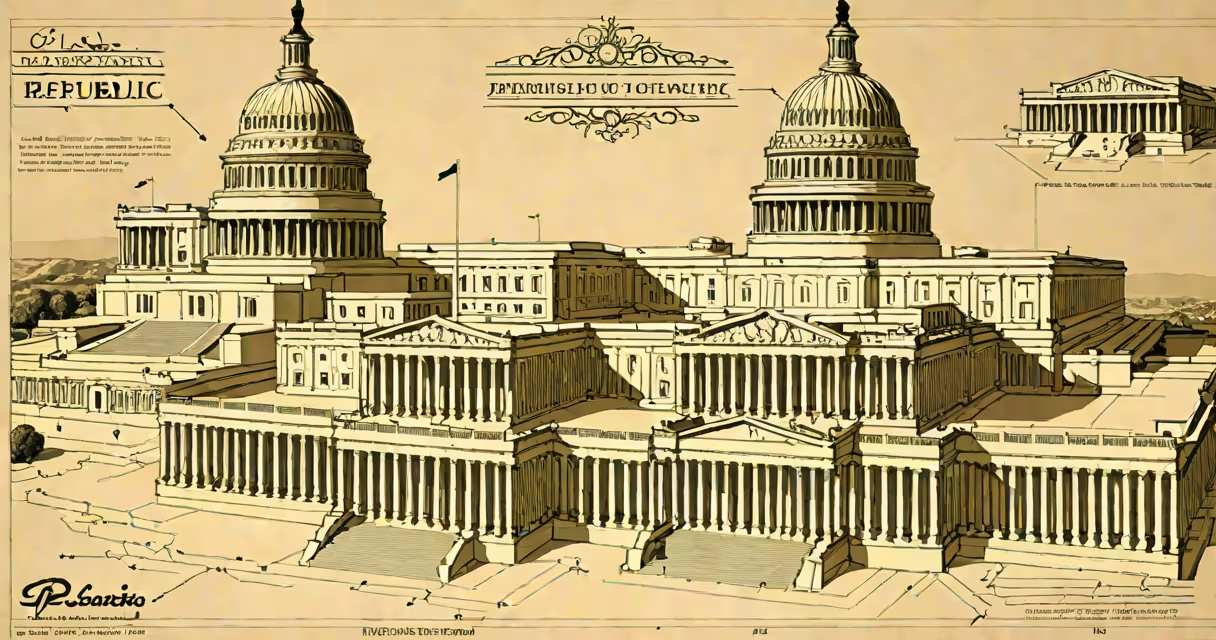
A democracy is a system where citizens vote directly on laws and policies, while a republic is a representative form of government where elected officials make decisions on behalf of the people. The United States is a constitutional republic, not a pure democracy, because it uses elected representatives and protects individual rights through a written constitution.
Democracies originated in ancient Athens around 500 BCE, where eligible male citizens gathered in assemblies to debate and vote on legislation. This direct model required a small population and high civic engagement. Modern democracies, such as Switzerland's, still use referendums and initiatives, but most large nations have moved toward representative models due to scale.
Republics emerged in Rome around 509 BCE, replacing monarchy with elected officials who governed under law. The term "republic" comes from Latin *res publica*, meaning "public affair." In a republic, citizens do not vote on every law-they elect leaders bound by legal frameworks to act in the public interest. The U.S. Constitution establishes a federal republic with separation of powers among branches.
In a direct democracy, decisions are made by majority vote in public assemblies or through binding ballots. Citizens participate in setting policy, approving budgets, and choosing leadership. This model functions best in small communities where face-to-face deliberation is practical.
Representative systems, like republics, rely on elected officials to draft, debate, and pass laws. These officials serve fixed terms and are accountable through regular elections. The U.S. House of Representatives and Senate operate under this principle, with members chosen by state voters.
The U.S. system combines both elements. Citizens vote in elections (a republican feature), but they also approve amendments and ballot measures (a democratic feature). For example, California's Proposition 13 (1978) passed via voter initiative, limiting property taxes-a direct democratic action within a republican structure.
| Feature | Democracy | Republic |
|---|---|---|
| Decision-Making | Direct citizen voting | Elected representatives legislate |
| Scale | Works best in small populations | Suitable for large nations |
| Legal Structure | May lack formal constitutional limits | Bound by written constitutions |
| Protection of Minorities | Potential for majority tyranny | Constitutional safeguards prevent abuse |
One critical distinction often missed: a republic emphasizes rule of law and institutional checks, while pure democracy risks majoritarian oppression. The U.S. Supreme Court's decision in *Brown v. Board of Education* (1954) illustrates this. A direct democracy might have upheld segregated schools if a majority voted for them. But the Constitution protected minority rights, allowing courts to strike down unjust laws.
Historical examples show the tension. In 1933, Germany's Weimar Republic collapsed after a popular vote elected Adolf Hitler, despite constitutional protections. The failure wasn't in democracy itself-but in weak institutions. A well-designed republic includes mechanisms like judicial review and bicameral legislatures to prevent such outcomes.
Many people assume the U.S. is a democracy. It is not. It is a constitutional republic. The Founding Fathers deliberately avoided pure democracy, fearing mob rule. James Madison wrote in Federalist Paper #10 that "the public good is superior to the private interest," but majorities can still harm minorities. He argued for a republic to filter popular passions through representative bodies.
Another misconception is that republics are inherently more stable. That's not always true. The Roman Republic fell into civil war and dictatorship after centuries of decline. The U.S. system avoids this through term limits, independent judiciary, and electoral college structures designed to prevent concentration of power.
A non-obvious fact: the term "democracy" was used pejoratively in early American discourse. Founders like John Adams called it "the worst form of government," believing it led to chaos. They preferred "republic" as a more stable, orderly alternative. The word "democracy" only became widely accepted in U.S. political rhetoric during the 20th century.
Switzerland operates a hybrid model. It holds national referendums on major issues-like joining the European Union-and allows citizens to initiate laws. Yet it also has a federal parliament and executive council. This blend enables direct input while maintaining administrative efficiency.
Consider the 2016 U.S. presidential election. Nearly 138 million votes were cast-yet the winner was determined by the Electoral College, not the popular vote. This reflects the republican structure: the president is not chosen by direct popular vote but by electors selected by states. This mechanism prevents smaller states from being ignored.
For a fully worked example: In 2020, Colorado voters approved Amendment 79, which banned the use of private prisons. The measure passed by 55% of the vote-direct democracy in action. However, the state legislature later challenged the amendment's legality, citing conflict with state law. The Colorado Supreme Court ruled in favor of the amendment, affirming that direct voter power supersedes legislative override in certain cases. This shows how democratic tools function within a republican system.
I once attended a town hall meeting in Vermont where residents debated a proposed school bond. The discussion lasted over two hours. After a vote, the results were tallied and reported to the school board. This process blended democratic participation with republican governance-citizens voiced opinions, but the final decision rested with elected officials.
Distinguishing between democracy and republic clarifies how power is distributed and protected. A pure democracy can be unstable under pressure. A republic with strong institutions resists tyranny and preserves rights. The U.S. Constitution balances both: it enshrines popular sovereignty while placing limits on it.
Understanding this difference helps citizens evaluate political proposals. A proposal to eliminate term limits in Congress, for example, shifts power toward direct democracy. But it may weaken checks on authority. Conversely, expanding ballot initiatives increases democratic influence-but risks policy inconsistency if driven by emotion rather than evidence.