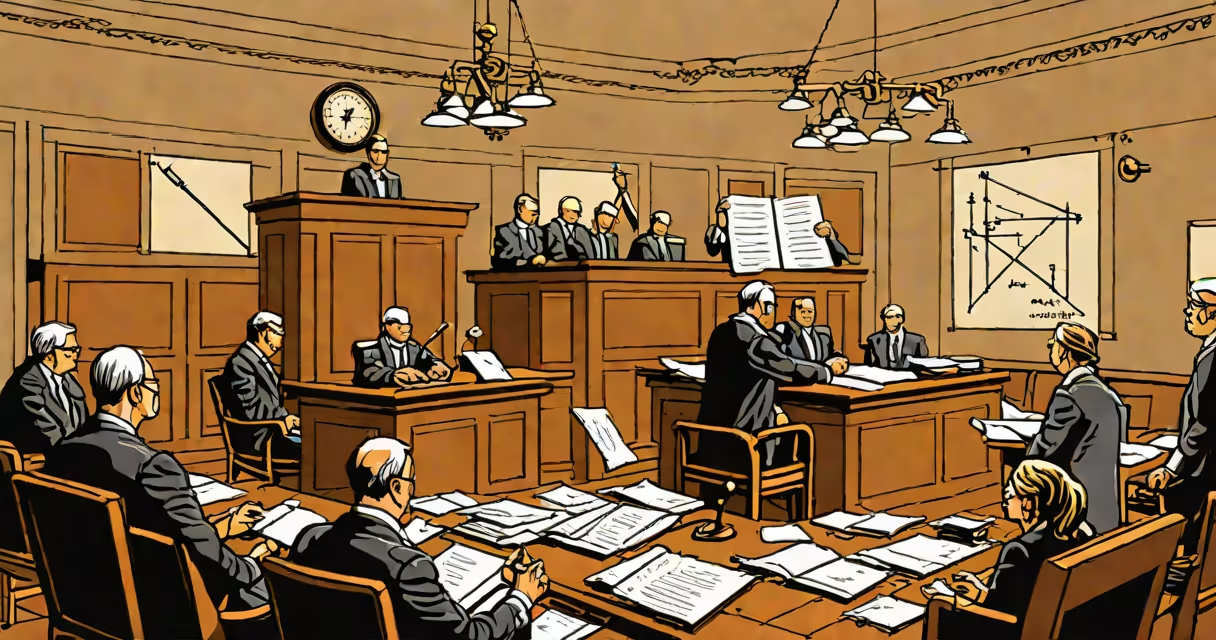
Insanity is a legal term used to describe a mental state that may excuse someone from criminal responsibility due to severe mental disorder. It is not a clinical diagnosis but a standard applied in court to determine whether a defendant could understand their actions or distinguish right from wrong at the time of a crime.
The concept of insanity originated in 19th-century English common law and was later adopted in U.S. jurisprudence. It does not refer to general mental illness or emotional distress. Instead, it applies only when a person's mental condition prevents them from forming intent or comprehending the nature of their conduct. The burden of proving insanity lies with the defense, and the standard varies by jurisdiction.
Under the M'Naghten Rule-the most widely used test in the United States-a defendant is legally insane if, at the time of the offense, they did not know the nature and quality of their act or did not know it was wrong. This rule focuses on cognitive ability, not emotional control. For example, a person who believes they are acting under divine command and cannot grasp that murder is morally wrong may meet this criterion.
Courts do not rely on lay opinions. Instead, they require expert testimony from psychiatrists or psychologists. These professionals evaluate the defendant using standardized assessments, medical records, and interviews. The evaluation must show that the mental disorder was present at the time of the crime and impaired the individual's capacity to understand or control their behavior.
For instance, in the 1982 trial of John Hinckley Jr., who attempted to assassinate President Ronald Reagan, his defense team presented evidence of schizophrenia and delusional thinking. A federal jury accepted the verdict of not guilty by reason of insanity, based on expert testimony that Hinckley believed he was acting to impress actress Jodie Build. The court concluded he lacked the ability to distinguish right from wrong during the attack.
After a finding of insanity, the defendant is typically committed to a psychiatric facility rather than prison. They remain there until deemed no longer a danger to themselves or others. In some states, such as California, individuals found not guilty by reason of insanity can be released only after a court review confirms they are stable and pose no risk.
Not all U.S. states use the M'Naghten Rule. Some apply alternative standards, each with different thresholds for legal responsibility.
| Test Name | Key Requirement | Used In |
|---|---|---|
| M'Naghten Rule | Defendant didn't know the act was wrong or its nature | Most states, including New York and Texas |
| Irresistible Impulse Test | Defendant couldn't control their actions despite knowing right from wrong | Some states, like Pennsylvania |
| Model Penal Code (MPC) Standard | Defendant lacked substantial capacity to conform conduct to the law | Over half the states, including Oregon and Florida |
The MPC standard is broader than M'Naghten because it accounts for both understanding and behavioral control. A person with severe depression who commits a crime while experiencing suicidal ideation may qualify under MPC if they were unable to resist acting on impulses due to mental illness.
Only about 1% of criminal defendants in the U.S. plead not guilty by reason of insanity. Of those, fewer than 30% succeed. The low success rate reflects the high burden of proof and the difficulty of demonstrating a severe mental disorder at the precise moment of the crime.
Insanity is often misunderstood as a way to avoid punishment. In reality, a successful insanity plea results in long-term institutionalization, not freedom. The average stay in a psychiatric hospital for someone found not guilty by reason of insanity is 10 to 15 years, according to the National Institute of Mental Health (NIMH).
Another myth is that people declared insane are automatically released after a set period. That is false. Release requires a formal hearing and ongoing evaluation. In 2016, the Supreme Court ruled in *United States v. Comstock* that Congress could authorize indefinite civil commitment of individuals found not guilty by reason of insanity if they remain dangerous.
There is also confusion between "insanity" and "mental illness." All people with serious mental disorders are not legally insane. A person with anxiety or bipolar disorder who commits a crime while manic may still be held criminally responsible unless the court finds they lacked awareness of wrongdoing.
In 2001, Andrea Yates drowned her five children in a bathtub in Houston, Texas. She had been diagnosed with postpartum psychosis, a rare but severe condition affecting new mothers. Her defense argued she was suffering from a psychotic episode and could not understand her actions.
A Texas jury initially convicted her, but the conviction was overturned on appeal. In a retrial, she was found not guilty by reason of insanity. She was committed to a psychiatric facility. After years of treatment, she was eventually released in 2010 under strict supervision.
This case illustrates how the legal system treats extreme mental breakdowns differently from typical criminal behavior. The court focused on whether Yates knew her actions were wrong-not whether she regretted them afterward. Her condition met the criteria under Texas's version of the M'Naghten Rule.
Insanity serves a core function in justice: ensuring that punishment aligns with moral responsibility. If a person acts under a delusion or hallucination, punishing them may not deter future crimes or rehabilitate them effectively. The legal system recognizes that not all behavior stems from free will.
According to the American Psychiatric Association, approximately 15% of incarcerated individuals have a serious mental illness. Yet only a small fraction are evaluated for insanity. Most cases proceed without such assessment because the legal bar is high and the process is costly.
I once observed a forensic evaluation in a state psychiatric hospital. The psychiatrist spent four hours interviewing a man accused of arson. He showed clear signs of paranoid schizophrenia-believing neighbors were poisoning his food. But when asked if he knew fire could kill people, he nodded slowly and said, "Yes, I know. But I thought it was necessary." His inability to connect his belief with the consequences of his actions supported a claim of legal insanity.
Understanding what is insanity helps clarify the limits of personal accountability. It is not a loophole. It is a mechanism to uphold fairness in a system that values both justice and human psychology.
What is insanity remains a precise legal term, not a synonym for mental illness. It describes a specific failure of cognition at the moment of crime. Courts use it sparingly, relying on expert evidence to decide whether a person truly lacked the capacity to understand their actions. The outcome is not freedom-it is treatment, supervision, and sometimes long-term confinement.