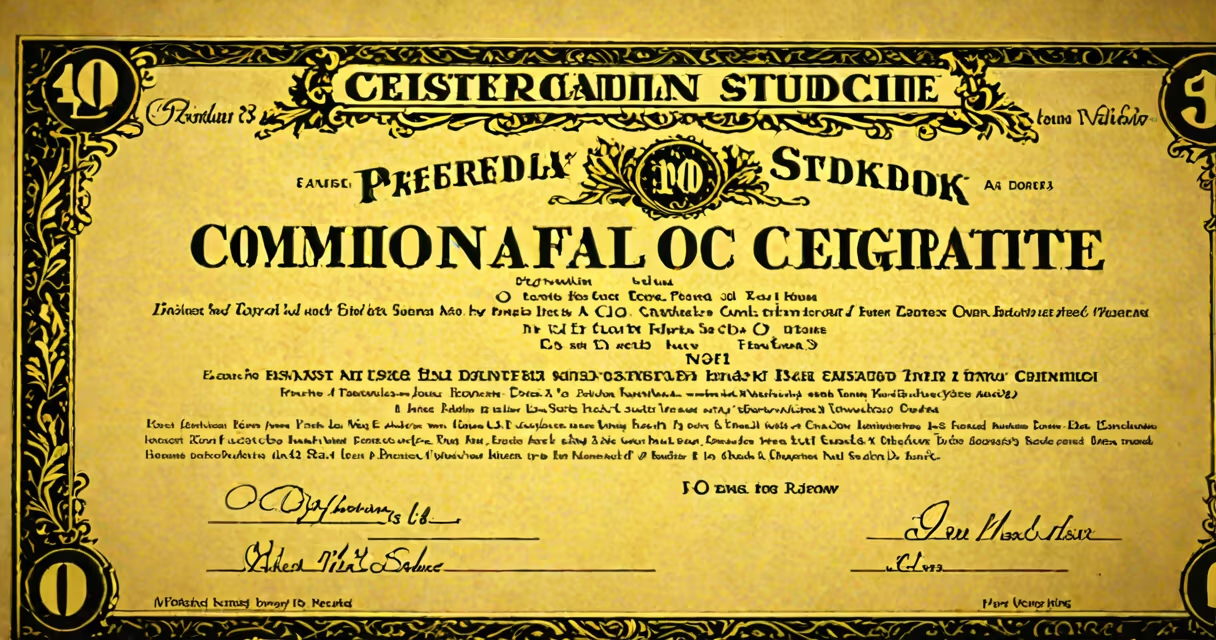
The par value of common stock is a nominal dollar amount assigned to each share during a company's incorporation, used primarily for legal capital purposes. It has no direct relationship to market price or intrinsic value. This figure appears on stock certificates and in corporate charters.
Par value is set by the issuing corporation and remains unchanged unless amended through a formal corporate resolution. It serves as a baseline for accounting entries during stock issuance and helps define minimum capital requirements under state law. Despite its presence in financial documents, par value rarely influences trading or investor decisions.
For example, a company might issue 100,000 shares of common stock with a par value of $0.01 per share. The total par value is $1,000, recorded as contributed capital on the balance sheet. Any amount received above this-say, $10 per share-is classified as additional paid-in capital.
When a company issues shares, the par value determines the minimum amount of capital it must report as "contributed" by shareholders. This is a legal safeguard, ensuring that equity cannot be issued below a stated value, though most states allow very low par values.
Under U.S. corporate law, particularly Delaware General Corporation Law (DGCL), companies may assign a par value as low as $0.01. Many modern corporations, including Apple and Amazon, use $0.01 par value for their common stock. This reflects a shift away from historical uses of par value as a proxy for fair value.
Consider a startup issuing 1 million shares at $10 per share with a $0.01 par value. The company records $10,000,000 in cash, $1,000 as par value (1,000,000 × $0.01), and $9,999,999 as additional paid-in capital. The difference between issue price and par value flows into retained earnings and equity accounts.
While most common stock has a nominal par value, some stocks are issued with no par value. These are designated as "no-par stock" and are legally permitted under Section 151 of the Delaware General Corporation Law. No-par stock eliminates the need to assign a minimum value, simplifying issuance and reducing compliance overhead.
| Type | Par Value | Use Case | Example Company |
|---|---|---|---|
| Low par value | $0.01 | Standard issuance; minimal legal capital requirement | Apple Inc. (AAPL) |
| No par value | None | Flexible pricing; common in startups and tech firms | Google (GOOGL) |
| Higher par value | $1.00 or more | Rare; used historically in utilities or regulated industries | Some regional electric providers |
Despite appearances, higher par values are uncommon today. The Securities and Exchange Commission (SEC) recognizes that par value is largely symbolic. As of 2023, over 90% of S&P 500 companies use either $0.01 par value or no par value.
Par value is frequently misunderstood as the actual value of a share. It is not. A share with a $0.01 par value can trade at $150 per share on the NYSE. Market price reflects supply, demand, earnings potential, and investor sentiment-not par value.
Another misconception is that par value affects dividends. It does not. Dividends are declared by the board based on net income and policy, not on par value. A company with $1 par value stock pays the same dividend per share as one with $0.01 par value, assuming equal payout ratios.
A lesser-known fact: par value can influence the treatment of stock splits and reverse splits. In a 2-for-1 split, the number of shares doubles, but par value is halved to maintain the same total par value. For example, 100,000 shares at $0.01 par value become 200,000 shares at $0.005 par value. This adjustment keeps the balance sheet consistent.
Par value still plays a role in corporate governance and regulatory filings. Form S-1, filed with the SEC during initial public offerings (IPOs), requires disclosure of par value. It helps auditors verify that equity accounts are properly structured.
Par value affects certain legal obligations. In some states, creditors may claim against a company's "capital surplus" if assets fall below liabilities. Par value contributes to the total capital base, which can affect solvency assessments under state insolvency laws.
From personal observation, I once reviewed the prospectus for a biotech IPO where the par value was listed as $0.001. The company raised $250 million in equity, with $250,000 attributed to par value and $249.75 million to paid-in capital. The low par value enabled flexible pricing and avoided unnecessary legal friction during registration.
Par value differs from both market price and book value. Market price is determined daily by trading activity. Book value per share is calculated as (total assets - total liabilities) ÷ number of outstanding shares. Par value is neither.
Similarly, NCR Corporation (NCR), a provider of retail and banking systems, has a par value of $0.01 per share. Its stock trades near $60 per share. The par value is immaterial to investment decisions. Yet it remains on the balance sheet as a component of contributed capital. If you're evaluating NCR's stock value, focus on revenue growth, margins, and free cash flow-not par value.
The par value of common stock is a legal formality, not a financial indicator. It establishes a baseline for capital reporting but does not reflect market value, earnings, or risk. Most companies use $0.01 par value or none at all. Understanding this distinction prevents confusion when reading financial statements or analyzing equity structures.
While the term appears in filings and balance sheets, it has little practical impact on investors. What matters is earnings, cash flow, and long-term strategy-not a nominal value assigned decades ago.