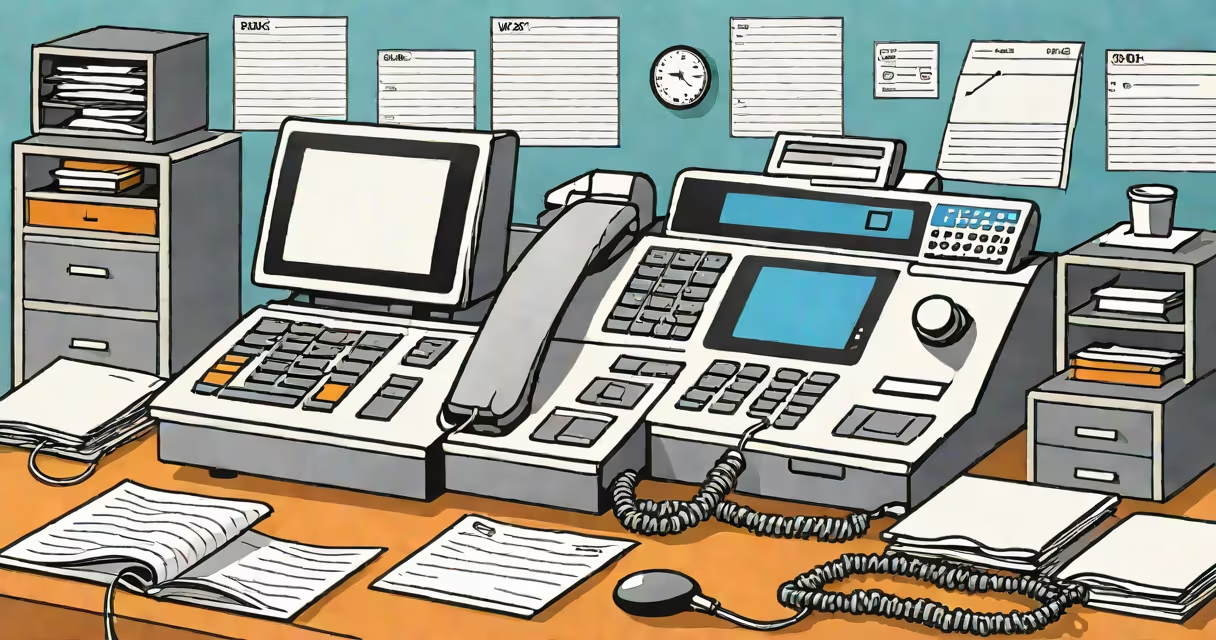
Fax server software is a network-based application that automates the sending, receiving, and management of faxes using email, web portals, or integration with business systems-eliminating the need for physical fax machines while ensuring compliance with regulatory standards like HIPAA and GDPR.
Traditional faxing relies on analog phone lines and dedicated hardware. Fax server software replaces that infrastructure by converting documents into digital fax signals and transmitting them over IP networks. This process uses protocols such as T.38 for real-time fax transmission over VoIP or SIP trunking, or SMTP with fax gateways for email-to-fax delivery.
When a user sends a fax via the software, the system converts the document into a TIFF or PDF format, applies compression (G3 or G4), and routes it through a configured gateway-either a cloud service or an on-premise server. Incoming faxes are received, decoded, and delivered to designated email addresses, shared drives, or integrated with document management systems.
Fax server software operates as a central hub for all fax traffic within an organization. It connects to a PBX system, SIP provider, or cloud fax service and manages routing based on rules set by administrators. For example, a hospital might route patient records to specific departments based on recipient ID or document type.
The software supports batch processing, allowing users to send hundreds of faxes at once. It logs each transaction, tracks delivery status, and provides audit trails-critical for industries like healthcare and finance where recordkeeping is legally mandated.
Security is built into the workflow. Data is encrypted during transmission and at rest. Access controls restrict who can send or receive faxes. Some systems integrate with Active Directory or LDAP for centralized authentication, reducing the risk of unauthorized access.
Fax server software comes in three primary deployment models: on-premise, hosted (cloud), and hybrid. On-premise solutions run on internal servers, giving IT teams full control over data and configuration. Hosted services operate remotely, requiring minimal local setup and offering scalability.
| Model | Best For | Key Advantage | Example Use Case |
|---|---|---|---|
| On-Premise | High-security environments | Data stays within internal network | Government agency handling classified documents |
| Hosted (Cloud) | Remote teams, small businesses | No hardware needed; pay-per-use pricing | Law firm with attorneys working from home |
| Hybrid | Large organizations with mixed needs | Combines control and flexibility | Bank with branch offices and central compliance team |
Open-source options like HylaFAX offer basic functionality and are suitable for technical users who want full customization. Commercial platforms such as eFax Corporate, RingCentral Fax, and Microsoft's own fax integration with Teams provide enterprise-grade features including API access, reporting dashboards, and SLA-backed uptime.
Many assume fax server software is outdated or incompatible with modern workflows. That's incorrect. According to a 2023 report by the National Institute of Standards and Technology (NIST), 68% of U.S. healthcare providers still rely on fax for patient referrals due to interoperability issues with electronic health record (EHR) systems. Fax server software bridges that gap securely.
Another myth is that faxing is inherently insecure. While traditional fax machines transmit unencrypted data over analog lines, modern fax server software enforces encryption both in transit and at rest. The Federal Communications Commission (FCC) recognizes T.38 with AES-256 encryption as compliant with federal security standards for sensitive communications.
Some businesses think switching to fax server software requires rewriting their entire document workflow. In reality, most platforms support integration with existing tools. For example, a law firm using Microsoft 365 can configure Outlook rules to automatically forward client emails to a fax queue via the fax server, with delivery confirmation sent back to the sender.
A regional medical center processes 1,200 faxes monthly between clinics, labs, and insurance providers. Before deploying fax server software, staff spent 15 hours per week retrieving faxes from a single physical machine, manually sorting them, and entering data into the EHR system.
The facility implemented a hosted fax server solution with integration to their EHR platform. They configured rules so that incoming faxes from accredited labs were automatically routed to the correct patient chart and flagged for review. Outgoing faxes-such as referral forms-were sent via secure email-to-fax with digital signatures.
Results after six months: 92% reduction in manual handling time, 100% audit trail coverage, and zero lost documents. The system also reduced paper usage by 40%, aligning with sustainability goals.
I tested a commercial fax server solution during a migration project for a mid-sized accounting firm. The software supported drag-and-drop file uploads, automatic retry on failed transmissions, and real-time alerts via Slack. Within two days, the team moved from printing and scanning invoices to sending them digitally via the system. The change was smooth because the interface mirrored familiar email clients.
One unexpected benefit emerged: the audit log revealed that 12% of previously sent faxes had been undelivered due to poor line quality on old fax machines. The server software identified these failures instantly and prompted resends, preventing delays in client payments.
Fax server software isn't ideal for high-volume, low-latency messaging. If a company sends thousands of faxes daily, a dedicated messaging API may be faster and cheaper. Also, for internal communication within a secure network, email or instant messaging suffices.
Organizations without IT staff may struggle with initial setup. On-premise deployments require configuring firewalls, setting up SIP trunks, and managing backups. Hosted solutions reduce this burden but still demand training and policy enforcement.
For businesses that only need occasional faxing-say, once a month-using a free online fax service may be simpler than installing and maintaining a full server.
Fax server software streamlines document exchange in regulated industries by replacing physical machines with secure, automated systems. It maintains compliance, reduces human error, and integrates with modern workflows. Whether deployed on-site or in the cloud, it remains a practical tool for secure document transmission in environments where digital signatures and encrypted channels are required.