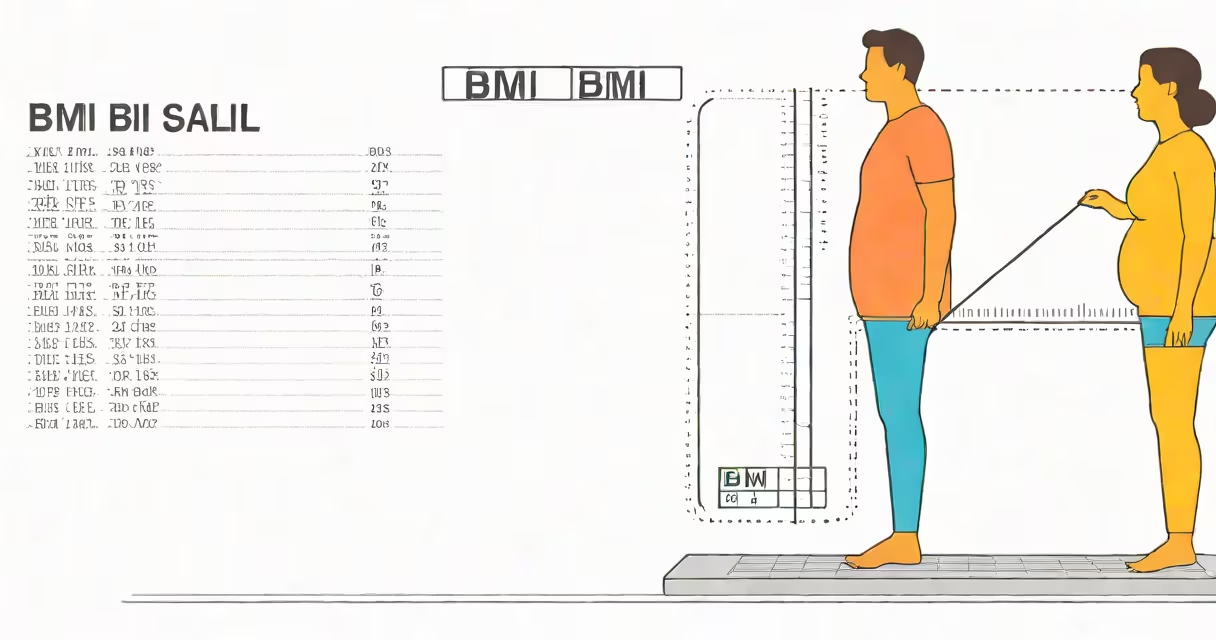
Body Mass Index (BMI) is a numerical value derived from a person's weight and height, used to categorize individuals into weight status groups such as underweight, normal weight, overweight, and obese. It serves as a screening tool for potential health risks linked to body composition, though it does not measure body fat directly.
BMI was developed in the 19th century by Belgian mathematician Adolphe Quetelet, who sought a simple way to compare population-wide weight distributions. Today, it remains a standard metric in public health and clinical settings due to its ease of calculation and widespread availability. The formula is weight in kilograms divided by the square of height in meters (kg/m²).
For example, a person weighing 70 kg and standing 1.75 m tall has a BMI of 22.86, which falls within the "normal weight" range (18.5-24.9). This classification suggests a lower risk for conditions like type 2 diabetes and cardiovascular disease compared to higher BMI values.
Clinicians use BMI to quickly assess whether a patient's weight may be contributing to health issues. A single number provides a baseline for further evaluation. For instance, a BMI above 30 indicates obesity, which correlates with increased risk for hypertension, sleep apnea, and certain cancers.
Public health agencies rely on BMI data to track population trends. The Centers for Disease Control and Prevention (CDC) reports that nearly 42% of U.S. adults had a BMI in the obese range in 2020, up from 31% in 2000. These statistics inform policy decisions on nutrition programs and preventive care funding.
BMI is not diagnostic. It cannot distinguish between muscle mass and fat. A professional athlete with high muscle density may have a BMI in the overweight category despite low body fat. This limitation underscores why BMI should be interpreted alongside other metrics like waist circumference, blood pressure, and lab results.
BMI is categorized into four main ranges based on international standards set by the World Health Organization (WHO). These categories are widely adopted globally, including in national health guidelines.
| BMI Range | Category | Health Risk Level |
|---|---|---|
| <18.5 | Underweight | Increased risk of malnutrition and osteoporosis |
| 18.5-24.9 | Normal weight | Lower risk for chronic diseases |
| 25.0-29.9 | Overweight | Moderate risk for metabolic syndrome |
| ≥30.0 | Obese | High risk for heart disease, stroke, and type 2 diabetes |
These ranges apply to adults aged 18 and older. Children and adolescents use age- and sex-specific percentiles because their bodies change rapidly during growth. The CDC provides growth charts for pediatric BMI assessments.
Some countries adjust thresholds slightly. For example, Asian populations often use a lower cutoff for overweight (23 kg/m²) due to higher rates of insulin resistance at lower BMIs compared to Western populations.
BMI is frequently misunderstood as a direct measure of health or fitness. It is not. A person with a BMI in the "normal" range can still have high visceral fat, poor diet quality, and sedentary habits-all of which increase disease risk.
A well-documented error is assuming BMI reflects body fat percentage. In reality, BMI correlates only moderately with actual body fat. Studies show that up to 30% of people classified as "normal weight" by BMI have excess visceral fat, a condition known as metabolically obese normal-weight (MONW).
Another misconception is that BMI applies equally across ethnic groups. Research published in *The Lancet* shows that South Asian populations develop type 2 diabetes at lower BMIs than White Europeans. This highlights the need for context-specific interpretations, especially in diverse healthcare settings.
I used BMI during a routine physical exam in 2021. My weight was 165 lbs (74.8 kg), and my height was 5'7" (1.70 m). My calculated BMI was 25.8, placing me in the overweight category. My doctor did not diagnose me as unhealthy-instead, they ordered blood tests and asked about exercise habits. The results showed normal glucose and cholesterol levels, confirming that BMI alone didn't tell the full story.
BMI remains a foundational tool in medicine and public health. Its strength lies in simplicity and scalability. But its limitations demand caution. It should never replace clinical judgment, detailed diagnostics, or individualized care plans.
The purpose of BMI is not to define health-but to flag potential concerns that warrant deeper investigation. Used responsibly, it supports early intervention. Misused, it leads to inaccurate assumptions and missed diagnoses.