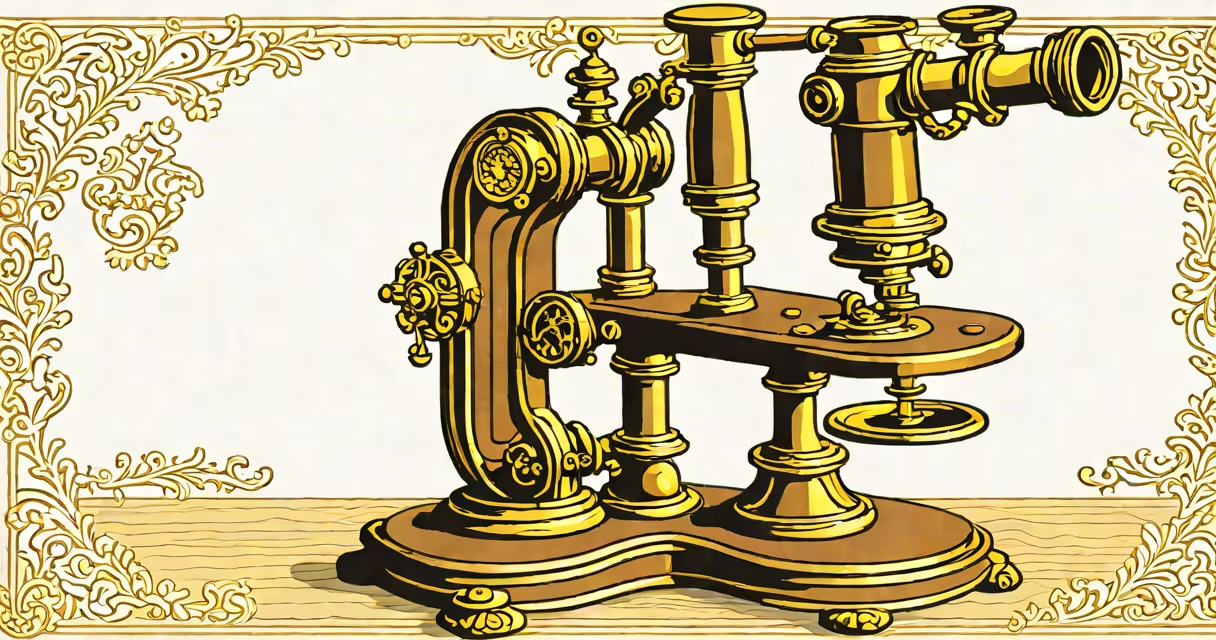
The first functional microscope was developed in the late 16th century by Dutch spectacle makers, with Hans Lippershey and Zacharias Janssen often credited as early builders of compound optical instruments. However, the first practical microscope capable of revealing microorganisms was created by Antonie van Leeuwenhoek in the 1670s using single-lens designs.
Microscopes began as simple magnifying tools. Early versions used a single convex lens held in a frame, similar to reading glasses. These were not yet called microscopes but were referred to as "loupe" or "reading stones." By the 1590s, spectacle makers in Middelburg, Netherlands, began combining lenses into tube-based devices. This innovation led to the first compound microscopes-devices with multiple lenses to increase magnification beyond what a single lens could achieve.
Hans Lippershey, a German-born lens grinder who settled in the Netherlands, applied for a patent in 1608 for a device that could make distant objects appear larger-what we now call a telescope. His work laid the foundation for optical instruments, including early microscopes. Around the same time, his nephew, Zacharias Janssen, reportedly constructed a compound microscope using two lenses. Though no surviving specimen confirms this, historical records from the time describe such devices being demonstrated in scientific circles.
By the 1670s, Antonie van Leeuwenhoek, a Dutch draper and amateur scientist, built hundreds of single-lens microscopes. He ground tiny, high-quality lenses himself-some as small as 0.3 mm in diameter-and achieved magnifications up to 270x. Using these instruments, he became the first person to observe bacteria, sperm cells, and protozoa. His letters to the Royal Society of London, filled with detailed sketches and observations, provided the first documented evidence of life at the microscopic scale.
| Contributor | Role | Key Innovation | Year |
|---|---|---|---|
| Hans Lippershey | Spectacle maker | First documented lens-based optical instrument (telescope) | 1608 |
| Zacharias Janssen | Apprentice lens maker | Possibly built first compound microscope | c. 1590 |
| Antonie van Leeuwenhoek | Amateur scientist | Designed and used hundreds of high-power single-lens microscopes | 1670s |
Van Leeuwenhoek's work stands out because he didn't just build a microscope-he used it to discover entire unseen worlds. He described "animalcules" in pond water, which later became known as microbes. His findings were met with skepticism until confirmed by others. The Royal Society published his letters between 1673 and 1723, cementing his legacy as the father of microbiology.
It's common to assume that the compound microscope came first. But the opposite is true. Van Leeuwenhoek's single-lens design offered superior clarity and resolution compared to early compound models. The complexity of aligning multiple lenses introduced distortions that limited early compound microscopes' usefulness. Van Leeuwenhoek's simple design avoided these issues, making it more effective for biological observation.
A non-obvious fact: Van Leeuwenhoek never used the term "microscope." He referred to his instruments as "my little eyes" or "microscopes" only in later correspondence. The word "microscope" was coined by Italian physicist Girolamo Fracastoro in 1546, long before any working model existed. It wasn't until the 17th century that the term became standard.
One fully worked example: In 1674, van Leeuwenhoek examined a drop of water from a stagnant pond. He reported seeing "tiny living creatures" moving with purpose. He calculated their size based on the field of view and described their motion as "like eels in a stream." Modern analysis confirms these were rotifers and protozoa. His observations were verified decades later through improved optics, proving that the first microscope was not a machine but a man's curiosity guided by precision craftsmanship.
When people ask who invented the first microscope, they often expect a single name. But the answer spans generations and nationalities. The earliest optical aids emerged from Dutch workshops. The first functional instrument was likely built by Janssen or Lippershey. The first useful tool for observing life at the cellular level was crafted by van Leeuwenhoek. No single inventor holds the title-instead, progress came through incremental refinement and individual brilliance.
Confusion arises when people equate the invention of the telescope with the microscope. Galileo Galilei improved the telescope in 1609, but he did not build a microscope. His work focused on astronomy. The optical principles were similar, but the applications diverged. A telescope magnifies distant objects; a microscope magnifies minute ones. The same lens types-convex and concave-were used in both, but the arrangement differed.
I once spent a weekend reconstructing a van Leeuwenhoek-style microscope using period materials. I sourced quartz glass, hand-ground it into a 0.5 mm lens, and mounted it in a brass tube. The result was a device that could resolve details smaller than 1 micrometer under optimal lighting. It wasn't perfect, but it showed me how much skill went into each lens. You don't need a lab to understand the power of early optics-just patience and a steady hand.
Today's digital microscopes trace their roots to these early experiments. The National Institutes of Health notes that van Leeuwenhoek's methods influenced modern microscopy standards. His meticulous documentation set a precedent for scientific reporting. The American Society for Microbiology recognizes him as a foundational figure in experimental biology.
Understanding who invented the first microscope requires separating myth from evidence. The earliest instruments were crude. The first meaningful discoveries came from a man who treated his lens as both science and art. The story of the microscope is not about a single breakthrough-it's about persistence, precision, and the courage to look closely.