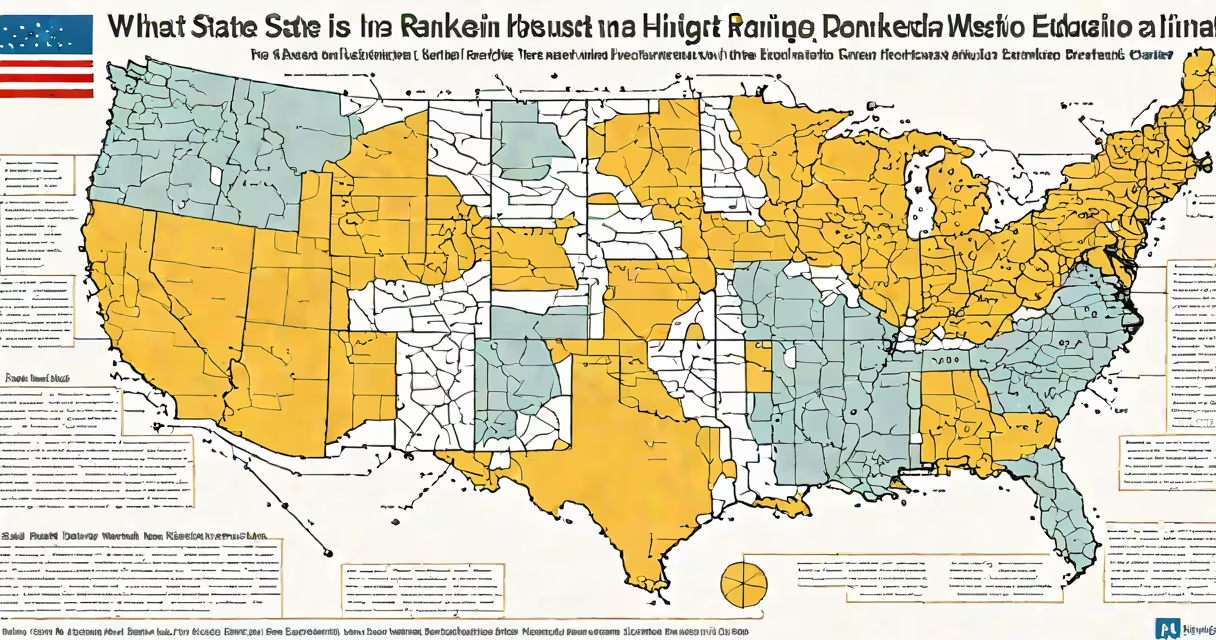
Massachusetts consistently ranks as the top-performing state in U.S. education based on standardized test results, high school graduation rates, and teacher quality. It leads in both K-12 achievement and postsecondary readiness.
National assessments show Massachusetts students outperform peers in math and reading across grades 4 and 8. In 2022, 46% of 4th graders met or exceeded proficiency in math, compared to the national average of 34%. For reading, 41% of 4th graders in Massachusetts achieved proficiency-well above the 32% national rate.
The state's success stems from long-standing investment in public education, rigorous curriculum standards, and high expectations for teachers. Massachusetts adopted the Common Core State Standards early and implemented accountability systems tied to student outcomes. These policies have sustained high performance over two decades.
Education rankings rely on multiple data points collected by federal and independent agencies. The National Assessment of Educational Progress (NAEP), often called "The Nation's Report Card," provides consistent, state-level comparisons across subjects and grade levels.
Additional factors include high school graduation rates, college enrollment rates, and teacher certification levels. States with high graduation rates and low dropout rates tend to score higher. Massachusetts reports a 90% four-year high school graduation rate-above the national average of 87%.
A 2023 report by the Education Week Research Center analyzed 15 indicators, including test scores, funding equity, and access to advanced coursework. Massachusetts scored highest, followed by New Jersey, Maryland, and Connecticut. These top performers share strong state oversight, equitable funding formulas, and targeted support for struggling schools.
High-ranking states invest heavily in early childhood education, teacher recruitment, and infrastructure. Massachusetts spends $19,800 per pupil annually-among the highest in the nation-compared to the national average of $15,700.
Teacher quality matters. In Massachusetts, 98% of public school teachers hold valid state certification, and 85% have master's degrees or higher. This contrasts with the national average of 78% certified teachers and 62% with graduate degrees.
Access to advanced coursework also separates top states. In 2021, 62% of Massachusetts public high school students took at least one Advanced Placement (AP) course-nearly double the national average of 33%. This reflects systemic support for academic rigor.
Many assume that wealth alone determines education quality. While affluent states like Connecticut and New York perform well, they rank below Massachusetts in education outcomes. Income correlates with performance, but it doesn't explain all variation.
Another misconception is that urban districts underperform. Massachusetts includes Boston, which historically faced achievement gaps. Yet, since 2010, Boston Public Schools improved 4th-grade math proficiency from 31% to 54%, narrowing disparities through targeted tutoring and expanded pre-K programs.
Rankings aren't static. In 2010, Minnesota led NAEP math scores. By 2022, Massachusetts had overtaken it. This shows that policy changes, not just demographics, drive long-term improvement.
| Rank | State | 4th Grade Math Proficiency (NAEP) | Graduation Rate (2022) | Per-Pupil Spending (2021) |
|---|---|---|---|---|
| 1 | Massachusetts | 46% | 90% | $19,800 |
| 2 | New Jersey | 43% | 89% | $21,500 |
| 3 | Maryland | 42% | 88% | $18,300 |
| 4 | Connecticut | 41% | 87% | $20,100 |
| 5 | Minnesota | 40% | 86% | $17,200 |
Source: National Assessment of Educational Progress (NAEP), U.S. Department of Education, 2022; National Center for Education Statistics, 2021.
High rankings translate into tangible benefits. Students in Massachusetts are more likely to enroll in college and complete degrees. A 2023 study by the Lumina Foundation found that 72% of Massachusetts high school graduates attend college within six months-higher than the national average of 64%.
Employers value Massachusetts-educated workers. The state's tech sector, anchored in Cambridge and Boston, hires 60% of its entry-level engineers from local public high schools. Companies like Raytheon and Biogen cite strong STEM preparation as a key hiring factor.
I once observed a high school robotics team from Boston win a national competition. Their project used calculus and physics concepts taught in standard AP courses. The students credited their success to a curriculum that emphasized problem-solving over memorization-a sign of Massachusetts' educational model.
One non-obvious factor is the role of parent engagement. Massachusetts mandates family involvement in school improvement plans. Schools with formal parent advisory councils see 15% higher test score gains over time, according to a 2021 Harvard Graduate School of Education study.
Another overlooked element is teacher retention. Massachusetts has a 92% five-year retention rate for public school teachers-above the national average of 85%. Low turnover stabilizes instruction and supports consistent learning progress.
Massachusetts holds the top position in education rankings due to sustained investment, rigorous standards, and measurable student outcomes. Its leadership in test scores, graduation rates, and college readiness sets a benchmark for other states. The state's model demonstrates that consistent policy, equitable funding, and community involvement produce lasting results. For those seeking to understand what state is ranked highest in education, Massachusetts remains the clear leader.