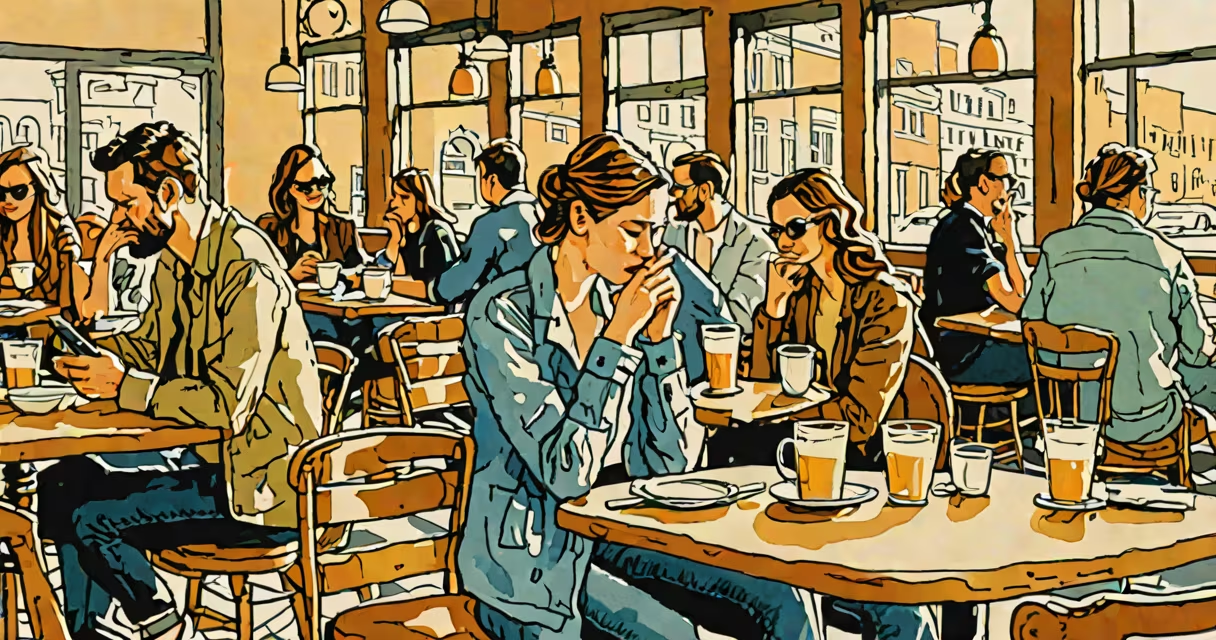
Feeling disliked by others is a widespread human experience, often driven by internal biases rather than actual social rejection. This sensation arises from misreading social cues, overestimating negative judgment, and interpreting neutral behavior as personal rejection.
People don't inherently dislike you because of who you are. Instead, the feeling stems from how your mind interprets interactions-especially when attention is focused inward. You may notice subtle shifts in tone, silence during conversation, or lack of eye contact and interpret them as signs of disapproval. But those moments often reflect the other person's mood, distraction, or cultural norms-not your worth.
Research shows that individuals frequently overestimate how much others notice them. A 2017 study published in *Nature Human Behaviour* found that people believe they're being evaluated more harshly than they actually are. Participants judged themselves as more awkward and less likable than observers rated them-confirming a gap between self-perception and reality.
Your brain is wired to detect threats, especially social ones. Evolutionarily, being excluded from a group meant higher risk of survival. As a result, humans are hypersensitive to signs of exclusion-even when none exist. This is known as the "spotlight effect," where you assume everyone is watching and judging you more closely than they actually are.
For example, someone walks past you without smiling. Your mind might instantly label that as "dislike." But the person may have been distracted, stressed, or simply following a cultural norm where brief eye contact is enough. A 2021 review in *Journal of Personality and Social Psychology* confirmed that people consistently misattribute neutral expressions to hostility, especially under stress or fatigue.
Another factor is rumination-the habit of replaying interactions in your head. After a meeting, you might dwell on a pause in conversation or a comment that felt cold. But in reality, most people forget such moments within minutes. A 2019 study from the University of Michigan showed that participants recalled their own social blunders as far more significant than others did-often exaggerating the impact.
Several patterns distort how we see social feedback:
These aren't flaws in your personality-they're predictable outcomes of how the human brain processes social information. Even people with strong social skills report feeling isolated at times. That doesn't mean they're unpopular. It means the brain sometimes lies to protect you from perceived danger.
While most feelings of being disliked stem from internal processing, real rejection does happen. The difference lies in pattern recognition. If you've experienced consistent exclusion-being left out of groups, ignored in meetings, or mocked repeatedly-it may indicate a behavioral or situational issue.
Real social rejection often follows clear patterns:
| Sign | What It May Mean |
|---|---|
| Repeated exclusion from plans | Group dynamics may be excluding you intentionally or unintentionally. |
| Consistent criticism without feedback | Power imbalance or poor communication style. |
| People avoid eye contact or turn away during conversation | Nonverbal signals of discomfort or disengagement. |
If these behaviors persist across multiple settings-work, school, friendships-you may be facing actual social friction. But even then, the cause is rarely personal. It's often about mismatched values, communication styles, or unspoken expectations.
For example, a colleague avoids working with you despite repeated invitations. You feel rejected. But when asked directly, they admit they're overwhelmed and don't know how to set boundaries. The issue wasn't dislike-it was unclear communication. Addressing that directly resolved the tension.
Some behaviors are mislabeled as rejection when they're actually neutral or context-specific:
A 2020 cross-cultural study from the University of California, Berkeley, found that Americans were more likely to interpret neutral facial expressions as unfriendly compared to Japanese participants, who emphasized context over micro-expressions. This suggests that interpretation varies widely based on upbringing and environment.
In a classroom setting, I once observed a student named Jordan who believed classmates disliked him. He avoided speaking, sat at the edge of the room, and reported feeling invisible. His teacher noticed this and invited him to lead a five-minute discussion.
Afterward, students were asked anonymously whether they'd noticed Jordan. 86% said yes. 72% said they'd liked his contribution. Only 3% mentioned he seemed uncomfortable. The student's perception of rejection was not aligned with reality.
When asked why he felt excluded, Jordan said, "I didn't think anyone heard me." But the class had responded positively. His self-assessment was distorted by anxiety. Once he spoke, the feedback loop changed-he began to see himself as included.
Most people are too focused on their own thoughts, worries, and goals to spend time evaluating you. Research from the University of Texas at Austin shows that individuals spend only 1.5 seconds on average analyzing another person's appearance during casual encounters. That's not enough time to form a lasting opinion.
Even in high-stakes situations-job interviews, first dates-people focus on their own performance. A 2018 study in *Social Psychological and Personality Science* found that interviewees believed they were being judged more harshly than interviewers actually rated them. The gap was statistically significant.
This means your fear of being disliked is often a mirror-reflecting your own insecurities, not the truth of how others see you.
Instead of asking "Why do so many people dislike me?" try shifting the question: "What am I assuming about this situation?" Challenge assumptions with evidence. Ask trusted friends: "Do you think I'm coming across as unapproachable?" Get external validation.
Practice small social experiments: speak up once in a meeting, ask a question, make eye contact. Track the outcome. Most of the time, the result is neutral or positive. Over time, this builds confidence and corrects misperceptions.
If the feeling persists despite effort, consider speaking with a therapist. Chronic feelings of rejection can signal underlying anxiety or depression. Cognitive Behavioral Therapy (CBT) has proven effective in reshaping negative thought patterns. According to the American Psychological Association, CBT reduces symptoms of social anxiety in 70% of patients after 12 sessions.
Remember: you are not alone in this. Millions report similar experiences. The problem isn't you-it's how your mind interprets the world. With awareness and practice, you can recalibrate your perception and reduce unnecessary suffering.