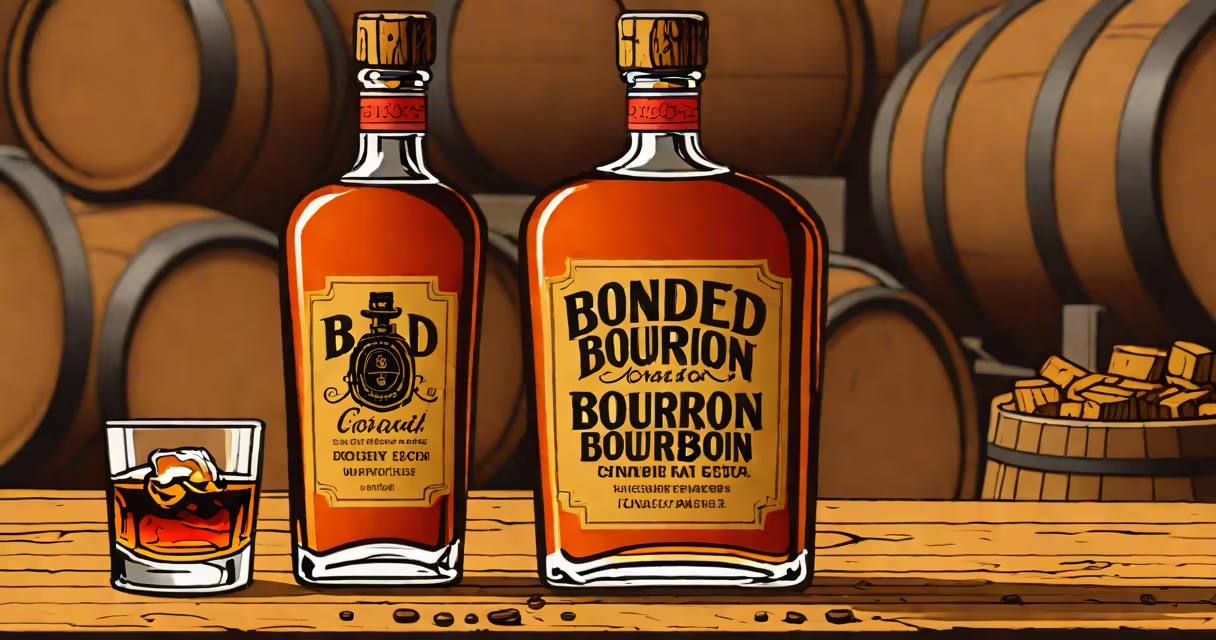
Bonded bourbon is a legally defined type of American whiskey that must be aged for at least four years in a federally bonded warehouse under U.S. Treasury supervision, with no added coloring, flavoring, or blending. This designation ensures consistent quality and regulatory compliance.
The term "bonded" refers to a federal requirement established under the U.S. Internal Revenue Code. To qualify, the distiller must pay a bond to the government, guaranteeing that the product meets strict production and storage standards. This system prevents fraud and ensures transparency in the distillation process.
Bonded bourbon must be produced entirely at one distillery, aged a minimum of four years, and stored in a bonded warehouse. These rules are enforced by the Alcohol and Tobacco Tax and Trade Bureau (TTB), which oversees all aspects of spirit production and labeling in the United States.
Bonded bourbon is subject to a federal bonding system managed by the TTB. The distiller deposits a bond- a financial guarantee-with the U.S. Treasury before beginning production. This bond helps all taxes owed on the alcohol are paid and that the product complies with federal regulations.
Once bonded, the whiskey must remain in a federally licensed warehouse throughout aging. These facilities are inspected regularly to ensure proper recordkeeping and storage conditions. The bond remains active until the product is sold or transferred out of the bonded system.
Any change in ownership, blending, or addition of non-compliant ingredients during aging voids the bonded status. This makes bonded bourbon traceable and auditable from still to bottle.
To be labeled "bonded," a bourbon must meet these criteria:
These standards are codified in 27 CFR § 5.22, which defines bonded products under U.S. federal law. The TTB enforces these rules through audits and labeling reviews.
According to the TTB, "A bonded product is one that is produced under the supervision of the U.S. Treasury Department and is subject to continuous custody and control." This means the distiller cannot alter or move the product without official approval.
Bonded bourbon is distinct from standard bourbon, which only requires a minimum of two years aging. The four-year minimum for bonded bourbon results in deeper color, richer flavor, and greater complexity due to extended interaction with the wood.
Some consumers assume "bonded" means higher proof or stronger alcohol content. That's incorrect. Bonded bourbon is not necessarily stronger-it can be bottled at any legal proof between 80 and 125. The bond refers to the production and storage process, not the strength.
Another common confusion is equating "bonded" with "single barrel" or "small batch." These terms describe different aspects of production. A bonded bourbon may be blended, while a single-barrel bourbon is drawn from one cask and not blended at all.
| Feature | Bonded Bourbon | Standard Bourbon | Small Batch |
|---|---|---|---|
| Minimum Age | 4 years | 2 years | Varies (often 4-6 years) |
| Federal Bond Required | Yes | No | No |
| Blending Allowed | Yes | Yes | Yes |
| Barrel Type | New charred oak | New charred oak | New charred oak |
One non-obvious fact: the bonded designation was introduced in 1862 under the Revenue Act to combat fraud in the alcohol trade. Before that, distillers could mislabel products or mix in cheaper spirits. The bond system restored trust in the market.
Four Roses Single Barrel Bourbon is not bonded, despite being aged over eight years. It is not required to be bonded because it does not carry the "bonded" label. However, Four Roses' Small Batch Reserve is bonded, meeting all federal requirements including the four-year minimum and bonded warehouse storage.
Another example is Buffalo Trace's Antique Collection, which includes several bonded bourbons. The 2022 release of the "Pappy Van Winkle Family Reserve" was not bonded, but the "William Larue Weller" expression-aged 10 years and bottled at 100 proof-is bonded. This distinction matters for collectors and regulators alike.
I once visited the Buffalo Trace Distillery in Frankfort, Kentucky, and saw the bonded warehouse facility firsthand. The building had steel doors sealed with wax seals, and each barrel was logged into a TTB database. The staff confirmed that only products with active bonds could be moved between bonded facilities.
Many people think "bonded" means the whiskey is aged longer. While bonded bourbon is always aged at least four years, the reverse isn't true-some bourbons aged four years aren't bonded. The label "four-year-old bourbon" doesn't imply bonded status unless explicitly stated.
Also, bonded bourbon is not automatically better. Quality depends on distillation technique, grain selection, and barrel sourcing. A well-made two-year bourbon can outshine a poorly crafted bonded bourbon.
Finally, the term "bonded" applies only to spirits produced in the U.S. A Canadian whisky labeled "bonded" would be misleading and illegal under U.S. law. Only U.S.-produced whiskey qualifies.
Bonded bourbon offers transparency and consistency. For buyers, it signals adherence to federal standards. For regulators, it enables audit trails and tax collection. For drinkers, it guarantees authenticity and provenance.
When shopping, look for the phrase "bonded" on the label. It appears below the brand name and above the ABV. For example: "Bourbon - Bonded - 100 Proof - 4 Year Old." This label confirms the product met all federal requirements.
If you're exploring the differences between various bourbon terms, learn what "I.E." means in alcohol labeling to avoid confusion with other industry abbreviations.
Bonded bourbon is not just a marketing term-it's a legal classification rooted in decades of federal regulation. Understanding it helps distinguish authentic, compliant products from those that lack oversight.