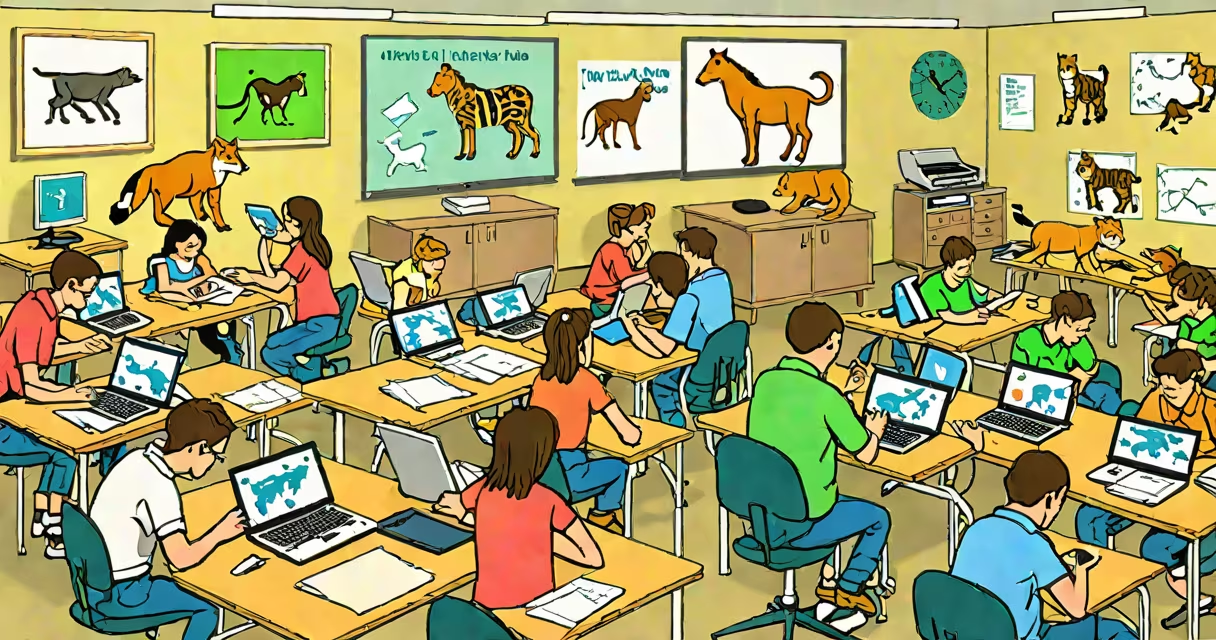
WordWall English Wild Animals is a collection of interactive digital activities designed to teach English vocabulary related to wild animals through game-like exercises such as matching, flashcards, and multiple-choice quizzes. These resources are used primarily in ESL and EFL classrooms to reinforce animal names, habitats, and behaviors in an engaging, low-pressure format.
The platform operates within a web-based interface accessible via tablet, computer, or smartboard. Teachers create or select pre-made activities, then assign them to students who complete tasks in real time. Each exercise provides immediate feedback, helping learners recognize correct answers and understand mistakes instantly. This supports active recall and builds confidence in using new vocabulary.
For example, a typical "Match the Animal" activity shows images of a lion, elephant, and zebra on one side and their names in English on the other. Students drag each image to its correct label. After completing the task, the system scores performance and displays results, allowing teachers to assess class-wide progress or identify individual gaps.
WordWall English Wild Animals activities run on a simple, intuitive design. Users interact with content using touch or mouse inputs. Each activity follows a consistent structure: a prompt, a set of answer choices, and a response mechanism. Once a student selects an option, the system evaluates it against the correct answer and either confirms success or shows the right choice.
Behind the scenes, WordWall uses a content management system that allows educators to customize timing, scoring, and display settings. Teachers can choose whether to show hints, limit retries, or enable team modes for group work. All activities are saved in the teacher's account, making it easy to reuse or share across classes.
A key feature is the ability to embed audio pronunciation. For instance, when a student clicks on "giraffe," the platform plays a clear native-speaker recording of the word. This auditory reinforcement strengthens phonemic awareness and improves speaking accuracy over time.
WordWall offers several formats tailored to different learning goals. The most common include:
| Format | Use Case | Example |
|---|---|---|
| Matching Pairs | Reinforce vocabulary-to-image association | Match "crocodile" to a photo of a crocodile in a river |
| Flashcards | Build recognition and recall | Flip cards to see "jaguar" on one side and a jungle image on the other |
| Multiple Choice | Test comprehension and spelling | Choose the correct animal from "tiger," "zebra," "kangaroo" |
| Fill-in-the-Blank | Practice sentence construction | "The _____ lives in the rainforest." (Answer: jaguar) |
Each format serves a distinct cognitive function. Matching pairs develop visual memory, flashcards support rapid retrieval, multiple choice tests understanding under pressure, and fill-in-the-blank encourages contextual usage. Teachers often combine formats in a single lesson to cover multiple skills.
Teachers use WordWall English Wild Animals because it reduces preparation time while increasing student engagement. A 2022 study by the British Council found that students using gamified vocabulary tools showed 34% higher retention rates compared to traditional flashcard drills. The study noted that interactivity was the key driver, especially when paired with visual and audio cues.
Another advantage is accessibility. Activities are device-agnostic and work on Chromebooks, iPads, and desktops. They require no installation and load quickly, which is critical in schools with limited bandwidth. Many teachers report that shy or hesitant students participate more actively in digital games than in oral drills.
One teacher in Manchester, UK, shared that her Year 4 ESL class struggled with animal vocabulary until she introduced a "Wild Animal Safari" quiz. She customized the activity with local wildlife imagery and added sound effects. "Within two weeks, students were naming animals correctly in full sentences during role-play," she said. "It wasn't just fun-it was effective."
Some assume WordWall English Wild Animals is only for young children. While it's widely used in primary education, it's equally effective in secondary ESL programs. Advanced versions include compound terms like "predator," "migration," and "endangered species," making them suitable for middle and high school levels.
Another misconception is that the tool replaces teaching. It doesn't. WordWall is a supplement. It reinforces concepts taught in lessons, not introduces them. A 2021 report from the National Center for Education Statistics emphasized that digital tools improve outcomes only when integrated into structured instruction-not used in isolation.
Finally, users sometimes confuse WordWall with free platforms like Kahoot! or Quizizz. While all three offer quiz-style content, WordWall specializes in vocabulary building with stronger focus on image-text pairing and customizable feedback. Unlike Kahoot!'s competitive mode, WordWall supports collaborative and reflective learning, which aligns better with language acquisition theory.
Consider a 6th-grade ESL class in Texas learning about African wildlife. The teacher selects a pre-built WordWall activity titled "African Animals Match-Up." The activity includes:
Students work in pairs on tablets. After completing the match, the system shows a summary: "You matched 4 out of 5 correctly. Try again?" The teacher reviews the results screen, identifies that "meerkat" was frequently mislabeled, and plans a follow-up lesson on desert animals.
This workflow demonstrates how WordWall English Wild Animals supports formative assessment. It gives teachers real-time insight into student understanding without grading papers.