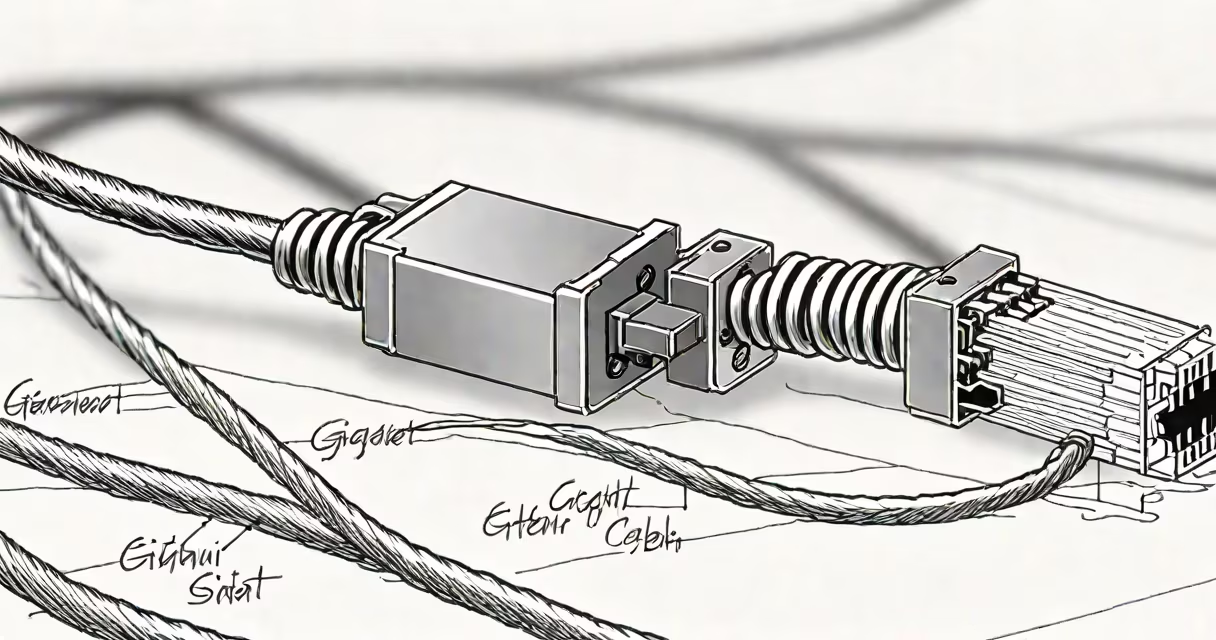
10 gigabit ethernet copper is a wired networking standard that transmits data at 10 gigabits per second using twisted-pair copper cabling, typically Cat6a or Cat7 cables, enabling high-speed connections between devices like servers, switches, and workstations.
The standard operates under IEEE 802.3an, ratified in 2010, and defines how data is encoded and transmitted over copper wires. Unlike fiber-based 10GbE, which uses light pulses through glass or plastic fibers, 10 gigabit ethernet copper relies on electrical signals sent through metal conductors. This makes it suitable for shorter distances-up to 100 meters-within buildings or server rooms.
It supports full-duplex communication, meaning data can flow in both directions simultaneously without interference. This capability is essential for applications such as real-time video editing, large-scale database access, and virtualized environments where low latency and consistent throughput are critical.
10 gigabit ethernet copper uses four pairs of wires in a single cable to transmit data in parallel. Each pair handles 2.5 Gbps, combining to deliver 10 Gbps total bandwidth. This technique, known as PAM-16 encoding, allows higher data rates over existing copper infrastructure by modulating voltage levels more precisely than older standards.
Signal integrity is maintained through advanced equalization and echo cancellation techniques. These processes compensate for signal degradation caused by electromagnetic interference and crosstalk-common issues in densely packed wiring environments. Without these corrections, data errors would increase beyond 30 meters.
For example, a workstation running a 4K video rendering application connected via 10 gigabit ethernet copper to a storage range can transfer a 50 GB file in approximately 40 seconds. That's roughly 1.25 GB/s sustained throughput, far exceeding the 100 Mbps limit of traditional Fast Ethernet.
Two primary variants exist under the 10 gigabit ethernet copper umbrella:
| Standard | Cable Type | Max Distance | Use Case |
|---|---|---|---|
| 10GBASE-T | Cat6a or Cat7 | 100 meters | Office networks, server racks |
| 10GBASE-T SFP+ | Cat6a or Cat7 | 100 meters | Modular switches, future-proofing |
10GBASE-T is the most widely adopted variant. It requires Category 6a (Cat6a) or better cabling-Cat6 alone cannot reliably support 10 Gbps over 100 meters due to insufficient shielding and higher crosstalk. Cat7 offers improved performance with foil shielding around each wire pair and an braided shield, reducing external interference.
One widespread misunderstanding is that 10 gigabit ethernet copper performs identically to fiber-optic 10GbE. While both achieve 10 Gbps, fiber supports longer distances-up to 40 kilometers with single-mode fiber-without signal degradation. Copper is limited to 100 meters and becomes unreliable beyond that due to attenuation and noise.
Another misconception is that upgrading to 10 gigabit ethernet copper automatically improves network speed. The actual throughput depends on the entire chain: the switch, the NIC, the cable, and the connected device. A 10GbE switch connected to a computer with a 1GbE NIC will still max out at 1 Gbps.
A lesser-known fact: 10GBASE-T consumes more power than lower-speed standards. A typical 10GBASE-T port draws 3.5 watts under load-about 2.5 times more than a 1GbE port. This impacts energy costs and heat dissipation in densely packed server racks.
In a mid-sized design firm, a team of 12 graphic designers needed faster access to shared project files stored on a central NAS. Previously, they used 1GbE connections, resulting in 15-second delays when loading complex 3D models. After replacing all desktops and the core switch with 10 gigabit ethernet copper components-including Cat6a cables and a managed 8-port 10 gigabit switch-the average file load time dropped to under 2 seconds.
Performance gains were measurable across multiple tasks: exporting a 4K animation sequence took 1 minute 12 seconds instead of 3 minutes 45 seconds. The upgrade cost $1,200 in hardware and labor but reduced project turnaround time by 22%, directly improving client delivery timelines.
When deploying 10 gigabit ethernet copper, ensure all components meet the required specification. Using Cat6 cables instead of Cat6a led to intermittent disconnections during peak usage. Replacing them resolved the issue immediately.
For organizations relying on stable, high-throughput internal networks, 10 gigabit ethernet copper remains a practical choice. It balances performance, compatibility, and cost-especially when fiber isn't feasible due to installation constraints or budget limits.
Understanding the differences between copper and fiber, and ensuring proper cabling and equipment selection, separates successful deployments from frustrating failures.