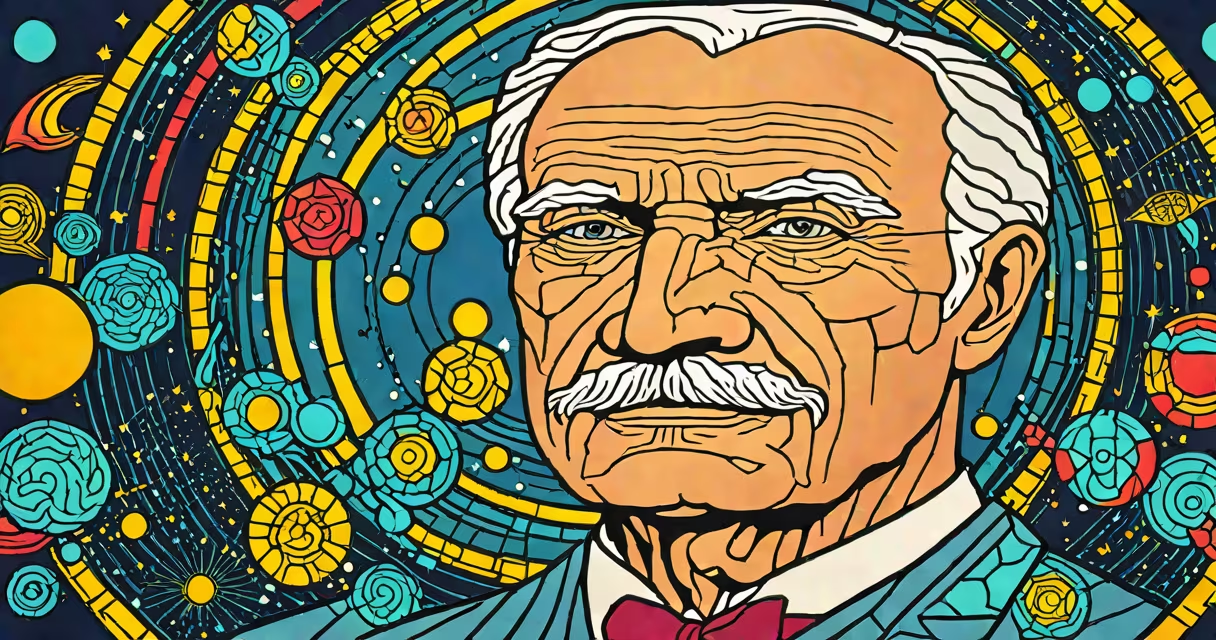
The psyche in psychology is the totality of the human mind, encompassing conscious thoughts, emotions, and unconscious drives. It includes both the personal unconscious and, according to Carl Jung, a collective unconscious shared across humanity.
Psychologists use the term to describe the internal system through which people perceive, interpret, and respond to experiences. This structure explains how early memories, hidden fears, and unspoken desires influence decisions, relationships, and identity formation.
Modern research confirms that mental processes governed by the psyche operate beyond awareness. fMRI studies show brain activity related to emotion and memory persists even during tasks requiring no conscious effort, validating the idea that much of psychological functioning occurs beneath the surface of thought.
The psyche functions through layers of processing. Conscious thoughts-like deciding what to eat-form the tip of the mental iceberg. Below this surface lie automatic emotional responses, implicit memories, and deeply rooted motivations.
Sigmund Freud proposed that the psyche consists of three parts: the id, ego, and superego. The id operates on instinctual drives and pleasure-seeking. The ego mediates between reality and desire. The superego enforces moral standards, often leading to guilt when ideals are violated.
Jung expanded this model. He believed the psyche contains archetypes-universal symbols such as the shadow (repressed aspects of self), anima/animus (opposite gender inner image), and the self (the unified whole). These shapes appear in dreams, myths, and art across cultures.
While the psyche is a single system, different schools emphasize distinct components:
| Model | Key Elements | Source |
|---|---|---|
| Freudian | Id, ego, superego; unconscious drives | Freud, 1923, *The Ego and the Id* |
| Jungian | Personal unconscious, collective unconscious, archetypes | Jung, 1934, *The Archetypes and the Collective Unconscious* |
| Humanistic | Self-actualization, authenticity, free will | Rogers, 1951, *Client-Centered Therapy* |
Freud's model focuses on conflict resolution. A child who wants to play instead of doing homework may feel guilt (superego) while craving fun (id). The ego tries to balance both.
Jung's view emphasizes integration. A person avoiding confrontation may project their anger onto others-a sign of an unacknowledged shadow. Recognizing this pattern allows healing through self-awareness.
Humanistic psychology treats the psyche as inherently growth-oriented. Carl Rogers argued that people move toward wholeness when supported by unconditional positive regard. This contrasts with Freud's focus on repression and conflict.
Many assume the psyche is synonymous with the soul or spirit. But in psychology, it is a scientific construct describing mental organization, not a metaphysical entity.
Another error is thinking the unconscious is purely negative. While Freud linked it to repressed trauma, Jung saw it as creative and generative. Dreams, art, and sudden insights often arise from unconscious processing.
A lesser-known fact: the term "psyche" originated in ancient Greek, meaning "life force" or "breath." It evolved into a philosophical concept before being adopted by 19th-century psychiatry. Modern neuroscience now maps neural correlates of psychic phenomena, such as the default mode network's role in self-referential thought.
Clinical therapy relies heavily on understanding the psyche. Cognitive Behavioral Therapy (CBT) targets distorted conscious beliefs. Psychodynamic therapy explores unconscious patterns behind recurring relationship issues.
For example, a client repeatedly ends romantic relationships shortly after they begin. A therapist using psychodynamic principles might explore early attachment history. The client recalls being abandoned by a parent at age five. This event likely shaped an unconscious fear of abandonment, manifesting as self-sabotage in adult relationships.
Even in education, the psyche influences learning. Students with anxiety about failure may avoid challenging tasks-not because they lack ability, but due to unconscious performance fears. Teachers trained in psychological insight can identify these patterns and adjust support accordingly.
I once observed a group therapy session where participants described recurring nightmares involving falling. Through guided discussion, several connected the dream to recent job changes. The falling symbolized loss of control-something the psyche was trying to process before the conscious mind recognized it.
Understanding the psyche requires distinguishing it from similar terms:
When someone says, "I don't trust my gut," they're dismissing a function of the psyche. Gut feelings stem from rapid subconscious evaluation-pattern recognition honed by evolution. Ignoring them can lead to poor decisions, even when logic seems clear.
The psyche definition psychology remains central to understanding human behavior. It is not a static structure but a changing field shaped by biology, culture, and lived experience. Its study continues to evolve with advances in neuroscience and clinical practice.