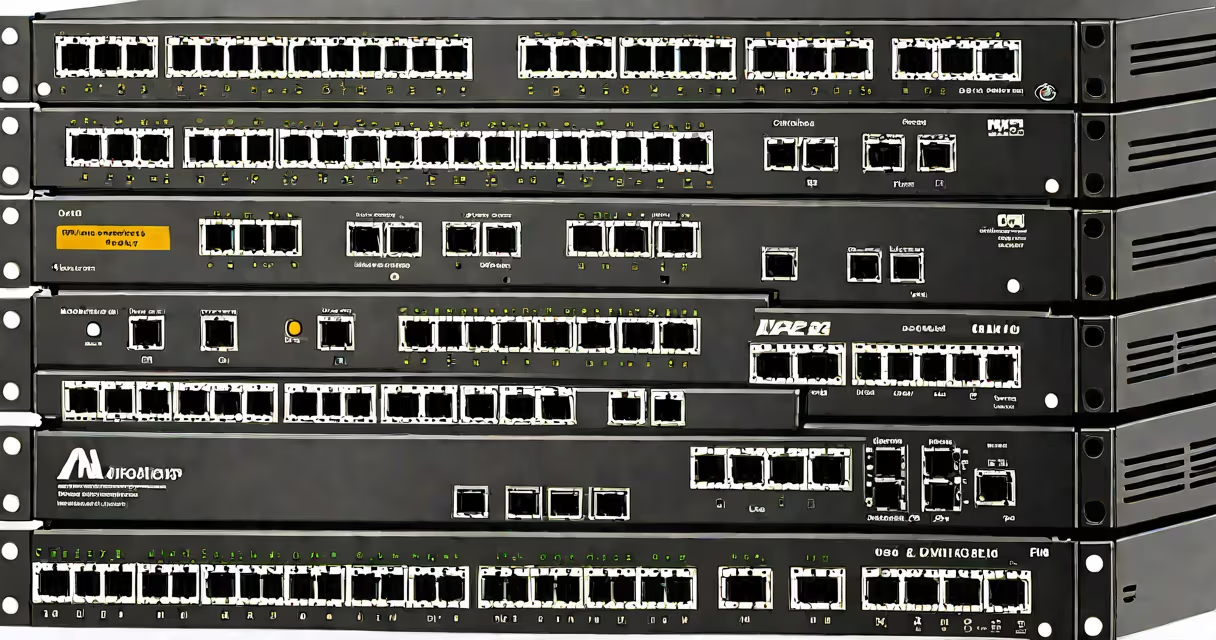
A 32 port PoE switch is a network device that delivers both electrical power and data transmission over standard Ethernet cables to up to 32 connected devices, such as IP security cameras, wireless access points, and VoIP phones. It operates under IEEE 802.3af or 802.3at standards, enabling centralized power management without requiring separate power outlets.
These switches function as traffic directors within a local area network (LAN). They receive incoming data packets from connected devices, examine destination addresses, and forward each packet only to the intended recipient. This reduces network congestion and improves performance compared to older hub-based systems.
Power over Ethernet (PoE) eliminates the need for wall adapters or power strips near devices. A single Cat 5e or Cat 6 cable handles both data and power, simplifying installation in locations like ceilings, hallways, or outdoor areas where power outlets are unavailable.
The 32 port PoE switch draws power from a standard AC outlet via a power adapter or PoE injector. It then distributes this power through the Ethernet ports using specific wire pairs in the twisted-pair cable. For example, in 100BASE-TX, data flows over pairs 2 and 3, while power is delivered over pairs 1 and 4.
When a device connects, the switch detects its power requirements through a handshake process called "discovery." It verifies whether the device supports PoE and allocates power accordingly. If the device doesn't support PoE, the switch sends no power to avoid damage.
For example, a 32 port PoE switch rated at 370 watts can power up to 32 IP cameras drawing 15 watts each (total 480 watts), but only if the switch's total power budget allows it. Exceeding this limit causes automatic shutdown of lower-priority ports to prevent overload.
32 port PoE switches fall into two categories: unmanaged and managed. Unmanaged models are plug-and-play devices ideal for small offices or home networks. Managed switches offer advanced features like VLANs, QoS, port mirroring, and remote monitoring-essential for enterprise environments.
Common PoE standards include:
Power budgets vary. A typical 32 port PoE switch may have a total power capacity between 370W and 600W. Always verify the maximum power draw against the sum of all connected devices' power needs.
| Feature | Unmanaged 32 Port PoE Switch | Managed 32 Port PoE Switch |
|---|---|---|
| Port Count | 32 RJ45 ports | 32 RJ45 ports |
| PoE Standard | 802.3af/at | 802.3af/at/bt |
| Power Budget | 370W-400W | 500W-600W |
| Management | None (auto-configuration) | Web GUI, CLI, SNMP |
| Use Case | Small business, residential, basic surveillance | Enterprise, campus networks, critical infrastructure |
32 port PoE switches are deployed in settings requiring multiple powered network endpoints. Common applications include office buildings, retail stores, schools, warehouses, and surveillance systems.
In a university campus, a single 32 port PoE switch can power 32 classroom IP cameras, 16 wireless access points, and 8 digital signage displays-all from one central rack. This reduces cabling complexity and maintenance costs compared to running separate power lines.
For example, a school district installed a 32 port PoE switch in a utility closet to manage 24 IP cameras covering hallways and entrances. The switch used 802.3at PoE+, delivering 30 watts per port. All cameras operated reliably without needing nearby outlets. When a camera failed, the IT team remotely rebooted it via the switch's web interface-saving hours of on-site visits.
Many assume all 32 port PoE switches deliver full power to every port simultaneously. This is false. The total power available is limited by the switch's power supply. A 32 port switch with a 400W power supply cannot provide 30W to all 32 ports-it would exceed its capacity.
Another misconception is that PoE switches replace surge protectors. They do not. Surge protection must still be applied at the network entry point. A lightning strike can damage a PoE switch even if it's properly rated.
Some users believe higher port count equals better performance. But performance depends on switching capacity (Gbps throughput), buffer size, and CPU speed-not just port count. A 32 port switch with 1 Gbps bandwidth per port performs poorly under heavy load compared to one with 10 Gbps uplinks and hardware-based forwarding.
A retail chain needed to install 30 surveillance cameras across five stores. Each camera required 15W of power and 100 Mbps bandwidth. The solution: deploy a managed 32 port PoE switch at each store's network closet.
Each switch was configured with VLANs to isolate camera traffic from employee workstations. QoS settings prioritized video streams to reduce latency. The total power draw was 450W (30 cameras × 15W), which fell within the switch's 500W power budget.
After deployment, the IT team monitored power usage via SNMP. One store reported a port drawing 40W-indicating a faulty camera. The system flagged the anomaly, allowing replacement before failure occurred. This prevented downtime during peak shopping hours.
Always validate power requirements before connecting devices. Overloading a 32 port PoE switch leads to port shutdowns and service interruptions. Use vendor documentation to calculate total power draw and ensure compliance with IEEE 802.3at specifications.